
Gary Eugene Howell uses the Berean Standard Bible. The Holy Bible, Berean Standard Bible, BSB is produced in cooperation with Bible Hub, Discovery Bible, OpenBible.com, and the Berean Bible Translation Committee. The Text of the Berean Standard Bible was dedicated to the public domain as of April 30, 2023.
Verses 1-13
At that time the kingdom of heaven will be like ten virgins who took their lamps and went out to meet the bridegroom. Five of them were foolish, and five were wise. The foolish ones took their lamps but did not take along any extra oil. But the wise ones took oil in flasks along with their lamps. When the bridegroom was delayed, they all became drowsy and fell asleep.
At midnight the cry rang out: ‘Here is the bridegroom! Come out to meet him!’ Then all the virgins woke up and trimmed their lamps. The foolish ones said to the wise, ‘Give us some of your oil; our lamps are going out.’
‘No,’ said the wise ones, ‘or there may not be enough for both us and you. Instead, go to those who sell oil and buy some for yourselves.’ But while they were on their way to buy it, the bridegroom arrived. Those who were ready went in with him to the wedding banquet, and the door was shut.
Later the other virgins arrived and said, ‘Lord, lord, open the door for us!’
But he replied, ‘Truly I tell you, I do not know you.’
Therefore keep watch, because you do not know the day or the hour.
Commentary
Continuing from Chapter 24, the focus of this parable is on those who are ready for Christ’s return and those who are not. In this parable, the oil represents the Holy Spirit. The ten women represent ten Christians: half of them had the Holy Spirit, and half did not. This means that half had put their faith in Jesus Christ and, in doing so, were filled with the Holy Spirit. The other five had not put their faith in Christ, were not filled with the Holy Spirit, but were merely participating in Christian activities.
When Christ arrives, those without the Holy Spirit suddenly realize they have a problem. Meanwhile, the other five enter with Jesus because they are ready. The doors are shut, and when the others finally arrive, it is too late.
Notice that Jesus says to those who arrived late, “I do not know you.” This is the same thing Jesus said earlier in Matthew 7:
Not everyone who says to Me, ‘Lord, Lord,’ will enter the kingdom of heaven, but only he who does the will of My Father in heaven. Many will say to Me on that day, ‘Lord, Lord, did we not prophesy in Your name, and in Your name drive out demons and perform many miracles?’ Then I will tell them plainly, ‘I never knew you; depart from Me, you workers of lawlessness!’ (Matthew 7:21-23)
The will of the Father is that we walk in faith with Jesus Christ. In doing so, we are filled with the Holy Spirit. It is through faith that we have a relationship with Jesus, and thus He knows us.
If you’re not sure whether you have been filled with the Holy Spirit, ask the Lord in prayer, “Jesus, can I please have the Holy Spirit?”
Verses 14-15
For it is just like a man going on a journey, who called his servants and entrusted them with his possessions. To one he gave five talents, to another two talents, and to another one talent—each according to his own ability. And he went on his journey.
Commentary
The man going on a journey represents Christ ascending to heaven after His resurrection. The servants represent Christians. Christ entrusts each of us with work according to our abilities. One person may be called to be a missionary, another a pastor, and yet another may be called to perform simple tasks. Whatever the case, each role is important in the work of spreading the gospel and bringing others to saving faith.
Verses 16-23
The servant who had received the five talents went at once and put them to work and gained five more. Likewise, the one with the two talents gained two more. But the servant who had received the one talent went off, dug a hole in the ground, and hid his master’s money.
After a long time the master of those servants returned and settled accounts with them. The servant who had received the five talents came and presented five more. ‘Master,’ he said, ‘you entrusted me with five talents. See, I have gained five more.’
His master replied, ‘Well done, good and faithful servant! You have been faithful with a few things; I will put you in charge of many things. Enter into the joy of your master!’
The servant who had received the two talents also came and said, ‘Master, you entrusted me with two talents. See, I have gained two more.’
His master replied, ‘Well done, good and faithful servant! You have been faithful with a few things; I will put you in charge of many things. Enter into the joy of your master!’
Commentary
Of the three servants, two used their master’s money to earn even more. In the spiritual context, these two servants represent Christ-followers. They relied upon the Spirit and went out into the world to bring more people to Christ.
When Christ returned, He said to these two servants, ‘Well done, good and faithful servant! You have been faithful with a few things; I will put you in charge of many things. Enter into the joy of your master!’
This commentary writer believes that “being put in charge of many things” refers to the Millennial Reign (see 2 Timothy 2:12; Revelation 2:26–27; Revelation 5:9–10; Revelation 20:4–6).
For a period of 1,000 years, Christ will rule on earth as King. Both mortal people and resurrected believers will enter this Millennial Reign. Mortal people will repopulate the earth and establish communities, towns, and cities. However, if these communities were governed by these mortal people, whose flesh remains subject to sin, they would be vulnerable to corruption, just as we see today.
Therefore, this commentary writer concludes that those who are resurrected and reign with Christ will be appointed by Jesus to authoritative positions over the communities, towns, and cities populated by mortal people.
The first servant came forward and said, ‘Master, your mina has produced ten more minas.’
His master replied, ‘Well done, good servant! Because you have been faithful in a very small matter, you shall have authority over ten cities.’
The second servant came and said, ‘Master, your mina has made five minas.’
And to this one he said, ‘You shall have authority over five cities.’ (Luke 19:16-19)
The author of this commentary holds the belief that, during the 1,000-year Millennial Reign, every position of authority on earth, whether president of a nation or president of a local school board, will be filled by resurrected Christians appointed to those roles by Jesus.
When Jesus says, “Enter into the joy of your master,” He is referring to eternal life.
Verses 24-30
Finally, the servant who had received the one talent came and said, ‘Master, I knew that you are a hard man, reaping where you have not sown and gathering where you have not scattered seed. So I was afraid and went out and hid your talent in the ground. See, you have what belongs to you.’
‘You wicked, lazy servant!’ replied his master. ‘You knew that I reap where I have not sown and gather where I have not scattered seed. Then you should have deposited my money with the bankers, and on my return I would have received it back with interest.
Therefore take the talent from him and give it to the one who has ten talents. For everyone who has will be given more, and he will have an abundance. But the one who does not have, even what he has will be taken away from him. And throw that worthless servant into the outer darkness, where there will be weeping and gnashing of teeth.’
Commentary
The first thing we need to notice is that whenever Jesus mentions outer darkness, weeping, and gnashing of teeth, He is referring to hell. Therefore, we understand from this text that the third servant went to hell.
Knowing that, we can draw out the interpretation. We already know that those who go to hell are the ones who did not put their faith in Jesus Christ. Thus, when we read that this third servant went off, dug a hole in the ground, and hid his master’s money, it represents his rejection of faith and trust in his master.
When explaining to Jesus what he had done, he said, “Master, I knew that you are a hard man, reaping where you have not sown and gathering where you have not scattered seed. So I was afraid and went out and hid your talent in the ground.”
What this shows is that this individual did not know who Jesus actually is. This servant was completely wrong about Jesus’s methods, morals, values and intentions. This represents the person who misjudges the character of Jesus, claiming to understand Him while in reality they have no idea who He is.
Consider statements such as Richard Dawkins saying, “Jesus is a moral monster,” or Sam Harris saying, “Jesus believes in eternal torture, which makes Him morally problematic,” or Christopher Hitchens saying, “If you accept what Jesus said about hell, He was incredibly cruel.” These are individuals who have no true understanding of who Jesus is, yet each esteems himself as wise. To such as these, Jesus replies, “You wicked, lazy servant!”
If this third servant had shown faith in Jesus Christ (remember that a major part of faith is trust), he could have at the very least deposited the money with the bankers, where it would have earned interest.
Not everyone is called to be a missionary traveling to foreign and sometimes dangerous countries to share the gospel. Sometimes the best thing we can do is support those who are called to go. Many missionaries leave the field because they run out of financial support. In this parable, the bankers represent those who are actively advancing the gospel. Jesus is saying that this third servant could have at least supported them in their work, even if he was unwilling to do the work himself.
There are many ways in which a person can support the gospel: tithing to a church, supporting a ministry, giving to missionaries, or offering one’s time to assist those who are spreading the gospel. All of these are legitimate.
Jesus continues His reprimand by saying, “Therefore take the talent from him and give it to the one who has ten talents. For everyone who has will be given more, and he will have an abundance. But the one who does not have, even what he has will be taken away from him. And throw that worthless servant into the outer darkness, where there will be weeping and gnashing of teeth.”
Without the Holy Spirit, spiritual tasks are impossible. Those who have no faith do not rely upon the Holy Spirit and therefore cannot succeed in performing spiritual work. Thus, the one who calls himself a Christian and participates in Christian activity, but has no faith, will eventually be removed by God, that is, God takes away what little he had.
We see this often in people who once attended church and fellowshipped with believers, but have since walked away. We see this in the person who claims to have been hurt by a church and now uses that as an excuse to avoid church altogether. We see it in the pastor who led a large congregation but was later fired from his job after an extra-marital affair came to light. God took away what he had. We see it in the musically gifted worship leader who once led others in praise but now performs only secular music and no longer even believes in God. God took away what little he had given them.
Verses 31-33
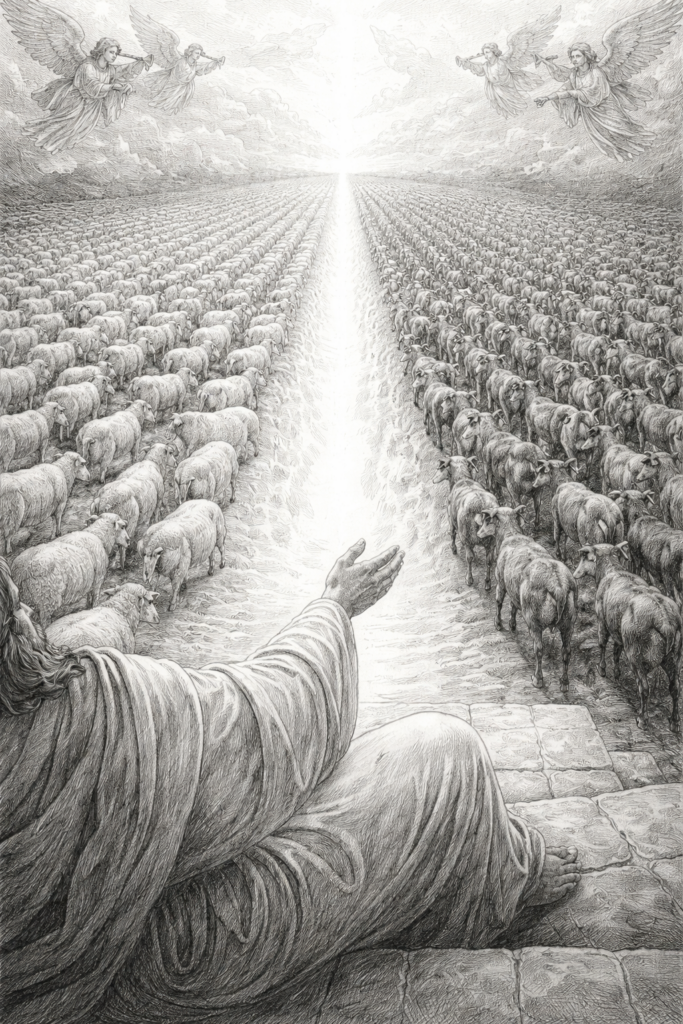
When the Son of Man comes in His glory, and all the angels with Him, He will sit on His glorious throne. All the nations will be gathered before Him, and He will separate the people one from another, as a shepherd separates the sheep from the goats. He will place the sheep on His right and the goats on His left.
Commentary
“He will sit on His glorious throne,” meaning that Jesus Christ is the authority of all authorities. He is the King of kings. Notice also that He is no longer presented as a suffering servant; instead, He is the reigning King who judges the nations.
“All the nations will be gathered before Him.” This shows that no individual or group can avoid or escape His judgment. This is proof that every person will stand before Christ to be judged.
“He will separate the people one from another, as a shepherd separates the sheep from the goats.” God has the ability to know what is in our hearts; He knows our inner motivations. A sheep is easily distinguishable from a goat. In the same way, Jesus can easily distinguish between those who walk by faith and those who, on the inside, are devoid of faith and the Holy Spirit.
The act of separation also shows that proximity to the flock is not the same as being part of it. The sheep and goats may have appeared together during life, and at the time you and I may not have been able to tell the difference. Yet at the moment of judgment, Jesus immediately separates them. This shows the danger of merely associating with Christianity without having genuine faith. External participation cannot substitute for an authentic relationship with Christ.
“He will place the sheep on His right and the goats on His left.” His right side is the position of favor and blessing, while His left represents disfavor and judgment. This is also why the Bible states that Jesus stands at the right hand of God (see Acts 7:55–56).
Verses 34-40
Then the King will say to those on His right, ‘Come, you who are blessed by My Father, inherit the kingdom prepared for you from the foundation of the world. For I was hungry and you gave Me something to eat, I was thirsty and you gave Me something to drink, I was a stranger and you took Me in, I was naked and you clothed Me, I was sick and you looked after Me, I was in prison and you visited Me.’
Then the righteous will answer Him, ‘Lord, when did we see You hungry and feed You, or thirsty and give You something to drink? When did we see You a stranger and take You in, or naked and clothe You? When did we see You sick or in prison and visit You?’
And the King will reply, ‘Truly I tell you, whatever you did for one of the least of these brothers of Mine, you did for Me.’
Commentary
“Then the King…” Jesus Christ is King. A question for the reader: Do you allow Jesus to be King of your life?
“Inherit the kingdom prepared for you from the foundation of the world.” Thousands of years before you were born, God prepared a kingdom for you to inherit. This means that God desires for you to be saved and to have an eternal relationship with Him.
Then Jesus lists a series of actions taken by those on His right: feeding the hungry, giving drink to the thirsty, welcoming strangers, clothing the needy, caring for the sick, and visiting prisoners. These are examples of a larger principle that Jesus stated earlier: “Love your neighbor as yourself.” (Matthew 22:39b)
Do nothing out of selfish ambition or empty pride, but in humility consider others more important than yourselves. Each of you should look not only to your own interests, but also to the interests of others. (Philippians 2:3-4)
However, I want to remind the reader that we do not earn salvation by doing good works. That is not what these verses are stating. For example, a person does not begin driving on public roads in order to earn a driver’s license. They must first obtain their license, and only afterward are they permitted to drive. In the same way, it is the Holy Spirit who enables us to do good works.
“Truly I tell you, whatever you did for one of the least of these brothers of Mine, you did for Me.” We are all made in the image of God. When a person shows kindness to another, they are showing kindness to the image of God.
Verses 41-46
Then He will say to those on His left, ‘Depart from Me, you who are cursed, into the eternal fire prepared for the devil and his angels. For I was hungry and you gave Me nothing to eat, I was thirsty and you gave Me nothing to drink, I was a stranger and you did not take Me in, I was naked and you did not clothe Me, I was sick and in prison and you did not look after Me.’
And they too will reply, ‘Lord, when did we see You hungry or thirsty or a stranger or naked or sick or in prison, and did not minister to You?’
Then the King will answer, ‘Truly I tell you, whatever you did not do for one of the least of these, you did not do for Me.’
And they will go away into eternal punishment, but the righteous into eternal life.”
Commentary
God made hell for the devil and his demons. As an all-loving God, He sent His own Son to rescue people from the fate of ending up in hell. Unfortunately, most people reject God’s Son and, in doing so, become cursed. The result is a path that leads directly into the eternal fire prepared for the devil and his angels.
“Truly I tell you, whatever you did not do for one of the least of these, you did not do for Me.” These are the people who neither love their neighbors nor love God.
Again, we are all made in the image of God. When a person shows contempt or disdain toward another, they are showing contempt toward the image of God.
“And they will go away into eternal punishment, but the righteous into eternal life.” When we love God, we learn, through the leading of the Holy Spirit, to love others. Thus, our external actions are a reflection of our internal beliefs. It is our love for God, shown through faith, that allows us to inherit eternal life.