Category Archives: Commentary

New Testament Bible commentaries by Gary Eugene Howell

Commentary Matthew 25

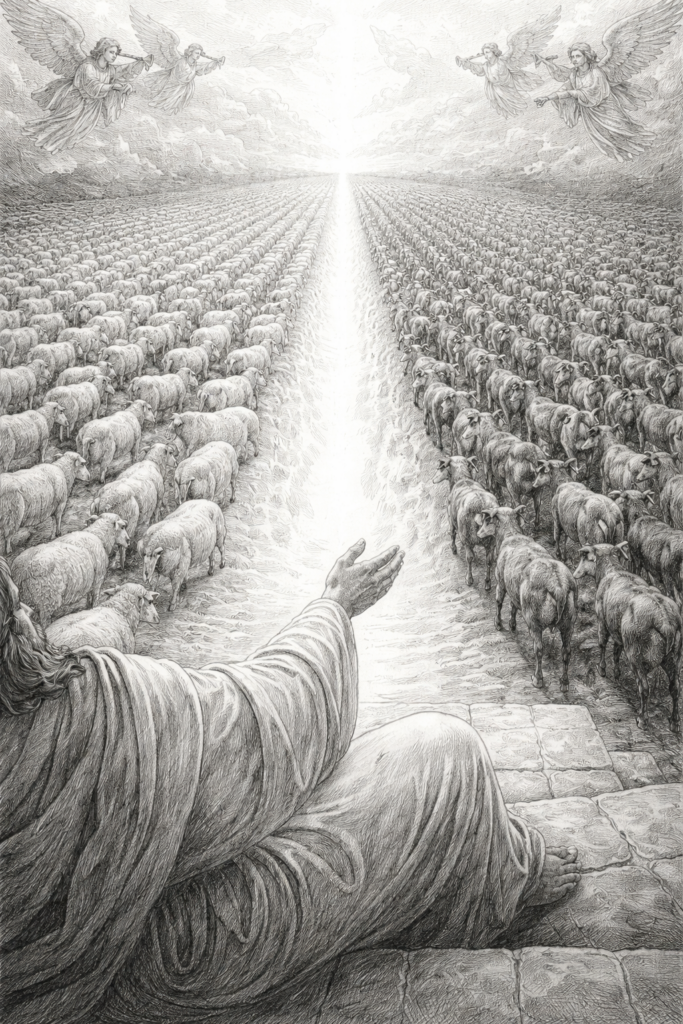
sheep and Goats

Gary Eugene Howell uses the Berean Standard Bible. The Holy Bible, Berean Standard Bible, BSB is produced in cooperation with Bible Hub, Discovery Bible, OpenBible.com, and the Berean Bible Translation Committee. The Text of the Berean Standard Bible was dedicated to the public domain as of April 30, 2023.

Verses 1-13

At that time the kingdom of heaven will be like ten virgins who took their lamps and went out to meet the bridegroom. Five of them were foolish, and five were wise. The foolish ones took their lamps but did not take along any extra oil. But the wise ones took oil in flasks along with their lamps. When the bridegroom was delayed, they all became drowsy and fell asleep.

At midnight the cry rang out: ‘Here is the bridegroom! Come out to meet him!’ Then all the virgins woke up and trimmed their lamps. The foolish ones said to the wise, ‘Give us some of your oil; our lamps are going out.’

‘No,’ said the wise ones, ‘or there may not be enough for both us and you. Instead, go to those who sell oil and buy some for yourselves.’ But while they were on their way to buy it, the bridegroom arrived. Those who were ready went in with him to the wedding banquet, and the door was shut.

Later the other virgins arrived and said, ‘Lord, lord, open the door for us!’

But he replied, ‘Truly I tell you, I do not know you.’

Therefore keep watch, because you do not know the day or the hour.

Commentary

Continuing from Chapter 24, the focus of this parable is on those who are ready for Christ’s return and those who are not. In this parable, the oil represents the Holy Spirit. The ten women represent ten Christians: half of them had the Holy Spirit, and half did not. This means that half had put their faith in Jesus Christ and, in doing so, were filled with the Holy Spirit. The other five had not put their faith in Christ, were not filled with the Holy Spirit, but were merely participating in Christian activities.

When Christ arrives, those without the Holy Spirit suddenly realize they have a problem. Meanwhile, the other five enter with Jesus because they are ready. The doors are shut, and when the others finally arrive, it is too late.

Notice that Jesus says to those who arrived late, “I do not know you.” This is the same thing Jesus said earlier in Matthew 7:

Not everyone who says to Me, ‘Lord, Lord,’ will enter the kingdom of heaven, but only he who does the will of My Father in heaven. Many will say to Me on that day, ‘Lord, Lord, did we not prophesy in Your name, and in Your name drive out demons and perform many miracles?’ Then I will tell them plainly, ‘I never knew you; depart from Me, you workers of lawlessness!’ (Matthew 7:21-23)

The will of the Father is that we walk in faith with Jesus Christ. In doing so, we are filled with the Holy Spirit. It is through faith that we have a relationship with Jesus, and thus He knows us.

If you’re not sure whether you have been filled with the Holy Spirit, ask the Lord in prayer, “Jesus, can I please have the Holy Spirit?”

Verses 14-15

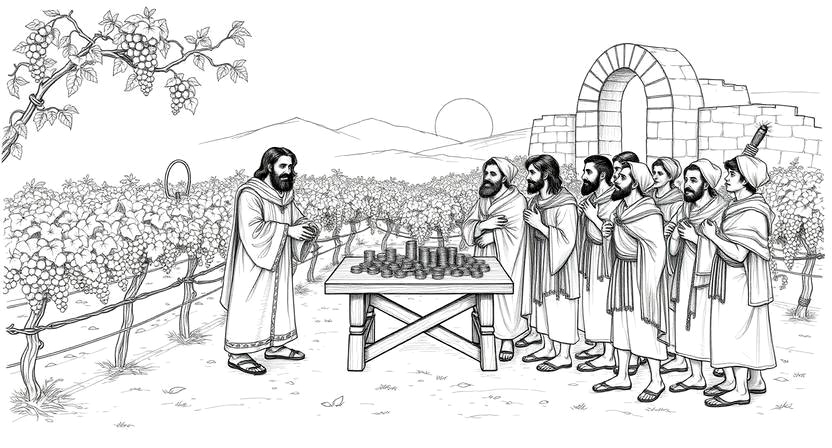
For it is just like a man going on a journey, who called his servants and entrusted them with his possessions. To one he gave five talents, to another two talents, and to another one talent—each according to his own ability. And he went on his journey.

Commentary

The man going on a journey represents Christ ascending to heaven after His resurrection. The servants represent Christians. Christ entrusts each of us with work according to our abilities. One person may be called to be a missionary, another a pastor, and yet another may be called to perform simple tasks. Whatever the case, each role is important in the work of spreading the gospel and bringing others to saving faith.

Verses 16-23

The servant who had received the five talents went at once and put them to work and gained five more. Likewise, the one with the two talents gained two more. But the servant who had received the one talent went off, dug a hole in the ground, and hid his master’s money.

After a long time the master of those servants returned and settled accounts with them. The servant who had received the five talents came and presented five more. ‘Master,’ he said, ‘you entrusted me with five talents. See, I have gained five more.’

His master replied, ‘Well done, good and faithful servant! You have been faithful with a few things; I will put you in charge of many things. Enter into the joy of your master!’

The servant who had received the two talents also came and said, ‘Master, you entrusted me with two talents. See, I have gained two more.’

His master replied, ‘Well done, good and faithful servant! You have been faithful with a few things; I will put you in charge of many things. Enter into the joy of your master!’

Commentary

Of the three servants, two used their master’s money to earn even more. In the spiritual context, these two servants represent Christ-followers. They relied upon the Spirit and went out into the world to bring more people to Christ.

When Christ returned, He said to these two servants, ‘Well done, good and faithful servant! You have been faithful with a few things; I will put you in charge of many things. Enter into the joy of your master!’

This commentary writer believes that “being put in charge of many things” refers to the Millennial Reign (see 2 Timothy 2:12; Revelation 2:26–27; Revelation 5:9–10; Revelation 20:4–6).

For a period of 1,000 years, Christ will rule on earth as King. Both mortal people and resurrected believers will enter this Millennial Reign. Mortal people will repopulate the earth and establish communities, towns, and cities. However, if these communities were governed by these mortal people, whose flesh remains subject to sin, they would be vulnerable to corruption, just as we see today.

Therefore, this commentary writer concludes that those who are resurrected and reign with Christ will be appointed by Jesus to authoritative positions over the communities, towns, and cities populated by mortal people.

The first servant came forward and said, ‘Master, your mina has produced ten more minas.’

His master replied, ‘Well done, good servant! Because you have been faithful in a very small matter, you shall have authority over ten cities.’

The second servant came and said, ‘Master, your mina has made five minas.’

And to this one he said, ‘You shall have authority over five cities.’ (Luke 19:16-19)

The author of this commentary holds the belief that, during the 1,000-year Millennial Reign, every position of authority on earth, whether president of a nation or president of a local school board, will be filled by resurrected Christians appointed to those roles by Jesus.

When Jesus says, “Enter into the joy of your master,” He is referring to eternal life.

Verses 24-30

Finally, the servant who had received the one talent came and said, ‘Master, I knew that you are a hard man, reaping where you have not sown and gathering where you have not scattered seed. So I was afraid and went out and hid your talent in the ground. See, you have what belongs to you.’

‘You wicked, lazy servant!’ replied his master. ‘You knew that I reap where I have not sown and gather where I have not scattered seed. Then you should have deposited my money with the bankers, and on my return I would have received it back with interest.

Therefore take the talent from him and give it to the one who has ten talents. For everyone who has will be given more, and he will have an abundance. But the one who does not have, even what he has will be taken away from him. And throw that worthless servant into the outer darkness, where there will be weeping and gnashing of teeth.’

Commentary

The first thing we need to notice is that whenever Jesus mentions outer darkness, weeping, and gnashing of teeth, He is referring to hell. Therefore, we understand from this text that the third servant went to hell.

Knowing that, we can draw out the interpretation. We already know that those who go to hell are the ones who did not put their faith in Jesus Christ. Thus, when we read that this third servant went off, dug a hole in the ground, and hid his master’s money, it represents his rejection of faith and trust in his master.

When explaining to Jesus what he had done, he said, “Master, I knew that you are a hard man, reaping where you have not sown and gathering where you have not scattered seed. So I was afraid and went out and hid your talent in the ground.”

What this shows is that this individual did not know who Jesus actually is. This servant was completely wrong about Jesus’s methods, morals, values and intentions. This represents the person who misjudges the character of Jesus, claiming to understand Him while in reality they have no idea who He is.

Consider statements such as Richard Dawkins saying, “Jesus is a moral monster,” or Sam Harris saying, “Jesus believes in eternal torture, which makes Him morally problematic,” or Christopher Hitchens saying, “If you accept what Jesus said about hell, He was incredibly cruel.” These are individuals who have no true understanding of who Jesus is, yet each esteems himself as wise. To such as these, Jesus replies, “You wicked, lazy servant!”

If this third servant had shown faith in Jesus Christ (remember that a major part of faith is trust), he could have at the very least deposited the money with the bankers, where it would have earned interest.

Not everyone is called to be a missionary traveling to foreign and sometimes dangerous countries to share the gospel. Sometimes the best thing we can do is support those who are called to go. Many missionaries leave the field because they run out of financial support. In this parable, the bankers represent those who are actively advancing the gospel. Jesus is saying that this third servant could have at least supported them in their work, even if he was unwilling to do the work himself.

There are many ways in which a person can support the gospel: tithing to a church, supporting a ministry, giving to missionaries, or offering one’s time to assist those who are spreading the gospel. All of these are legitimate.

Jesus continues His reprimand by saying, “Therefore take the talent from him and give it to the one who has ten talents. For everyone who has will be given more, and he will have an abundance. But the one who does not have, even what he has will be taken away from him. And throw that worthless servant into the outer darkness, where there will be weeping and gnashing of teeth.”

Without the Holy Spirit, spiritual tasks are impossible. Those who have no faith do not rely upon the Holy Spirit and therefore cannot succeed in performing spiritual work. Thus, the one who calls himself a Christian and participates in Christian activity, but has no faith, will eventually be removed by God, that is, God takes away what little he had.

We see this often in people who once attended church and fellowshipped with believers, but have since walked away. We see this in the person who claims to have been hurt by a church and now uses that as an excuse to avoid church altogether. We see it in the pastor who led a large congregation but was later fired from his job after an extra-marital affair came to light. God took away what he had. We see it in the musically gifted worship leader who once led others in praise but now performs only secular music and no longer even believes in God. God took away what little he had given them.

Verses 31-33

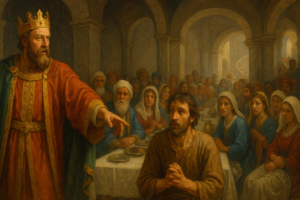
When the Son of Man comes in His glory, and all the angels with Him, He will sit on His glorious throne. All the nations will be gathered before Him, and He will separate the people one from another, as a shepherd separates the sheep from the goats. He will place the sheep on His right and the goats on His left.

Commentary

“He will sit on His glorious throne,” meaning that Jesus Christ is the authority of all authorities. He is the King of kings. Notice also that He is no longer presented as a suffering servant; instead, He is the reigning King who judges the nations.

“All the nations will be gathered before Him.” This shows that no individual or group can avoid or escape His judgment. This is proof that every person will stand before Christ to be judged.

“He will separate the people one from another, as a shepherd separates the sheep from the goats.” God has the ability to know what is in our hearts; He knows our inner motivations. A sheep is easily distinguishable from a goat. In the same way, Jesus can easily distinguish between those who walk by faith and those who, on the inside, are devoid of faith and the Holy Spirit.

The act of separation also shows that proximity to the flock is not the same as being part of it. The sheep and goats may have appeared together during life, and at the time you and I may not have been able to tell the difference. Yet at the moment of judgment, Jesus immediately separates them. This shows the danger of merely associating with Christianity without having genuine faith. External participation cannot substitute for an authentic relationship with Christ.

“He will place the sheep on His right and the goats on His left.” His right side is the position of favor and blessing, while His left represents disfavor and judgment. This is also why the Bible states that Jesus stands at the right hand of God (see Acts 7:55–56).

Verses 34-40

Then the King will say to those on His right, ‘Come, you who are blessed by My Father, inherit the kingdom prepared for you from the foundation of the world. For I was hungry and you gave Me something to eat, I was thirsty and you gave Me something to drink, I was a stranger and you took Me in, I was naked and you clothed Me, I was sick and you looked after Me, I was in prison and you visited Me.’

Then the righteous will answer Him, ‘Lord, when did we see You hungry and feed You, or thirsty and give You something to drink? When did we see You a stranger and take You in, or naked and clothe You? When did we see You sick or in prison and visit You?’

And the King will reply, ‘Truly I tell you, whatever you did for one of the least of these brothers of Mine, you did for Me.’

Commentary

“Then the King…” Jesus Christ is King. A question for the reader: Do you allow Jesus to be King of your life?

“Inherit the kingdom prepared for you from the foundation of the world.” Thousands of years before you were born, God prepared a kingdom for you to inherit. This means that God desires for you to be saved and to have an eternal relationship with Him.

Then Jesus lists a series of actions taken by those on His right: feeding the hungry, giving drink to the thirsty, welcoming strangers, clothing the needy, caring for the sick, and visiting prisoners. These are examples of a larger principle that Jesus stated earlier: “Love your neighbor as yourself.” (Matthew 22:39b)

Do nothing out of selfish ambition or empty pride, but in humility consider others more important than yourselves. Each of you should look not only to your own interests, but also to the interests of others. (Philippians 2:3-4)

However, I want to remind the reader that we do not earn salvation by doing good works. That is not what these verses are stating. For example, a person does not begin driving on public roads in order to earn a driver’s license. They must first obtain their license, and only afterward are they permitted to drive. In the same way, it is the Holy Spirit who enables us to do good works.

“Truly I tell you, whatever you did for one of the least of these brothers of Mine, you did for Me.” We are all made in the image of God. When a person shows kindness to another, they are showing kindness to the image of God.

Verses 41-46

Then He will say to those on His left, ‘Depart from Me, you who are cursed, into the eternal fire prepared for the devil and his angels. For I was hungry and you gave Me nothing to eat, I was thirsty and you gave Me nothing to drink, I was a stranger and you did not take Me in, I was naked and you did not clothe Me, I was sick and in prison and you did not look after Me.’

And they too will reply, ‘Lord, when did we see You hungry or thirsty or a stranger or naked or sick or in prison, and did not minister to You?’

Then the King will answer, ‘Truly I tell you, whatever you did not do for one of the least of these, you did not do for Me.’

And they will go away into eternal punishment, but the righteous into eternal life.”

Commentary

God made hell for the devil and his demons. As an all-loving God, He sent His own Son to rescue people from the fate of ending up in hell. Unfortunately, most people reject God’s Son and, in doing so, become cursed. The result is a path that leads directly into the eternal fire prepared for the devil and his angels.

“Truly I tell you, whatever you did not do for one of the least of these, you did not do for Me.” These are the people who neither love their neighbors nor love God.

Again, we are all made in the image of God. When a person shows contempt or disdain toward another, they are showing contempt toward the image of God.

“And they will go away into eternal punishment, but the righteous into eternal life.” When we love God, we learn, through the leading of the Holy Spirit, to love others. Thus, our external actions are a reflection of our internal beliefs. It is our love for God, shown through faith, that allows us to inherit eternal life.

Commentary Matthew 24

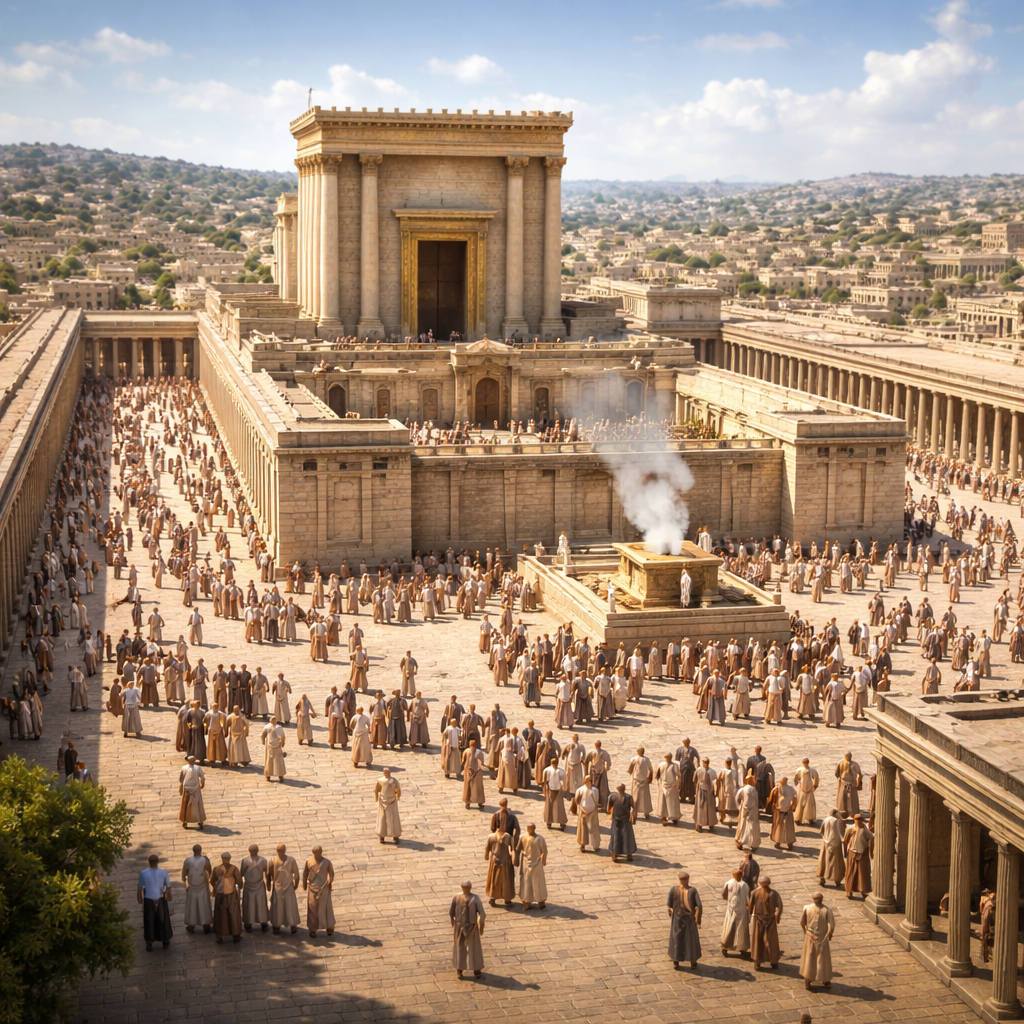
Herod’s Temple in ancient Jerusalem

Gary Eugene Howell uses the Berean Standard Bible. The Holy Bible, Berean Standard Bible, BSB is produced in cooperation with Bible Hub, Discovery Bible, OpenBible.com, and the Berean Bible Translation Committee. The Text of the Berean Standard Bible was dedicated to the public domain as of April 30, 2023.

Verses 1-2

As Jesus left the temple and was walking away, His disciples came up to Him to point out its buildings.

“Do you see all these things?” He replied. “Truly I tell you, not one stone here will be left on another; every one will be thrown down.”

Commentary

For the remainder of this chapter and throughout the next, Jesus speaks to the disciples about the future, covering events from 70 AD all the way to His second coming more than two thousand years later. He begins with the First Jewish–Roman War, which was only a few decades away. Jerusalem and the temple would be destroyed. This was God’s judgment against Israel for killing the prophets and for crucifying Jesus (see Matthew 23:29–36).

Verse 3

While Jesus was sitting on the Mount of Olives, the disciples came to Him privately. “Tell us,” they said, “when will these things happen, and what will be the sign of Your coming and of the end of the age?”

Commentary

Moments earlier, Jesus told the disciples that not one stone of the temple would remain upon another. It now appears that the disciples assumed such a catastrophic event could only occur at the end of the age.

Jesus does not directly correct their assumption. He doesn’t tell them of the rapidly approaching Jewish–Roman War, which was only a few years away. Instead, He begins to give the disciples, and us as readers of Scripture, instruction and guidance concerning His second coming, which we are still waiting for today.

Verses 4-5

Jesus answered, “See to it that no one deceives you. For many will come in My name, claiming, ‘I am the Christ,’ and will deceive many.

Commentary

This verse is self-explanatory. Jesus warns His followers that spiritual deception will be a constant danger. False messiahs and false teachers will arise, claiming spiritual authority in order to mislead people. The responsibility is placed on believers to remain alert and discerning, testing every claim against the truth of Scripture.

Popularity, charisma, or a large number of subscribers, is not proof that a person speaks for God. Because many will be deceived, the only safeguard is a growing knowledge of Christ and a commitment to His Word so that we are not led astray.

[And by the way, the best method for growing in your knowledge of Christ is to regularly associate with Christians who are more knowledgeable than yourself.]

Verses 6-7

You will hear of wars and rumors of wars, but see to it that you are not alarmed. These things must happen, but the end is still to come. Nation will rise against nation, and kingdom against kingdom. There will be famines and earthquakes in various places.

Commentary

Jesus is subtly telling the disciples that it’s going to be a long time from then, but they didn’t understand. How many wars have there been since Jesus walked the earth? The number is probably in the tens of thousands. In my lifetime alone, the United States has been involved in more than 14 military conflicts that most Americans would describe as “wars.” Notice, however, that Jesus says, “but the end is still to come.” Again, He is hinting that it may be a very long time.

“There will be famines and earthquakes in various places.” I remember when I was in elementary school, there was a severe famine in Ethiopia. Television broadcasts showed children so emaciated they appeared almost like skin and bones. In the United States, parents would tell picky children to eat their dinner because there were “starving kids in Africa.” The phrase was meant to help children appreciate the food they had, since elsewhere in the world, many children had none at all.

In 1984, about 50 of the world’s most famous rock and pop stars came together to record a song about the Ethiopian famine. The song was titled ‘Do They Know It’s Christmas?’ and still to this day it’s played on the radio every Christmas season.

As for earthquakes, according to NASA’s Jet Propulsion Laboratory, approximately 55 occur every day around the world.

Verse 8

All these are the beginning of birth pains.

Commentary

“The beginning of birth pains” is an indication that the tribulation will be worse than all the wars, famines, and earthquakes that have ever taken place. Jesus is saying that all the wars and famines throughout history were only the beginning of birth pains.

In the Bible, creation is often portrayed as a living, sentient entity capable of responding to God’s purpose. For example, Paul writes:

The creation waits in eager expectation for the revelation of the sons of God. For the creation was subjected to futility, not by its own will, but because of the One who subjected it, in hope that the creation itself will be set free from its bondage to decay and brought into the glorious freedom of the children of God. We know that the whole creation has been groaning together in the pains of childbirth until the present time. (Romans 8:19-22)

In speaking of creation, Paul is referring to all the animals, insects, birds, and fish, which are subjected to futility in that they kill and are killed by one another. I interpret creation’s bondage to decay as a reference to the second law of thermodynamics, which states that everything moves from order to disorder; everything deteriorates.

When Jesus speaks of wars, earthquakes, and famines as the beginning of birth pains, the birth he is referring to is his second coming and his 1,000-year Millennial Reign, during which time:

The wolf will live with the lamb, and the leopard will lie down with the goat; the calf and young lion and fatling will be together, and a little child will lead them. The cow will graze with the bear, their young will lie down together, and the lion will eat straw like the ox. The infant will play by the cobra’s den, and the toddler will reach into the viper’s nest. They will neither harm nor destroy on all My holy mountain, for the earth will be full of the knowledge of the LORD as the sea is full of water. (Isaiah 11:6-9)

For the law will go forth from Zion and the word of the LORD from Jerusalem. Then He will judge between many peoples and arbitrate for strong nations far and wide. Then they will beat their swords into plowshares and their spears into pruning hooks. Nation will no longer take up the sword against nation, nor will they train anymore for war. And each man will sit under his own vine and under his own fig tree, with no one to frighten him. (Micah 4:2b-4)

No longer will a nursing infant live but a few days, or an old man fail to live out his years. For the youth will die at a hundred years, and he who fails to reach a hundred will be considered accursed. They will build houses and dwell in them; they will plant vineyards and eat their fruit. No longer will they build houses for others to inhabit, nor plant for others to eat. For as is the lifetime of a tree, so will be the days of My people, and My chosen ones will fully enjoy the work of their hands. They will not labor in vain or bear children doomed to disaster; for they will be a people blessed by the LORD—they and their descendants with them. Even before they call, I will answer, and while they are still speaking, I will hear. (Isaiah 65:20-24)

The 1,000-year Millennial Reign is a sabbath rest for the earth and creation.

Verse 9

Then they will deliver you over to be persecuted and killed, and you will be hated by all nations because of My name.

Commentary

Don’t be confused. We just read several verses about the Millennial reign of Christ, but now we return to Jesus’s description of what will happen before that. He is speaking of Christians being persecuted and killed, and of all nations hating Christians because of Him.

One thing that has always puzzled me is why people hate Jesus. From the time I was seven years old, I have always seen Him as the one seeking to save me; the one who is rescuing me from death.

In works of fiction and in cinema, when someone comes to the rescue of others, that person is portrayed as the hero. Yet when Jesus gave his own life to save everyone from death, most of the world rejects him. Why? It makes no sense.

Imagine if a firefighter saved a family from a burning house, but afterward the news portrayed him as a terrible person. Or if a lifeguard rescued a man from drowning, only to be fired from his job.

That is exactly what the world has done to Jesus. He didn’t rescue hundreds or thousands; Jesus made a way for billions of people, throughout all of history, to be saved from death. Yet the world hates him.

And this is the verdict: The Light has come into the world, but men loved the darkness rather than the Light because their deeds were evil. Everyone who does evil hates the Light, and does not come into the Light for fear that his deeds will be exposed. (John 3:19-20)

Verse 10

At that time many will fall away and will betray and hate one another,

Commentary

“Many will fall away.” A question often asked after reading this verse is, “Does this mean a person can lose their salvation?”

Let’s review the Parable of the Sower.

And He told them many things in parables, saying, “A farmer went out to sow his seed. And as he was sowing, some seed fell along the path, and the birds came and devoured it. Some fell on rocky ground, where it did not have much soil. It sprang up quickly because the soil was shallow. But when the sun rose, the seedlings were scorched, and they withered because they had no root. Other seed fell among thorns, which grew up and choked the seedlings. Still other seed fell on good soil and produced a crop—a hundredfold, sixtyfold, or thirtyfold. (Matthew 13:3-8)

Later in that same chapter, Jesus explains its meaning:

Consider, then, the parable of the sower: When anyone hears the message of the kingdom but does not understand it, the evil one comes and snatches away what was sown in his heart. This is the seed sown along the path.

The seed sown on rocky ground is the one who hears the word and at once receives it with joy. But since he has no root, he remains for only a season. When trouble or persecution comes because of the word, he quickly falls away.

The seed sown among the thorns is the one who hears the word, but the worries of this life and the deceitfulness of wealth choke the word, and it becomes unfruitful.

But the seed sown on good soil is the one who hears the word and understands it. He indeed bears fruit and produces a crop—a hundredfold, sixtyfold, or thirtyfold.” (Matthew 13:18-23)

Does the phrase, “many will fall away,” mean that we can lose our salvation? No. Instead, take notice of what is being discussed in Matthew 24; “Then they will deliver you over to be persecuted and killed, and you will be hated by all nations because of My name.”

Those who fall away are the seed sown on rocky ground. They have no root, which means they were never filled with the Holy Spirit.

These people honor Me with their lips, but their hearts are far from Me. (Matthew 15:8)

I firmly believe that within Christianity, some are filled with the Holy Spirit, while others have yet to be filled. Some people participate in Christianity for years before truly being saved through faith.

God has a person’s entire lifetime to work out their salvation, and for some, it takes that long to reach the point of putting their faith in Christ.

But there are still others who put on a good show, making everyone think they’re a devoted Christian, while in reality, they never actually place their faith in Jesus. These, I believe, are the ones we see fall away. They have no root.

A core component of faith is trust. Those who place their trust in Jesus Christ and in God’s Word will not be shaken when hardship comes or when tragedy strikes. But those who have never truly trusted Christ have no foundation to stand on. When persecution comes, because they don’t have faith (they don’t truly value Christ), they see no reason to stay, so they fall away.

You and I might do the same with lesser things we aren’t fully committed to. When I was trying to learn how to surf, I made the mistake of buying too short a board. I struggled and struggled to stand. Every time I fell, I got pounded by the waves. Salt water would fill my sinuses, and it quickly became something that wasn’t fun. Rather than persevering through the hardship and spending hundreds of dollars on a longer board, I chose to quit.

For Christians who are not filled with the Holy Spirit, the choice to quit during persecution becomes a simple issue of comfort. They never truly trusted Christ enough to endure suffering for Him. It is the Holy Spirit that gives us the strength to endure. But without the Holy Spirit, persecution causes them to decide it isn’t worth it, and so they fall away.

Verse 11

and many false prophets will arise and deceive many.

Practical Application: Recognizing False Teachers Today in the Internet Age

Because of the internet, it’s very easy today to peek inside other churches. Before the internet, a person might have had no clue what went on in any church besides their own congregation. Today, however, nearly every church live streams its services. Recently, while planning a weekend trip to another city, I searched online for a church to attend on Sunday, the last day of our trip. After identifying a few possible options, the first thing I did was watch videos of their recent sermons. The first one I clicked on, however, turned out to be a pastor twisting Scripture to make it not about following Christ but about following him as the pastor. He reinterpreted Scripture in a way that made it sound as though the church needed to be faithful to him personally, and that his congregation should never question him because he, quote-unquote, “spoke for God”.

We don’t worship, idolize, or exalt our pastors. This was someone who had pushed Jesus aside and placed himself on the throne; a false teacher deceiving those still in his congregation.

Many false teachers have arisen today, and because of the internet, they have a much greater reach and influence than they did in the past. Some even use religion in combination with their online platforms as a path to stardom. The more clicks and subscribers they gain, the more money they make and the more famous they become.

This is why I often say that you should be ever seeing and ever perceiving (i.e. be on your guard against false teachers). Read your Bible. Know it well. When you hear false doctrine, be able to say to yourself, “Wait a minute; that’s not what the Bible says.”

The Danger of Swinging Too Far

Nearly everything in life can be illustrated with a bell curve. A bell curve shows the majority in the middle, with opposite extremes at each end.

If we created a bell curve to represent our ability to identify false teachers, one end would include those who believe every preacher, priest, and Bible teacher is sent from God above; and how dare anyone question what they’re preaching. These are the people who walk into a church with rose-colored glasses. A few friendly greetings from church members are all it takes to convince them it’s a great place to worship. Such individuals are easily led astray because they don’t know what’s in the Bible. They’ve never read it and certainly do not study it. They have no way of recognizing when they’re being spiritually lied to.

At the other extreme of our bell curve are those who accuse nearly every pastor of being a false teacher. These individuals point to almost anyone who interprets a passage differently than they do and declares them to be destined for hell. Pastors who have been faithfully preaching and teaching the Bible for 50 years may be resoundingly condemned by someone who hasn’t even been a Christian for 5 years. Such people have spent very little time studying the Word of God.

Some people, out of pride, enjoy trying to show others how smart they are. One simple way to exalt themselves is by putting other people down. By declaring everyone else a false teacher, they subtly position themselves as wiser than all those they condemn.

Also, keep in mind that on internet platforms such as YouTube, the driving force of content creation is often that of making money. One of the ways to attract large audiences is to be scandalous, shocking, and controversial. So whenever you see one Christian online pointing out the wrongdoing of another Christian, it is often the content creator’s intention to provoke outrage in order to gain more views and generate income. Of course, this is not always the case. Sometimes legitimate Christ-following teachers will point out those who are genuinely false teachers. But be wary of click-bait titles and images designed to look scandalous; they are meant to get you to click so the creator can make more money.

In the middle of the bell curve are those who do not major in the minors. These are believers who focus on the essentials of the faith rather than getting caught up in trivial or secondary matters. They understand that not every difference in practice or interpretation is a threat to their walk with Christ. For example, an individual who regularly attends a traditional evangelical Christian church may have a friend who is a Messianic Jew. He can join his friend on a Friday evening to celebrate Shabbat even though he doesn’t believe Saturday is inherently a sacred day. He participates in the fellowship and respects his friend’s traditions, while remaining firm in his own understanding of Scripture. This approach reflects spiritual maturity: it shows discernment without harsh judgment, flexibility without compromise, and the ability to maintain unity and love among believers who may have different practices but share the same faith in Christ.

Verse 12

Because of the multiplication of wickedness, the love of most will grow cold.

Commentary

In Matthew chapter twenty-two, Jesus declared, “Love the Lord your God with all your heart and with all your soul and with all your mind. This is the first and greatest commandment. And the second is like it: ‘Love your neighbor as yourself. All the Law and the Prophets hang on these two commandments.” (Matthew 22:37:40)

Because sin has multiplied in the world, people increasingly hate God and hate one another. We can already see this beginning to unfold today. A man was shot and killed simply for expressing his views about Jesus, and many people publicly celebrated his death. Another man, the CEO of an insurance company, was murdered in broad daylight, and afterwards thousands of people publicly elevated the murderer to hero status.

As believers, we have to be careful that our love does not also grow cold. It can be easy for us to feel bitterness and contempt toward those who commit such evil acts. But remember that Jesus loved those who killed Him, showing us the standard we are called to follow, even toward those who hate us.

Then Jesus said, “Father, forgive them, for they do not know what they are doing.” (Luke 23:34a)

Verse 13

But the one who perseveres to the end will be saved.

Commentary

In verse ten, I concluded that those who fall away are those who had yet to place their faith in Christ (they are not filled with the Holy Spirit). When trials and tribulations come, they fall away. In verse thirteen, Jesus says that those who persevere to the end will be saved. I take this to mean that those who do place their faith in Christ will be empowered by the Holy Spirit to be able to persevere; not by their own strength, but by Christ’s. By fully trusting in him, we learn to rely on him rather than on ourselves.

Verse 14

And this gospel of the kingdom will be preached in all the world as a testimony to all nations, and then the end will come.

Commentary

This is already happening. I cannot think of a single country on the map in which the gospel has not already reached and been preached. However, there are many people groups within the geographic borders of various countries who have yet to hear the gospel. A people group is a distinct culture, language, or ethnic group. Most of these unreached people groups are in North Africa, the middle east, and Asia. Today, however, if you walk into nearly any church in America and look at the missionaries they support, you will very likely find that some of them are serving in these parts of the world.

What does this tell us about how soon the end will come? A little later in this passage, Jesus says that He is right at the door. In my mind, I picture Him as already having His hand on this metaphorical doorknob and just beginning to turn it.

Verse 15

So when you see standing in the holy place ‘the abomination of desolation,’ spoken of by the prophet Daniel (let the reader understand),

Commentary

In order to understand this verse, Jesus is directing us to the book of Daniel. So let’s go there and see what Jesus is referring to.

Seventy weeks are decreed for your people and your holy city to stop their transgression, to put an end to sin, to make atonement for iniquity, to bring in everlasting righteousness, to seal up vision and prophecy, and to anoint the Most Holy Place.

Know and understand this: From the issuance of the decree to restore and rebuild Jerusalem until the Messiah, the Prince, there will be seven weeks and sixty-two weeks. It will be rebuilt with streets and a trench, but in times of distress.

Then after the sixty-two weeks the Messiah will be cut off and will have nothing.

Then the people of the prince who is to come will destroy the city and the sanctuary. The end will come like a flood, and until the end there will be war; desolations have been decreed. And he will confirm a covenant with many for one week, but in the middle of the week he will put an end to sacrifice and offering. And on the wing of the temple will come the abomination that causes desolation, until the decreed destruction is poured out upon him.” (Daniel 9:24-27)

Daniel 9:24 Commentary

When the angel Gabriel says to Daniel, “Seventy weeks,” he is using a “week” to represent a period of seven years. Seventy weeks, then, is (7 X 70 years) = 490 years.

Daniel 9:25 Commentary

Here Gabriel tells Daniel when the Messiah will come; centuries before Jesus walked the earth. Sixty-nine “weeks” (7 + 62), or sixty-nine sets of seven years, would pass. Exactly as Gabriel foretold, Jesus the Messiah arrived and fulfilled every prophecy concerning Himself.

But the prophecy speaks of seventy weeks. What about the seventieth? Most pastors, theologians, and scholars, as well as this commentary author, conclude that the prophetic clock was paused after the sixty-ninth week to allow the gospel to go to the Gentiles (non-Jewish people). This interval is commonly called the Church Age.

Within the context of what we are reading here in Matthew 24, Jesus just said, “And this gospel of the kingdom will be preached in all the world as a testimony to all nations, and then the end will come”. (Matthew 24:14)

I do not want you to be ignorant of this mystery, brothers, so that you will not be conceited: A hardening in part has come to Israel, until the full number of the Gentiles has come in. (Romans 11:25)

Daniel 9:26-27 Commentary

When the pause for the Gentiles ends, the final seven-year “week” described by the angel Gabriel will occur. This period is known as the Tribulation. During these seven years, the Jewish people will accept Jesus Christ as their Savior. However, bringing them to that point will require an unprecedented period of suffering and upheaval. The Antichrist will show up, and at first the Jewish people will believe he is the Messiah. Then he will commit an act in the temple (the holy place) so offensive (the abomination), that it will expose him as a fraud. Realizing he is not the Messiah, the Jewish people will flee (the desolation).

To read about these end times prophecies in greater detail, I encourage you to read, with prayer, the entire book of Daniel. [link Daniel chapter one]

(now let’s return to Matthew chapter 24)

Verses 16-21

then let those who are in Judea flee to the mountains. Let no one on the housetop come down to retrieve anything from his house. And let no one in the field return for his cloak.

How miserable those days will be for pregnant and nursing mothers! Pray that your flight will not occur in the winter or on the Sabbath. For at that time there will be great tribulation, unseen from the beginning of the world until now, and never to be seen again.

Commentary

Remember that Jesus is speaking to the disciples about events that, from their point in history, haven’t happened yet. Therefore, some of what Jesus describes refers to 70 AD, while other parts refer to His second coming. Some of His descriptions have a dual application. This passage is an example of that. Jesus is warning both those who would experience the war in 70 AD and those who will experience the tribulation that the events will be so severe that people should flee Judea immediately, without even going back for their personal possessions. This point of dual application to different periods of time will become clearer when we read the parallel accounts of this discourse in the Gospels of Mark and Luke.

During the Tribulation, conditions will become so bad so quickly that Jesus warns people not to even go back inside their homes to retrieve anything. Just run.

Imagine a pregnant woman trying to flee for her life. Picture a mother carrying a newborn baby, struggling to escape. Jesus adds that it will be even more brutal if this happens in winter when it’s cold outside. The urgency will be so extreme that no one should stop to grab a coat. Imagine people fleeing into winter weather without a coat!

Jesus concludes by saying that the Tribulation will be a time of distress and suffering unlike anything that has ever happened before or will ever happen again.

Verse 22

If those days had not been cut short, nobody would be saved. But for the sake of the elect, those days will be cut short.

Commentary

The NLT says it this way: In fact, unless that time of calamity is shortened, not a single person will survive. But it will be shortened for the sake of God’s chosen ones. (Matthew 24:22 NLT)

And the NIV puts it this way: “If those days had not been cut short, no one would survive, but for the sake of the elect those days will be shortened.” (Matthew 24:22 NIV)

To emphasize just how bad the tribulation will be, if God doesn’t cut it short, the entire human race would go extinct.

Verses 23-25

At that time, if anyone says to you, ‘Look, here is the Christ!’ or ‘There He is!’ do not believe it. For false Christs and false prophets will appear and perform great signs and wonders to deceive even the elect, if that were possible. See, I have told you in advance.

Commentary

This verse has the same meaning as verse 11.

and many false prophets will arise and deceive many. (Matthew 24:11)

This is a warning not to believe anyone who claims to be the 2nd coming of the Messiah. They will even perform “great signs and wonders”. Notice, however, that Jesus didn’t say they will perform miracles. We don’t put our faith and hope into sleight of hand, political backroom deals, or agenda-driven journalism. Don’t be deceived by such things. Instead, we place our faith, hope, and trust in Jesus alone.

The real 2nd coming of Christ will be unmistakable, (as we will read about in the next verses).

Are we meant to know and understand future Prophecies?

I have met people who believe it’s not for us to understand end-times prophecies. For example, some people claim “We are not meant to understand the book of Revelation”. To this I strongly disagree. Jesus says right here in this verse, “See, I have told you in advance.” In other words, one purpose of prophecy is that we can know beforehand what is going to happen.

Having said that, however, the farther back in history we look, the less people of those eras could have understood certain future prophecies. For example, before the invention of global communications, television, smartphones, and video, no one could have imagined how all peoples and tribes and tongues and nations could see two dead bodies lying in Jerusalem (Revelation 11). In 1800’s America, it took months for a simple letter to travel from California to New York. People back then could not have conceived how anyone in North America, South America, or any other part of the world could instantly see what was happening in Jerusalem. Today, however, we can watch news events live, even when they are occurring on the other side of the world.

The closer we get to Jesus’s return, the easier it becomes to understand end-times prophecy. This is true not only because of our technological understanding of how such events are possible, but also because, as time passes, more and more prophesy becomes fulfilled. Hindsight makes fulfilled prophecy much easier to understand, and the number of remaining, unfulfilled prophecies are fewer in number. A jigsaw puzzle becomes progressively easier as the number of pieces left to find decreases.

Verses 26-28

So if they tell you, ‘There He is, in the wilderness,’ do not go out, or, ‘Here He is, in the inner rooms,’ do not believe it. For just as the lightning comes from the east and flashes as far as the west, so will be the coming of the Son of Man. Wherever there is a carcass, there the vultures will gather.

Commentary

These verses are crucial. If Jesus hadn’t said this, anyone could claim to be His second coming, and we would all be left shrugging our shoulders and asking one another whether it were true.

But Jesus is telling us here that there’s no way anyone will mistake His second coming. It will be such a massive event that everyone on earth will know, without a doubt, that it’s happening.

“For just as the lightning comes from the east and flashes as far as the west, so will be the coming of the Son of Man.”

I enjoy watching lightning. Some people are scared of it, but whenever I see a storm approaching, I like to sit on the patio and watch the incredible display. A bolt of lightning, even miles away, can, for an instant, turn night into day. There’s no way anyone in my neighborhood wouldn’t know the storm is approaching. The same is true for Jesus’s second coming; everyone will know it’s happening. So don’t be deceived by anyone who claims to be Christ.

“Wherever there is a carcass, there the vultures will gather.”

Vultures

Here’s a similar example: whenever we look into the sky and see a dozen vultures circling, we know there’s a carcass directly beneath them. When people look up and see Jesus coming on the clouds, they’ll know it’s the 2nd coming.

Verse 29a

Immediately after the tribulation of those days:

Commentary

Jesus says, “Immediately after the tribulation.” This tells us that His second coming follows directly after the end of the tribulation. However, in just a few verses, Jesus is going to tell his disciples that no one knows about that day or hour, not even the angels in heaven. What, then, should we conclude? (Remember, there are no contradictions in the Bible. When something appears to be a contradiction, the problem lies in our own lack of understanding).

If the tribulation lasts seven years, and Jesus’s second coming occurs immediately after it, how can it also be true that no one knows the day or the hour? In that case, anyone could simply reason, “The tribulation began on this date, so Jesus’s second coming will occur seven years later on that date.” The angels especially could determine this easily, since they are the ones responsible for announcing the beginning of the tribulation.

One possibility is that the event of which no one knows the day or the hour is not Jesus descending on the clouds. Rather, it could refer to something else that occurs prior to the tribulation.

Let’s keep going and see what that event might be.

Verse 29b

‘The sun will be darkened, and the moon will not give its light; the stars will fall from the sky, and the powers of the heavens will be shaken.

Commentary

Could the sun being darkened and the moon not giving light be something as simple as dark clouds? Could it be an eclipse? Or is this something more miraculous? I tend to dismiss the idea of dark clouds because everyone sees storm clouds on a nearly regular basis. No one would give this even a second thought. Eclipses, though very dramatic, are also something modern-day people would not consider inexplicable.

Therefore, I tend to interpret this verse as describing the actual sun growing dim, or something greater than the moon blocking the sun’s light. This would also cause the moon to grow dark, because moonlight is merely reflected sunlight. This would obviously be something that’s never happened before and would instantly get the entire world’s attention (Remember, Jesus said there’s no reason to believe anyone who claims to be the second coming Messiah, because His actual second coming will be unmistakable).

There are other places in the Bible where this description of the sun going dark, the moon not giving light, and the stars falling is used. However, I believe those instances are foreshadowing this end-times event now being discussed (see Isaiah 13 and Ezekiel 32).

“Stars falling from the sky” could be a substantial meteor shower or miraculous forces pulling all man-made satellites out of their orbits, which from the ground would appear like shooting stars as they burn up in the atmosphere.

“Powers of the heavens will be shaken.” In the Bible, the word “heavens” has been used to describe the sky (where the clouds are), outer space (where the stars are), and also heaven itself (where the angels are). Paul, in 2 Corinthians 12, describes himself as having been taken up to the third heaven, meaning not the atmosphere or outer space, but the place where God abides. The heavens being shaken could refer to any of these three, or perhaps even all of them. This could refer to something such as massive lightning storms all over the planet, or some sort of interruption to our lunar tidal cycle, causing massively high and low tides, or it could be that heaven itself is somehow shaken.

Verse 30

At that time the sign of the Son of Man will appear in heaven, and all the tribes of the earth will mourn. They will see the Son of Man coming on the clouds of heaven with power and great glory.

Commentary

In Acts chapter one we read the following:

After He had said this, they watched as He was taken up, and a cloud hid Him from their sight. They were looking intently into the sky as He was going, when suddenly two men dressed in white stood beside them. “Men of Galilee,” they said, “why do you stand here looking into the sky? This same Jesus, who has been taken from you into heaven, will come back in the same way you have seen Him go into heaven.” (Acts 1:9-11)

“He will come back in the same way you have seen Him go into heaven.” The sign of the Son of Man appearing in the heavens will be Jesus coming on the clouds. He will descend with the clouds and land on the Mount of Olives in Jerusalem, exactly as He departed.

“and all the tribes on earth will mourn”

There is an often-quoted phrase used by atheists that goes something like, “I’ll believe it when I see it. If God would just rip open the heavens and step down from the sky, I would immediately believe.” However, this verse proves the opposite. God will literally flash from the heavens like lightning, visible as far as the east is from the west. Then He will descend from the sky, standing atop the clouds; and what does it say? All the tribes of the earth will mourn! The atheists, upon seeing Jesus descending, won’t suddenly believe and be baptized. No! They will mourn. The very sight of Jesus’s return will be so dreadful to them that it will provoke grief, not faith.

Always remember: we do not worship God by proof; we worship Him by faith. Jesus is patient and gracious. Doubting Thomas asked for proof, and as far as I know, he is the only person in history who was accommodated when he said he would not believe until it was shown to him. For the rest of us today, asking for proof before believing is completely contrary to faith.

Seeking proof before belief essentially makes a person God’s judge. They want to examine the evidence and decide whether it is valid. they want to judge God. Faith, on the other hand, centers on the heart. A person who truly wants to believe will do so, even without proof.

I would rather associate with people who genuinely want to be my friend than with those who feel obligated to act like my friend. Jesus feels the same way. He is looking for people whose hearts genuinely love Him, not those who are compelled by proof to acknowledge Him.

Verse 31

And He will send out His angels with a loud trumpet call, and they will gather His elect from the four winds, from one end of the heavens to the other.

Commentary

When Christ returns, the human race will enter what is called the Millennial Reign of Christ. It is a period of 1,000 years during which Jesus will rule over all the governments of the world. He will be King. During that time there will be peace on earth, diseases will be cured, and people will live much longer than they do today.

However, only believers will be allowed to enter this Millennial Reign. Unbelievers will not be permitted to enter. This is another reason why Jesus, only moments earlier, mentioned that wherever the vultures gather, there is a carcass.

Then I saw an angel standing in the sun, and he cried out in a loud voice to all the birds flying overhead, “Come, gather together for the great supper of God, so that you may eat the flesh of kings and commanders and mighty men, of horses and riders, of everyone slave and free, small and great.”

Then I saw the beast and the kings of the earth with their armies assembled to wage war against the One seated on the horse, and against His army. But the beast was captured along with the false prophet, who on its behalf had performed signs deceiving those who had the mark of the beast and worshiped its image. Both the beast and the false prophet were thrown alive into the fiery lake of burning sulfur. And the rest were killed with the sword that proceeded from the mouth of the One seated on the horse.

And all the birds gorged themselves on their flesh. (Revelation 19:17-21)

This is also why Jesus said, ‘If those days had not been cut short, nobody would be saved. But for the sake of the elect, those days will be cut short.’

During the persecution carried out by the Antichrist, nearly all believers will be killed. Then, when He returns, Christ will kill all the unbelievers.

“I will make man scarcer than pure gold, and mankind rarer than the gold of Ophir.” (Isaiah 13:12)

When the Millennial Reign begins, there will be very few people left on the earth. To illustrate, imagine a scenario in which only five people remain alive in the entire state of Texas. Texas is 268,000 square miles in size. A person who survives the tribulation and enters the Millennial Reign might find that they are the only person alive in an entire city. Places filled with skyscrapers will be like ghost towns.

Jesus will send out His angels to gather the elect from the most distant places on earth and will probably bring them to Jerusalem.

Furthermore, the verse says that the elect will not only be gathered from every part of the earth, but also from one end of the heavens to the other.

In the gospel of Mark it’s recorded this way: And He will send out the angels to gather His elect from the four winds, from the ends of the earth to the ends of heaven. (Mark 13:27)

The angels will also gather the elect from heaven. Every believer from all of history who went to heaven will be given a resurrected body and brought back to earth for this thousand-year reign. So start making your plans, because whatever you didn’t get to see or do in this life, you will have 1,000 more years to see it and do it. In this life, did you not get to visit the Grand Canyon, see the pyramids in Egypt, or the giant redwood trees in California, or walk along the great wall of China? During the Millennial Reign of Christ, you’ll have 1,000 years to visit those places and everywhere else on earth. Since there will be peace on earth and goodwill toward all people, there will be nowhere you could visit that would pose any danger. You could spend 1,000 years visiting every continent, country, city, state, town, and village on earth, and you will be warmly welcomed everywhere you go.

Verses 32-33

Now learn this lesson from the fig tree: As soon as its branches become tender and sprout leaves, you know that summer is near. So also, when you see all these things, you will know that He is near, right at the door.

Commentary

Jesus is instructing us on how to recognize when He is about to return. He begins by saying, ‘Learn this lesson…’ In other words, He wants us to understand the signs of His imminent return.

All deciduous trees, including fig trees, lose their leaves in the fall and grow new leaves in the spring. I have two pear trees in my yard, and every spring I start watching their buds. When the buds turn from brown to green and begin to swell, I know summer is near. Within a week or two, the buds will open, the trees will put out new leaves, and then the flowers will appear, eventually producing delicious pears.

Jesus is saying that when you see all the events He has just described happening, you will know that His return is near.

Verse 34

Truly I tell you, this generation will not pass away until all these things have happened.

Commentary

The word “this” in verse 34 has been hotly debated for a very long time. Shouldn’t it read “that generation”? If Jesus were referring to end-times prophecy; to events that were two thousand years in the future, wouldn’t He have said “that generation” instead? Why did He say “this generation,” which sounds as though He was referring to the people living in His own time?

This is often the passage that Preterists point to when claiming that Jesus has already returned. But I find that position ridiculous, because the conditions described after Jesus’s second coming are nothing like anything the earth has ever experienced. Furthermore, when we read 2 Thessalonians, it says:

Now concerning the coming of our Lord Jesus Christ and our being gathered together to Him, we ask you, brothers, not to be easily disconcerted or alarmed by any spirit or message or letter seeming to be from us, alleging that the Day of the Lord has already come. Let no one deceive you in any way, for it will not come until the rebellion occurs and the man of lawlessness—the son of destruction—is revealed. (2 Thessalonians 2:1-3)

So then, what is Jesus referring to when He says that this generation will not pass away until all these things have happened?

One possibility is that Jesus’s use of the phrase “these things” may refer back to the disciples’ original question in verse 3, when they asked about the destruction of the temple and said, “Tell us, when will these things happen?” If so, Jesus may be narrowing the scope of His discourse and bringing it back to their original question about the temple’s destruction. In that case, the generation living at the time of Jesus would indeed be the ones who would see the destruction of the temple.

For much of my Christian walk, I leaned toward interpreting this verse as referring to the generation alive at the time of the tribulation. But again, why didn’t He say ‘that generation’? The word ‘this’ normally refers to something nearby. Furthermore, Jesus used the phrase ‘this generation’ elsewhere to refer specifically to the people who were alive at that time, (see Matthew 11:16–17 and Matthew 23:36).

Today, my inclination is to interpret this verse as Jesus referring to the Jewish people as a whole. The Amalekites, Hittites, Amorites, Canaanites, Moabites, and Edomites no longer exist. It is truly miraculous that the Jewish people have survived to this day. So it may be that when Jesus says ‘this generation,’ He is referring to the descendants of Abraham, Isaac, and Jacob. The Jewish people will never be wiped out; they will never pass away.

Verse 35

Heaven and earth will pass away, but My words will never pass away.

Commentary

Jesus is telling the disciples that everything He has just described is absolutely going to happen. It is more likely that heaven and earth will cease to exist than for these end-times prophecies not to happen.

Verse 36-41

No one knows about that day or hour, not even the angels in heaven, nor the Son, but only the Father. As it was in the days of Noah, so will it be at the coming of the Son of Man. For in the days before the flood, people were eating and drinking, marrying and giving in marriage, up to the day Noah entered the ark. And they were oblivious until the flood came and swept them all away. So will it be at the coming of the Son of Man. Two men will be in the field: one will be taken and the other left. Two women will be grinding at the mill: one will be taken and the other left.

Commentary

Now hold on just a minute! Only a moment ago, Jesus was telling us to learn a lesson from the fig tree. He said that when we see all these things happening, we will know that His second coming is near. Now He’s telling us that no one knows when it will take place. What’s going on here?

There are two ways to view this verse. The first is to take it at literal face value and conclude that He is saying no one knows the exact day and hour of His second coming; as in a precise moment, such as a hypothetical ‘Tuesday at 11:36 a.m. Eastern Time.’

Some people might conclude that since He had just told us to know summer is near when the fig tree’s buds begin to open, perhaps we can know the season of Christ’s return, but not the exact day or hour.

However, I don’t tend to hold this view because the next verses describe how, just like before the flood, people will be eating and drinking, marrying and giving in marriage. In other words, people will be completely oblivious to what is about to happen to them. If, like the example of the fig tree, everyone could look around and say to themselves, ‘Well, we can’t say for sure the exact day or hour, but it’s obvious that Jesus will return within the next three months,’ they would not be planning weddings.

Furthermore, consider what will be taking place in the world: wars, famines, earthquakes, nation rising against nation, Christians being killed around the world, the multiplication of wickedness, the abomination of desolation, the sun darkened, the moon failing, and the stars falling. Does that sound like a time when someone would be planning a wedding? No! They would say “You know, honey, there’s a lot going on right now. Maybe we should postpone the wedding.”

Here’s what I’ve concluded. The day and hour that no one knows, not even the angels in heaven, nor the Son, but only the Father, is the pre-tribulation rapture. Just as in the days of Noah, life will be proceeding as normal for everyone on earth. People will be eating and drinking. They will wake up in the morning and have breakfast before heading off to work. They’ll put on their best clothes and go to a wedding. They will be working in the fields or laboring at the mill. They will be completely oblivious to what is about to happen that very day.

The church (i.e. Christ followers) will be removed. This is the rapture. Then God’s wrath will be poured out upon the earth (the tribulation), and after the tribulation Jesus will return to be King in Jerusalem (the Second Coming and Millennial Reign). At that time, Christ followers will be given glorified bodies and will return to the earth to live here for another 1,000 years. After this, the earth will be destroyed by fire, and God will create a new earth like the Garden of Eden, where we will live for eternity.

And the One seated on the throne said, “Behold, I make all things new.” (Revelation 21:5a)

Verses 42-44

Therefore keep watch, because you do not know the day on which your Lord will come. But understand this: If the homeowner had known in which watch of the night the thief was coming, he would have kept watch and would not have let his house be broken into. For this reason, you also must be ready, because the Son of Man will come at an hour you do not expect.

Commentary

Jesus is again stating that the rapture will occur on a day no one expects. Then He gives the example of a house being robbed. If you knew at what time of the night the thief was coming, you would have been ready. Jesus is telling us to be ready for the rapture. Although we don’t know the day He is coming, we do know that it will happen, so we should be ready.

I’ve heard pastors offer interpretations of this verse suggesting that Christians might not be ready or are failing to keep watch. For example, one pastor interpreted the verse to mean that Christians might be going about their daily activities while losing focus on spiritual priorities. While that may be good advice, I disagree that the interpretation applies to this verse, because the remainder of this chapter, and the entire next chapter, focuses on what becomes of those who do not keep watch and are not ready; and it is not Spirit-filled believers that Jesus is referring to. So, let’s dig in.

Verses 45-47

Who then is the faithful and wise servant, whom the master has put in charge of his household, to give the others their food at the proper time? Blessed is that servant whose master finds him doing so when he returns. Truly I tell you, he will put him in charge of all his possessions.

Commentary

The faithful and wise servants whom Jesus has put in charge are His followers (i.e. Christians). “To give the others their food at the proper time” refers to sharing the gospel.

Man shall not live on bread alone, but on every word that comes from the mouth of God. (Matthew 4:4b)

All authority in heaven and on earth has been given to Me. Therefore go and make disciples of all nations, baptizing them in the name of the Father and of the Son and of the Holy Spirit, and teaching them to obey all that I have commanded you. (Matthew 28:18b-20a)

Blessed is the servant whom Jesus finds doing His will when He returns. In the Millennial Reign, that person will be put in charge of many things.

Verses 48-51

But suppose that servant is wicked and says in his heart, ‘My master will be away a long time.’ And he begins to beat his fellow servants and to eat and drink with drunkards. The master of that servant will come on a day he does not expect and at an hour he does not anticipate. Then he will cut him to pieces and assign him a place with the hypocrites, where there will be weeping and gnashing of teeth.

Commentary

Okay, here is our first glimpse into the identity of those who are not keeping watch and are not ready when Jesus returns. Jesus says, “suppose that servant is wicked.” No Holy Spirit-filled believer who puts their faith in Jesus Christ is ever labeled as “wicked.”

For He chose us in Him before the foundation of the world to be holy and blameless in His presence. (Ephesians 1:4a)

In this parable, Jesus tells the story of a Christian who assumes the Messiah isn’t coming back anytime soon and begins to mistreat his fellow Christians. This is someone who isn’t really interested in the will of God, but instead is interested in his own selfish gain. This could be the pastor who’s on a power trip (think of Tony Alamo, Jim Jones, and David Koresh).

Jesus continues by saying that the servant who isn’t ready may be eating, drinking, and getting drunk. In other words, he’s pursuing worldly pleasures.

One evening a man sat down on his couch and turned on his television to watch the local news. But what he saw immediately shocked him. The news story being broadcast showed a mug shot of the man he knew as the assistant pastor at his church. The news report said, “Local pastor arrested for drunk driving.”

A young woman searching for Christian fellowship with people her age decided to attend a church’s young-adult barbecue social event. Upon arriving, however, she noticed that the young-adult-ministry pastor was openly drinking a beer in front of all the late teens and early twenties Christians from the ministry he was leading. She left and never went back to that church again.

“The master of that servant will come on a day he does not expect and at an hour he does not anticipate.”

It’s true that the Christian church has been waiting two thousand years for Christ to return. In that time, perhaps 100 generations have come and gone without seeing the Lord return. However, whether a person witnesses the return of Christ or dies and then stands before Him to be judged, the outcome is the same.

Those who do not put their faith in Jesus Christ, even though they call themselves Christians, will be assigned a place with the hypocrites, where there will be weeping and gnashing of teeth.

Any time we see the phrase “weeping and gnashing of teeth,” it is referring to hell. Therefore, throughout Matthew 24 and 25, we can conclude that when Jesus is talking about those who are not ready and not keeping watch, He is referring to Christians who are not saved. He is speaking of those who call themselves Christians but have not been filled with the Holy Spirit, because they have not put their faith in Him.

These people honor Me with their lips, but their hearts are far from Me. They worship Me in vain; they teach as doctrine the precepts of men. (Matthew 15:8-9)

One of the objections often put forth by non-believers is that Christians are hypocrites. While this is often used merely as an excuse to reject Christ, what they are actually noticing are the very people Jesus describes here: “But suppose that servant is wicked and says in his heart, “My master will be away a long time.”

In other words, the hypocrisy that unbelievers point to is evidence that Jesus’s warning is true. Among those who call themselves His servants are some who are not truly His. These are the ones who neither keep watch nor are they ready.

Again, I want to point to a song written by Curtis Mayfield titled “People Get Ready”. In it he sings,

“People Get Ready
There’s A Train A Comin’
You Don’t Need No Baggage
You Just Get On Board
All you need is faith
To Hear The Diesels Hummin’
You Don’t Need No Ticket
You Just Thank The lord”

Notice that he sings “People get ready”…..“all you need is faith”. The people who are ready are those who put their faith in Jesus Christ. If you have not yet done so yourself, ask the Lord in prayer to help you to have faith in Him.

“I do believe; help my unbelief!” (Mark 9:24b)

Photo credit: flickr Creative Commons, Vultures by Mike Prince

Commentary Matthew 23

Jesus Rebukes the Pharisees

Jesus Rebukes the Pharisees

Gary Eugene Howell uses the Berean Standard Bible. The Holy Bible, Berean Standard Bible, BSB is produced in cooperation with Bible Hub, Discovery Bible, OpenBible.com, and the Berean Bible Translation Committee. The Text of the Berean Standard Bible was dedicated to the public domain as of April 30, 2023.

Verses 1-3

Then Jesus spoke to the crowds and to His disciples: “The scribes and Pharisees sit in Moses’ seat. So practice and observe everything they tell you. But do not do what they do, for they do not practice what they preach.

Commentary

Why? Why should they practice and observe everything the scribes and Pharisees tell them if the scribes and Pharisees are hypocrites? Jesus has just finished thoroughly rebuking them throughout the last half of the previous chapter. It would seem more logical for Him to now instruct the crowds not to follow them. After reading chapter 22, we might expect Matthew 23:1 to say, “Ignore the Scribes and Pharisees.” Why then does Jesus tell the crowd to do everything they say?

The Israelites depend upon the scribes and Pharisees to tell them what the law of Moses says. Therefore, any Israelite who wants to pursue God has little choice but to receive instruction from them. This is why they sit in Moses’s seat. God spoke to Moses, and Moses instructed the Israelites. The scribes and Pharisees study the scriptures and tell Israel what they say. Anyone who wanted to follow God and obey the scriptures had to rely upon the scribes and Pharisees to instruct them.

But Jesus warns the people: “Do not do what they do, for they do not practice what they preach.” He then goes on to explain exactly what he means. Let’s look at the next few verses.

Verses 4-7

They tie up heavy, burdensome loads and lay them on men’s shoulders, but they themselves are not willing to lift a finger to move them.

All their deeds are done for men to see. They broaden their phylacteries and lengthen their tassels. They love the places of honor at banquets, the chief seats in the synagogues, the greetings in the marketplaces, and the title of ‘Rabbi’ by which they are addressed.

Commentary

Everything Jesus describes about the Pharisees ultimately comes down to their pride. Pride says, “I’m important.” “I deserve recognition.” “Look at what I’ve accomplished.” “I don’t need God.” “My will be done.”

“God opposes the proud, but gives grace to the humble” (James 4:6b).

Pride Is Not Just a Pharisee Problem

We tend to view the Pharisees as the villains of the New Testament, and understandably so given how Jesus addresses them. But people today do the exact same things they did.

Consider this hypothetical: a police officer pulls over a car for speeding, and behind the wheel is a city council member. The first thing out of the man’s mouth is, “Do you know who I am?” That’s pride. Being a member of the city council does not give him permission to speed. He believes his elevated position in the community makes him better than everyone else.

Humility, on the other hand, is very often an intentional choice; one that sometimes requires planning ahead. When someone knows they are about to be promoted, they might say to themselves, “I’m not going to let this go to my head.” Pride, on the other hand, can be the natural default. It requires no effort at all.

When you are promoted, I encourage you to rely daily on Jesus Christ rather than on yourself. Even if you’ve been doing something for years and have become an expert in your field, continue to ask Jesus Christ to help you. The goal is humbleness.

Verse 8

But you are not to be called ‘Rabbi,’ for you have one Teacher, and you are all brothers.

Commentary

In the previous verses Jesus said that the Pharisees love the places of honor, the greetings, and the titles. Jesus continues, “But you are not to be called ‘Rabbi’…” Jesus is not saying that the word Rabbi is somehow bad. Rather, he is making a comparison to the attitudes and behaviors of the Pharisees.

To obey this teaching, we don’t shed titles. If no one had a title, how would we know who’s responsible for what? Instead, Jesus is saying that the Pharisees loved to be called Rabbi. They craved honor and special places to sit at banquets. You and I, on the other hand, are not to let our titles inflate our egos. Don’t allow yourself to crave attention and glory.

Don’t get to the point where, after being pulled over for speeding, you say to the officer, “Don’t you know who I am?” The officer doesn’t know, and he doesn’t care. Your job is not to be self-important. Your job is to treat others as more important than yourself.

in humility consider others more important than yourselves. (Philippians 2:3b)

Verses 9-10

And do not call anyone on earth your father, for you have one Father, who is in heaven. Nor are you to be called instructors, for you have one Instructor, the Christ.

Commentary

Jesus had just told his followers not to become prideful when given positions of authority and honor. Now He tells them not to elevate others because of their elevated positions. We are not to revere or idolize people. Instead, we are to revere God.

Consider this: if, in your mind’s eye, you view a person in authority as infallible, you’ll be inclined to accept everything they say without question. This is how people end up being led astray by false teachers. They assume he is right and never take the time to examine what he is actually saying.

Don’t put people on pedestals.

Verse ten has the same message: do not exalt yourself because of your title. I once disagreed with someone over how a certain Bible verse was being interpreted. When I expressed my disagreement, he immediately informed me that he had been teaching a weekly Bible study for ten years. He didn’t want to discuss the merits of my disagreement. Instead, he wanted to shut me down by exalting himself and his credentials as a Bible instructor. That’s pride.

If he interprets a Bible passage incorrectly, and no one ever points out his error, he will likely continue to interpret it that way indefinitely. It doesn’t matter that he’s been teaching Bible studies for ten years. He may have been teaching them wrong for ten years.

Don’t think of yourself as a know-it-all just because you’re the one teaching the Bible study, and don’t get offended when someone wants to disagree with your interpretation. Be humble and carefully consider what they say.

When leading a Bible study, always seek God’s help, even if you’ve been doing it for ten years.

Verse 11

The greatest among you shall be your servant.

Commentary

This is the application of Jesus’s teaching. In every position you hold, and in every responsibility you’re given, think about who you are serving.

If you own a business, your job is to serve your customers. You also serve your employees in the sense that it’s your responsibility to teach them how to serve your customers. If you’re placed in charge of anything at church, your job is to serve the congregation in those roles and tasks. If you’re elected to an office of government, your job is to serve your constituents. If you are writing a New Testament Bible commentary, your job is to serve those who will read it.

But if in any pursuit, the work you’re doing serves only to exalt yourself, elevate yourself above others, show off, feed your pride, or enrich yourself; you’re doing it wrong!

Verse 12

For whoever exalts himself will be humbled, and whoever humbles himself will be exalted.

Commentary

Clothe yourselves with humility toward one another, because, “God opposes the proud, but gives grace to the humble.” Humble yourselves, therefore, under God’s mighty hand, so that in due time He may exalt you. (1 Peter 5:5b-6)

Verse 13

Woe to you, scribes and Pharisees, you hypocrites! You shut the kingdom of heaven in men’s faces. You yourselves do not enter, nor will you let in those who wish to enter.

Commentary

The Scribes and Pharisees were supposed to serve the people of Israel and lead them into the knowledge and understanding of God. They should have been feeding the hungry, caring for widows and orphans, and tending to the needs of the people. Instead, they became prideful in their important roles; even to the point of shutting the kingdom of heaven in men’s faces. The pursuit of God became their exclusive club, and they didn’t want the “riff raff” to join them.

Jesus is telling them that they themselves will not enter the kingdom of heaven, and they attempt to block others from entering as well.

Verse 14

The oldest manuscripts do not contain verse 14, so I am not including it here. However, it is included in the Gospels of Mark and Luke, and I will comment on it in those sections.

Verse 15

Woe to you, scribes and Pharisees, you hypocrites! You traverse land and sea to win a single convert, and when he becomes one, you make him twice as much a son of hell as you are.

Commentary

On the occasions when the Pharisees did attempt to convert someone, what they brought that person into was a religion of dead works, pride, and self-righteousness; which did not lead to salvation.

Verse 16-33

Woe to you, blind guides! You say, ‘If anyone swears by the temple, it means nothing; but if anyone swears by the gold of the temple, he is bound by his oath.’ You blind fools! Which is greater: the gold, or the temple that makes it sacred? And you say, ‘If anyone swears by the altar, it means nothing; but if anyone swears by the gift on it, he is bound by his oath.’ You blind men! Which is greater: the gift, or the altar that makes it sacred? So then, he who swears by the altar swears by it and by everything on it. And he who swears by the temple swears by it and by the One who dwells in it. And he who swears by heaven swears by God’s throne and by the One who sits on it.

Woe to you, scribes and Pharisees, you hypocrites! You pay tithes of mint, dill, and cumin. But you have disregarded the weightier matters of the law: justice, mercy, and faithfulness. You should have practiced the latter, without neglecting the former. You blind guides! You strain out a gnat but swallow a camel.

Woe to you, scribes and Pharisees, you hypocrites! You clean the outside of the cup and dish, but inside they are full of greed and self-indulgence. Blind Pharisee! First clean the inside of the cup and dish, so that the outside may become clean as well.

Woe to you, scribes and Pharisees, you hypocrites! You are like whitewashed tombs, which look beautiful on the outside but on the inside are full of dead men’s bones and every kind of impurity. In the same way, on the outside you appear to be righteous, but on the inside you are full of hypocrisy and wickedness.

Woe to you, scribes and Pharisees, you hypocrites! You build tombs for the prophets and decorate the monuments of the righteous. And you say, ‘If we had lived in the days of our fathers, we would not have been partners with them in shedding the blood of the prophets.’ So you testify against yourselves that you are the sons of those who murdered the prophets. Fill up, then, the measure of the sin of your fathers. You snakes! You brood of vipers! How will you escape the sentence of hell?

Commentary

“Woe to you, blind guides!” We are in the midst of Jesus listing seven woes against the Pharisees.

1. You will not let in those who are seeking the kingdom of heaven.
2. Your converts become sons of hell.
3. You’re blind and can’t see the errors of your own ways.
4. You disregard the weightier matters of the law: justice, mercy, and faithfulness.
5. Your righteousness is only for show; you don’t bother to cleanse your heart.
6. You are whitewashed tombs.
7. You are the sons of those who murdered the prophets.

This is quite a list of accusations. It’s no wonder they didn’t like Jesus. Yet all of these charges were true. Remember, these were the religious leaders of His time. The same danger can exist today. Watch out. Be ever seeing and ever perceiving.

By saying, “If we had lived in the days of our fathers,” the Pharisees were admitting that they were the sons of those who murdered the prophets.

Jesus said, “Fill up, then, the measure of the sin of your fathers.” The Pharisees were about to crucify the Messiah. Of all the prophets who were ever killed, these Pharisees speaking to Jesus were about to do worse than all of their ancestors combined. This is truly the highest example of dead religion.

All religions that are devoid of the Holy Spirit make decisions and perform actions based entirely on a heart that is absent of God. This can happen within the Christian religion as well; There are some Christian denominations, churches, pastors, elders, and laypeople who do not have the Holy Spirit.

For example, when a pastor retires and the board of elders is tasked with hiring a new pastor, if those elders do not have the Holy Spirit, by what standard will they make their selection? They will choose their next pastor based on the standard of their own sinful hearts.

For out of the heart come evil thoughts, murder, adultery, sexual immorality, theft, false testimony, and slander. These are what defile a man…(Matthew 15:19-20a)

Be ever seeing and ever perceiving. Don’t just trust people blindly.

Verse 34

Because of this, I am sending you prophets and wise men and teachers. Some of them you will kill and crucify, and others you will flog in your synagogues and persecute from town to town.

Commentary

Throughout the ages, God sent prophets and wise men, but like the Bible study teacher I mentioned earlier, pride blinded the religious leaders of Israel. The scribes and Pharisees were unwilling to be corrected.

Verse 35-36

And so upon you will come all the righteous blood shed on earth, from the blood of righteous Abel to the blood of Zechariah son of Berechiah, whom you murdered between the temple and the altar. Truly I tell you, all these things will come upon this generation.

Commentary

It’s interesting to note the last words of Zechariah as he was being murdered.

Then the Spirit of God came upon Zechariah son of Jehoiada the priest (Berechiah was likely his grandfather or great-grandfather), who stood up before the people and said to them, “This is what God says: ‘Why do you transgress the commandments of the LORD so that you cannot prosper? Because you have forsaken the LORD, He has forsaken you.’”

But they conspired against Zechariah, and by order of the king, they stoned him in the courtyard of the house of the LORD. Thus King Joash failed to remember the kindness that Zechariah’s father Jehoiada had extended to him. Instead, Joash killed Jehoiada’s son. As he lay dying, Zechariah said, “May the LORD see this and call you to account.” (2 Chronicles 24:20–22)

Some translations say ‘May the Lord see and avenge.’ That is exactly what is about to happen. Jesus said, ‘All these things will come upon this generation’; and just 33 years after this moment, the first Jewish-Roman War would begin.”

Israel had been ruled by Rome in a way that allowed it to retain much of its independence and way of life. However, within a few years of Jesus’s crucifixion, and the events of the book of Acts and the letters of Paul, Israel came under the direct rule of Rome, and was severely oppressed, its religious freedoms were taken away.

But I want to consider another possible way of viewing these two verses. Jesus says, “Upon you will come all the righteous blood shed on earth.” What makes a person righteous in God’s eyes? It is the blood of Jesus Christ. That blood would soon be shed, and it would be these very religious leaders who would be responsible for handing Him over to be crucified.

On the cross, Jesus took all our sins upon Himself. His blood paid for our sins. In that sense, the statement is true: “upon you will come all the righteous blood shed on earth.” Jesus bore our sins, yet these Pharisees were the very ones who would be held responsible for delivering the Son of God to death.

Verses 37-39

O Jerusalem, Jerusalem, who kills the prophets and stones those sent to her, how often I have longed to gather your children together, as a hen gathers her chicks under her wings, but you were unwilling! Look, your house is left to you desolate. For I tell you that you will not see Me again until you say, ‘Blessed is He who comes in the name of the Lord.’”

Commentary

Jesus says “how often I have longed to gather your children together, as a hen gathers her chicks under her wings”. Jesus is God; and long before he was born through Mary into the physical world, he had, from heaven, longed to gather Israel’s children together.

“I am the Alpha and the Omega, the First and the Last, the Beginning and the End.” (Revelation 22:13)

Jesus is God.

He continues, “but you were unwilling.” Salvation is not forced upon anyone. The very fact that salvation is by faith means that a person must be willing to be saved. Antagonists often ask, “How can an all-loving God send anyone to hell?” The answer, of course, is that God doesn’t send people to hell; rather, it is these people who are unwilling to go to heaven. In reality, their arguments are rarely presented so simplistically, yet at the core, it always comes down to this: whether or not a person is willing to love God and place their faith in Him. If they are not, they are choosing to forfeit salvation.

Jesus concludes His statement by saying, “For I tell you that you will not see Me again until you say, ‘Blessed is He who comes in the name of the Lord.’” This is a prophecy concerning the end times. The next time Jesus sets foot in Jerusalem will be at His second coming. The battle of Armageddon will look as though it will bring an end to the Jewish people. At that time, Jesus will come to their rescue, and they will shout, “Blessed is He who comes in the name of the Lord.” (See Revelation 1:7 and Revelation 19:11-16 and Revelation 20)

Commentary Matthew 22

Commentary Matthew 22

The Wedding Banquet Guest

The Wedding Banquet Guest

Gary Eugene Howell uses the Berean Standard Bible. The Holy Bible, Berean Standard Bible, BSB is produced in cooperation with Bible Hub, Discovery Bible, OpenBible.com, and the Berean Bible Translation Committee. The Text of the Berean Standard Bible was dedicated to the public domain as of April 30, 2023.

Verses 1-7

Once again, Jesus spoke to them in parables: “The kingdom of heaven is like a king who prepared a wedding banquet for his son. He sent his servants to call those he had invited to the banquet, but they refused to come.

Again, he sent other servants and said, ‘Tell those who have been invited that I have prepared my dinner. My oxen and fattened cattle have been killed, and everything is ready. Come to the wedding banquet.’

But they paid no attention and went away, one to his field, another to his business. The rest seized his servants, mistreated them, and killed them.

The king was enraged, and he sent his troops to destroy those murderers and burn their city.

Commentary

The king represents God, and the wedding banquet is between Jesus and the church. The servants are the prophets, and those who were invited but refused to come represent Israel; particularly Israel’s religious leaders

Verse 7 was, at the time, a future prophecy referring to the siege of Jerusalem in AD 70. When it says the king sent his troops, understand that God has the ability to direct any military force on earth and use it to accomplish His purpose.

And the LORD sent Chaldean, Aramean, Moabite, and Ammonite raiders against Jehoiakim in order to destroy Judah, according to the word that the LORD had spoken through His servants the prophets. (2 Kings 24:2)

Therefore this is what the LORD of Hosts says: ‘Because you have not obeyed My words, behold, I will summon all the families of the north, declares the LORD, and I will send for My servant Nebuchadnezzar king of Babylon, whom I will bring against this land, against its residents, and against all the surrounding nations. So I will devote them to destruction and make them an object of horror and contempt, an everlasting desolation. (Jeremiah 25:8-9)

Verses 8-10

Then he said to his servants, ‘The wedding banquet is ready, but those I invited were not worthy. Go therefore to the crossroads and invite to the banquet as many as you can find.’ So the servants went out into the streets and gathered everyone they could find, both evil and good, and the wedding hall was filled with guests.

Commentary

Make note of the fact that God instructed them to invite as many as they could find. The servants then gathered everyone they could find. The phrases “as many as you can find” and “gathered everyone they could find” shows us that God is calling everyone. God is telling his servants to invite everyone. Anyone they find, they should invite. Every human being today is invited to the wedding banquet of Jesus and the Church (i.e. everyone is invited to be saved).

But why does verse 10 say both evil and good? We are going to see in these next verses that there are some Christians who come to the banquet, but end up getting thrown out….Let’s take a look now.

Verses 11-12

But when the king came in to see the guests, he spotted a man who was not dressed in wedding clothes. ‘Friend,’ he asked, ‘how did you get in here without wedding clothes?’ But the man was speechless.

Commentary

Salvation is by faith. Those who put their faith in Jesus are filled with the Holy Spirit (i.e. they are dressed in wedding clothes).

A person can know about Jesus and yet make the mistake of trusting in themselves, incorrectly believing they’ll earn their salvation through good works and moral living. It’s entirely possible for a layperson, a church member, a deacon, an elder, and even a pastor or priest to be deeply involved in church activities, ministries, helping the poor, feeding the hungry, and so on, yet not have put their faith in Jesus Christ. This is the individual who shows up to the wedding banquet without wedding clothes (i.e. the Holy Spirit). They are the person who claimed to be a Christian, yet never put their faith in Christ.

Being Involved and Active While Missing the Opportunity Entirely: A Personal Anecdote

My first job was mowing grass at PGA National Resort in Palm Beach Gardens Florida. The employee handbook stated that employees could have one free round of golf per day. Every day I got up at 5:00am. By 6:00am, I was on the mower, going from one green to another. When I finished mowing all the greens, I had to go back and move the holes on each green. I also maintained the mowers and worked on the sprinklers. Our job was to keep the entire golf course running. At the end of the day, I was tired and wanted only to go home and sit down. As a result, I never once took advantage of the daily free round of golf.

Later, when I was about 40 years old and reflecting on my life, it occurred to me just how big of an opportunity I had missed. The golf course had a pro shop, and in the pro shop was a full-time professional golf instructor. That golf instructor was my coworker. He and I were both employees of the golf course. It never once occurred to me while working there, that I could have befriended him and asked him to go golfing with me each day, and during that time I could have gleaned valuable advice about my swing and technique.

Now consider this: a young man, just 18 years old, playing a full round of golf every day in the company of a professional golf instructor. Who knows? Perhaps I could have become a professional golfer myself. Perhaps I could have one day joined the PGA Tour. When I look back on my life in hindsight, I consider this to be a big opportunity missed. I worked at the golf course and took part in every activity required to keep the golf course running, yet I never played golf.

Likewise, there are many Christians who attend church, volunteer at church, or are even employed by a church. They perform activities to keep the church running, yet have not put their faith in Christ.

It doesn’t matter the denomination; every church in America has someone in the congregation or parish who has not yet placed their faith in Christ, even though they outwardly appear to be devout.

God judges the heart. We, however, cannot see into people’s hearts. All we can do is observe their actions and speech. On the day of judgment, each of us may be surprised to see who ends up being kicked out of the wedding banquet.

How can you know if you are such a person? Ask Jesus! One of the most essential aspects of putting our faith in Christ is relying on Him rather than on ourselves. Right now: ask Jesus Christ to help you put your faith in Him and to fill you with the Holy Spirit.

Here is a simple prayer you can pray: “Lord Jesus, help me to put my faith in You. Please fill me with the Holy Spirit.”

Ask, and it will be given to you; seek, and you will find; knock, and the door will be opened to you. For everyone who asks receives; he who seeks finds; and to him who knocks, the door will be opened. (Matthew 7:7-8)

Verse 13

Then the king told the servants, ‘Tie him hand and foot, and throw him into the outer darkness, where there will be weeping and gnashing of teeth.’

Commentary

This, of course, refers to hell. Anyone who has not been filled with the Holy Spirit at the time of their earthly death will not enter the kingdom of Heaven.

Verse 14

For many are called, but few are chosen.”

Commentary

God sent His servants to invite everyone they could find. “Many are called.” This is the Great Commission. God wants every Christian to go into the world and share the gospel (to invite everyone) so that every person on earth has the opportunity to hear what Jesus has done for them. All are invited; everyone.

“Few are chosen.” Those who are chosen are the ones who put their faith in Christ. “to those who believed in His name, He gave the right to become children of God” (John 1:12b)

Verses 15-16

Then the Pharisees went out and conspired to trap Jesus in His words. They sent their disciples to Him along with the Herodians. “Teacher,” they said, “we know that You are honest and that You teach the way of God in accordance with the truth. You seek favor from no one, because You pay no attention to external appearance.

Commentary

Ah ha! So they admit that Jesus is honest and teaches the way of God in accordance with the truth! By making this statement while actively conspiring to trap Jesus in His words, they are confessing that they are guilty of conspiring against God! Woe to them on the day of judgment!

Verses 17-18

So tell us what You think: Is it lawful to pay taxes to Caesar or not?” But Jesus knew their evil intent and said, “You hypocrites, why are you testing Me?

Commentary

Do not test the LORD your God as you tested Him at Massah (Deuteronomy 6:16)

He named the place Massah and Meribah because the Israelites quarreled, and because they tested the LORD, saying, “Is the LORD among us or not?” (Exodus 17:7)

What a coincidence; here are the spiritual leaders of Israel, asking the very same question again: “Is the Lord among us or not?” Their Messiah is standing right in front of them, yet all they want is to argue with Him.

Verses 19-22

Show Me the coin used for the tax.” And they brought Him a denarius. “Whose image is this,” He asked, “and whose inscription?”

“Caesar’s,” they answered.

So Jesus told them, “Give to Caesar what is Caesar’s, and to God what is God’s.” And when they heard this, they were amazed. So they left Him and went away.

Commentary

This passage shows Jesus’s unmatched wisdom. The Pharisees tried to corner Him: if He said pay the tax, He’d anger the people; if He said don’t pay the tax, He’d anger Rome. But Jesus completely sidesteps the trap, leaving them speechless and amazed.

Verses 23-29

That same day the Sadducees, who say there is no resurrection, came to Jesus and questioned Him. “Teacher,” they said, “Moses declared that if a man dies without having children, his brother is to marry the widow and raise up offspring for him. Now there were seven brothers among us. The first one married and died without having children. So he left his wife to his brother. The same thing happened to the second and third brothers, down to the seventh. And last of all, the woman died. In the resurrection, then, whose wife will she be of the seven? For all of them were married to her.”

Jesus answered, “You are mistaken because you do not know the Scriptures or the power of God.

The World Tolerates Religion but Rejects Jesus

“The Sadducees, who say there is no resurrection…” It’s interesting that the Pharisees and Sadducees appear to have been colleagues, perhaps even friends, even though they held vastly different spiritual beliefs. Meanwhile, Jesus arrives with teachings that are clearly different from both of them, and yet the Pharisees and the Sadducees hate Him, even to the point of wanting to kill Him. Why were the Pharisees and Sadducees able to tolerate one another’s differing beliefs, yet neither could tolerate Jesus?

Today in America, corporations, universities, and organizations often strive for diversity, equity, inclusion and tolerance for all religions except Christianity. At times, Christians are treated with disdain and intolerance. This phenomenon serves to illustrate that, among all world religions, Christianity stands apart. This author views this as evidence to the truth of God’s Word. The world hates Jesus; and this is expressed as a hatred of Christians.

If the world hates you, understand that it hated Me first. (John 15:18)

How Knowing Scripture Protects You from being Spiritually Deceived

The Sadducees come to Jesus with a hypothetical scenario in order to question Him about the resurrection, which they don’t even believe in. Their question involves seven brothers and one wife, and it culminates with them asking whose wife will she be in the resurrection. But here is what I want you, the reader, to focus on: Jesus responds, “You are mistaken because you do not know the Scriptures or the power of God.”

Every error that you and I might have in our understanding of who God is can be traced back to our not knowing the Scriptures. Remember when Jesus was in the desert being tempted by Satan (Matthew chapter 4)? Every rebuttal that Jesus gave to Satan began with, “It is written.” The way we avoid deception and false doctrine is by knowing the Scriptures well. The only way we can accomplish that is by faithfully and consistently reading the Bible.

[If you have never read the Bible before, I encourage you to start with the New Testament, because it contains all the core principles of the Christian faith. Most people who attempt, for the first time, to read the entire Bible, begin with the Old Testament and quit somewhere in or around the Book of Numbers, which is largely made up of census data and architectural measurements.]

It has become apparent in recent years that many Christians, perhaps most, do not read the Bible. Instead, they form their beliefs based on what others have told them, or through a self-invented spirituality shaped by personal experience, inner feelings, and preferences.

I have encountered Christians, both in person and online, whose stated beliefs are so far removed from Biblical truth that I am left genuinely bewildered at how anyone claiming to be a Christian could have arrived at such conclusions.

27% of Americans do not read books at all, and another 20% read only reluctantly. Given that the Bible has over 1,000 pages, it represents a serious undertaking, particularly for those unaccustomed to reading books. We can all agree that reading the entire Bible is a significant commitment; not to mention studying it in depth and reading it multiple times over the course of a lifetime.

For comparison, here are a few famous novels that each contain over 1,000 pages:

• Les Misérables by Victor Hugo (~1,400 pages)
• War and Peace by Leo Tolstoy (~1,200 pages)
• The Count of Monte Cristo by Alexandre Dumas (~1,200 pages)
• The Lord of the Rings (as a single volume) by J.R.R. Tolkien (~1,100 pages)
• Gone with the Wind by Margaret Mitchell (~1,000 pages)

So how do you read a 1,000 pages when you’d rather do almost anything else? Start by asking Jesus to give you a love for his Word. Then begin with the New Testament. That is where the bulk of Christian theology is concentrated, and reading it first gives you the hindsight needed to better understand the Old Testament when you get there.

Second, begin by reading for just five minutes a day. Five minutes is a good place to start building your reading endurance. If you love the Lord, you will make the time.

I also encourage you to listen to the Bible; not as an alternative to reading, but in addition to it. By listening to a recording of someone else reading the Scriptures, you can go through large portions of the Bible in a relatively short period of time.

Verses 30-33

In the resurrection, people will neither marry nor be given in marriage. Instead, they will be like the angels in heaven. But concerning the resurrection of the dead, have you not read what God said to you: ‘I am the God of Abraham, the God of Isaac, and the God of Jacob’? He is not the God of the dead, but of the living.” When the crowds heard this, they were astonished at His teaching.

Commentary

Even though our bodies stop functioning and are laid in the grave, those who are saved are not dead. Eternal life means being alive forever.

Verses 34-40

And when the Pharisees heard that Jesus had silenced the Sadducees, they themselves gathered together. One of them, an expert in the law, tested Him with a question: “Teacher, which commandment is the greatest in the Law?”

Jesus declared, “‘Love the Lord your God with all your heart and with all your soul and with all your mind.’ This is the first and greatest commandment. And the second is like it: ‘Love your neighbor as yourself.’ All the Law and the Prophets hang on these two commandments.”

Commentary

“Love the Lord your God with all your heart and with all your soul and with all your mind and love your neighbor as yourself”, this summarizes the entire law. Take careful notice that we are to love God with ALL our heart, soul and mind. But what exactly does that mean?

HEART – I would define this as being the same kind of love which we experience for our spouse, and/or our children. It is an affection. A longing desire to spend time with God.

SOUL – I interpret this as finding your identity in Christ. It means that your self-worth, the sense of who you are and your purpose are found in Christ. This is as opposed to those who find their self-worth in their own achievements, carrier advancements, material possessions, fame, or the recognition of other people.

MIND – I interpret this as your desire to study and learn about God’s and His will for your life. When Jesus says “all your mind”, he is referring to someone who desires to actively pursue God through study and the gaining of knowledge and wisdom.

Verses 41-46

While the Pharisees were assembled, Jesus questioned them: “What do you think about the Christ? Whose son is He?”

“David’s,” they answered.

Jesus said to them, “How then does David in the Spirit call Him ‘Lord’? For he says:

‘The Lord said to my Lord, “Sit at My right hand until I put Your enemies under Your feet.”’

So if David calls Him ‘Lord,’ how can He be David’s son?”

No one was able to answer a word, and from that day on no one dared to question Him any further.

Commentary

“What do you think about the Christ?” Remember that “Christ” is not Jesus’s last name; rather, it is a title meaning “Messiah.”

“Whose son is He?” And they answered correctly: “David’s”. Jesus is a descendant of King David.

Jesus said to them, “How then does David in the Spirit call Him ‘Lord’?”

Jesus then quotes the Psalms:

The LORD said to my Lord: “Sit at My right hand until I make Your enemies a footstool for Your feet.” (Psalm 110:1)

The identity of Christ is an extremely important question. “His worshipers must worship Him in truth” (John 4:24, paraphrased). Who exactly is Jesus?

The Pharisees answered correctly when they said that the Christ is descended from David. Thus, the Messiah (Jesus) is fully man. He is made of flesh and bone. He has a beating heart. He breathes air in and out of his lungs, no different than you and I.

A person would not normally call a son “Lord.” And yet David does call the Christ Lord. What this reveals is that Jesus is both fully man (a descendant of David) and fully divine. Jesus Christ is God.

Commentary Matthew 21

The Triumphal Entry

The Triumphal Entry

Gary Eugene Howell uses the Berean Standard Bible. The Holy Bible, Berean Standard Bible, BSB is produced in cooperation with Bible Hub, Discovery Bible, OpenBible.com, and the Berean Bible Translation Committee. The Text of the Berean Standard Bible was dedicated to the public domain as of April 30, 2023.

Verses 1-2

As they approached Jerusalem and came to Bethphage on the Mount of Olives, Jesus sent out two disciples, saying to them, “Go into the village ahead of you, and at once you will find a donkey tied there, with her colt beside her. Untie them and bring them to Me.”

Commentary

The triumphant entry of Jesus into Jerusalem is recorded in Zechariah 9:9–13, Matthew 21:1–11, Mark 11:1–11, Luke 19:28–44 and John 12:12–19.

Once again, Jesus demonstrates His omniscience. Clearly, He is not an ordinary man. He predicts future events with 100% accuracy.

Is this theft? Is Jesus telling the disciples to steal the donkey? No. He is borrowing it. Mark chapter 11 states that the animal’s owner was told his donkey would be returned to him shortly.

Verse 3

“If anyone questions you, tell him that the Lord needs them, and he will send them right away.”

Commentary

This can be viewed in a couple of different ways. The first is that Jesus is calling Himself Lord (i.e. Jesus is God). The second possible interpretation is that the Romans, as rulers over Israel, claimed the right to commandeer private property as needed for carrying out their duties. When the disciples said, “The Lord needs them,” the owner may have assumed the disciples had been sent by a Roman official. Whichever interpretation you lean toward, one thing is clear: Jesus knew ahead of time that the owner would agree to the borrowing of the animals.

Verses 4-5

This took place to fulfill what was spoken through the prophet:

“Say to the Daughter of Zion, ‘See, your King comes to you, gentle and riding on a donkey, on a colt, the foal of a donkey.’”

Commentary

Five hundred years earlier, God spoke through the prophet Zechariah, saying, “Your King comes to you, gentle and riding on a donkey …”

But did you know that this same prophecy given by Zechariah also includes references to Jesus’s second coming?

“Then He will proclaim peace to the nations. His dominion will extend from sea to sea, and from the Euphrates to the ends of the earth.” (Zechariah 9:10b)

This is speaking of Jesus’s millennial reign after the tribulation. This prediction is 100% accurate. It is going to happen. Faith is believing that what God has said is true.

Jesus’s first coming was marked by humility and servanthood. It’s why He was born in a manger and why He rode on a donkey. However, His second coming will be all about His authority as the King of kings, and He will be riding on a white horse.

Then I saw heaven standing open, and there before me was a white horse. And its rider is called Faithful and True. With righteousness He judges and wages war. He has eyes like blazing fire, and many royal crowns on His head. He has a name written on Him that only He Himself knows. He is dressed in a robe dipped in blood, and His name is The Word of God. (Revelation 19:11-13)

Today, in political and cultural discussions, Jesus is often presented as a figure who would align Himself with certain modern groups or causes assumed to represent compassion, justice, or love. The problem is that this version of Jesus is shaped entirely by His humble and lowly character as revealed in His first coming 2,000 years ago. At His second coming, however, Jesus will not be acting as a suffering servant but as a conquering King. Scripture teaches that He will judge and destroy all who oppose Him and will call the birds to come and eat their corpses, (See Revelation 19:17-18)

Verses 6-11

So the disciples went and did as Jesus had directed them. They brought the donkey and the colt and laid their cloaks on them, and Jesus sat on them. A massive crowd spread their cloaks on the road, while others cut branches from the trees and spread them on the road. The crowds that went ahead of Him and those that followed were shouting:

“Hosanna to the Son of David!”

“Blessed is He who comes in the name of the Lord!”

“Hosanna in the highest!”

When Jesus had entered Jerusalem, the whole city was stirred and asked, “Who is this?” The crowds replied, “This is Jesus, the prophet from Nazareth in Galilee.”

Commentary

The word Hosanna is a type of plea for salvation. When the people cried, “Hosanna in the highest,” they were essentially acknowledging Jesus as the Savior. Some may have realized that what they were witnessing fulfilled prophecy. Filled with excitement, they shouted Hosanna and praised Jesus.

Verses 12-13

Then Jesus entered the temple courts and drove out all who were buying and selling there. He overturned the tables of the money changers and the seats of those selling doves. And He declared to them, “It is written: ‘My house will be called a house of prayer.’ But you are making it ‘a den of robbers.’”

Commentary

When I read these two verses, the one thing that stands out to me the most is the phrase “den of robbers.” When the objective was to maximize profit rather than to perform a service for those coming to worship at the temple, the sellers and vendors made themselves robbers.

Gouging People for Profit & The Selling of Items at Church:

During World War II, German Luger pistols were highly sought after by U.S. soldiers. They were considered the pinnacle of war prizes. My father had two of them, and each was in near mint condition. He had gone to great effort over several decades to keep them in immaculate condition. After my father passed away, I inherited these two historical pieces. However, I did not have the same affinity for them that my father had, nor was it my intention to spend so much time caring for them, so I decided to sell them.

I took them to a public show where historical items are bought and sold. I visited one vendor who had many similar pieces on display. He examined the two pistols carefully and then offered me $250 for each. I had a strong feeling this man was trying to rob me. I declined his offer and walked away. A short while later, I found another vendor who had several historical German World War II relics similar to the ones I wanted to part with. I showed this second vendor what I had, and after examining them closely, he offered me $1,000 for each.

When people in Jesus’s time traveled to Jerusalem, they didn’t bring their temple sacrifice with them. They needed to purchase it upon arrival. The vendors who sold these sacrifices were gouging people, trying to make excessive profits rather than providing a service at a reasonable price to allow people to worship. These vendors were robbing people who simply wanted to worship God.

Today, if a church holds a Saturday morning flea market, there will often be someone who accuses them of wrongdoing, claiming that Jesus would flip over their tables. The issue in these verses, however, is not merely that money was being exchanged or that a service was being provided. It’s that the vendors were trying to rip people off. A church that holds a Saturday morning flea market may be attempting to raise money for a missionary, or perhaps they are raising funds to pay for a needed repair on the church building.

If, however, a church charged $10 for parking on Sunday mornings the same way a theme park or a professional sports stadium does, it would suggest that their desire for profit had begun overshadowing their invitation to worship.

Jesus was driving out of the temple those who were prioritizing profit at the expense of people being able to worship.

Verses 14-15

The blind and the lame came to Him at the temple, and He healed them. But the chief priests and scribes were indignant when they saw the wonders He performed and the children shouting in the temple courts, “Hosanna to the Son of David!”

Commentary

The priests and scribes in these verses hold the opinion that Jesus is not the Messiah. No matter what He does, they remain indignant toward Him. Even when He tells them plainly that He is the Messiah, they will declare it blasphemy (See Matthew 26:63–65).

This same pattern can be seen today. Some people begin with a fixed belief and then work backward into the Scriptures, twisting the Word of God to make it conform to their opinion. The proper approach, however, is the opposite. We must come to the Bible with humility, allowing it to shape and correct our beliefs rather than forcing it to support a pre-existing conclusion.

Verse 16

“Do You hear what these children are saying?” they asked. “Yes,” Jesus answered. “Have you never read: ‘From the mouths of children and infants You have ordained praise’?”

Commentary

It was only two chapters ago that Jesus said we all need to be like children (Matthew 19:13-15). Now, the children are praising Him and shouting, “Hosanna to the Son of David,” while the scribes and Pharisees are grumbling and complaining.

Furthermore, Jesus is quoting Psalm 8, which clearly speaks about God:

O LORD, our Lord, how majestic is Your name in all the earth! You have set Your glory above the heavens. From the mouths of children and infants You have ordained praise on account of Your adversaries, to silence the enemy and avenger. When I behold Your heavens, the work of Your fingers, the moon and the stars, which You have set in place—what is man that You are mindful of him, or the son of man that You care for him?

You made him a little lower than the angels; You crowned him with glory and honor. You made him ruler of the works of Your hands; You have placed everything under his feet: all sheep and oxen, and even the beasts of the field, the birds of the air and the fish of the sea, all that swim the paths of the seas. O LORD, our Lord, how majestic is Your name in all the earth! (Psalm 8:1-9)

By accepting the children’s praises and responding, “Have you never read: ‘From the mouths of children and infants You have ordained praise’?”, Jesus is identifying Himself as the subject of Psalm 8; the one crowned with glory and honor. In doing so, He is implicitly claiming to be God, the one worthy of praise from all creation.

Verse 17

Then He left them and went out of the city to Bethany, where He spent the night.

Commentary

This verse is largely self-explanatory, recording Jesus’s return to Bethany for the night after His actions in the temple. It marks the conclusion of His day teaching, healing, cleansing, and confrontation with the religious leaders.

Verses 18-19

In the morning, as Jesus was returning to the city, He was hungry. Seeing a fig tree by the road, He went up to it but found nothing on it except leaves. “May you never bear fruit again!” He said. And immediately the tree withered.

Commentary

This event is also recorded in Mark chapter 11, where it is described as occurring the following day, when the disciples see the fig tree withered. This, however, is not a contradiction, because a tree that withers completely overnight can still be described as having withered “immediately.” For example, when a pine tree is struck by lightning, it is typically killed instantly by electrocution, but it may take one to two weeks for its needles to dry and turn brown. Similarly, a tree that withers overnight can reasonably be described as having withered immediately.

But why did Jesus curse the tree?

Recall the parable of the sower, when Jesus describes the seed sown among thorns as unfruitful because “the worries of this life and the deceitfulness of wealth choke the word.” Then He explains that the seed sown on good soil represents those who hear the word and understand it. They bear fruit and produce a crop—a hundredfold, sixtyfold, or thirtyfold (Matthew 13:22–23).

Recall also when Jesus compared false teachers to bad trees bearing bad fruit (Matthew 7:15–20).

And when John the Baptist warned the Pharisees:

“You brood of vipers, who warned you to flee from the coming wrath? Produce fruit, then, in keeping with repentance. And do not presume to say to yourselves, ‘We have Abraham as our father.’ For I tell you that out of these stones God can raise up children for Abraham. The axe lies ready at the root of the trees, and every tree that does not produce good fruit will be cut down and thrown into the fire. (Matthew 3:7-10)

In Luke 13 we find the parable of the barren fig tree:

Then Jesus told this parable: “A man had a fig tree that was planted in his vineyard. He went to look for fruit on it but did not find any. So he said to the keeper of the vineyard, ‘Look, for the past three years I have come to search for fruit on this fig tree and haven’t found any. Therefore cut it down! Why should it use up the soil?’

‘Sir,’ the man replied, ‘leave it alone again this year, until I dig around it and fertilize it. If it bears fruit next year, fine. But if not, you can cut it down.’” (Luke 13:6-9)

Jesus is providing the disciples, and us, as Bible readers, a real-world example of what God’s judgment looks like. Those who bear no fruit (i.e. the fruit of faith) will be “withered”, cut down, and thrown into the fire.

Salvation is by faith. When we put our faith in Jesus Christ, we are filled with the Holy Spirit. This, in turn, begins to transform our lives so that slowly, over time, we become more like Christ. Our desires turn away from worldliness and toward God’s will for our present path and future. All of this can be compared to bearing fruit.

Figs on a tree

The person who “claims” the name of Christ yet has only green leaves and no fruit is someone who is merely playing Christianity but has not put their faith in Christ. There is no fooling God. As easily as you and I could walk up to a fig tree and see that it has no figs, God can just as easily look into our hearts and see whether or not we have faith.

These people honor Me with their lips, but their hearts are far from Me. (Matthew 15:8)

What Jesus is showing us in the example of the withered fig tree is that without the fruit of faith, you have no value to God. The fact that He planted you is evidence that He loves you, and the fact that you’re still alive is evidence that you remain under His grace and mercy. But if you don’t bear any fruit (i.e. if you have no faith), the love He has for you will not prevent Him from digging you up and throwing you away. He may love you, but do you love Him?

“Not everyone who says to Me, ‘Lord, Lord,’ will enter the kingdom of heaven, but only he who does the will of My Father in heaven. Many will say to Me on that day, ‘Lord, Lord, did we not prophesy in Your name, and in Your name drive out demons and perform many miracles?’ Then I will tell them plainly, ‘I never knew you; depart from Me, you workers of lawlessness!’” (Matthew 7:21-23)

What is the will of the Father in heaven? That we put our faith in Jesus Christ. Why does Jesus say He never knew them? Because they never put their faith in Him. The fact that they say, “Lord, Lord, did we not prophesy in Your name, and in Your name drive out demons and perform many miracles?” shows that they believed they could earn salvation through good works.

…without faith it is impossible to please God (Hebrews 11:6a)

Verses 20-22

When the disciples saw this, they marveled and asked, “How did the fig tree wither so quickly?”

“Truly I tell you,” Jesus replied, “if you have faith and do not doubt, not only will you do what was done to the fig tree, but even if you say to this mountain, ‘Be lifted up and thrown into the sea,’ it will happen. If you believe, you will receive whatever you ask for in prayer.”

Commentary

Does this mean we can all pray for a million dollars and expect to win the lottery next week? No. Absolutely not. Notice that Jesus said, “If you have faith.” Faith is believing that God exists, that Jesus Christ lived, died, and rose from the dead, and that what we read in the Word of God is true and trustworthy. Always remember: the Word was with God, and the Word was God (John 1:1).

If we have faith, we don’t pray to win the lottery because, by the Word of God, we understand that such a request would be contrary to God’s will. We don’t put our hope in money; we put our hope in Jesus.

To receive whatever you ask for in prayer, you must believe that the Word of God (the Bible) is true. Thus, the prayers you offer will begin to align with God’s will. We don’t ask for a million dollars, nor do we ask for the vain things of this world. Lust, fame, fortune, pride, and other worldly desires are all outside of God’s will. If we truly have faith, if we fully trust the Lord, we will not pray for such things.

Here’s an alternative: Pray for the salvation of every person you meet. Pray for every missionary you encounter, asking God to provide for them as they share the gospel around the world. Pray for the widows you meet, asking God to meet their needs, and that God might use you to provide those needs. Pray for Godly wisdom. Pray to be filled with the Holy Spirit. Pray for deeper understanding of God’s Word. Pray that you can raise your children to know and trust Jesus.

A Testimony of Doing What was Done to the Fig Tree

In Florida, there is an invasive species of tree called the Brazilian pepper. It’s native to Brazil. The rapid, widespread growth of its dense canopy threatens native Florida plant and animal species.

When my wife and I bought our first home, there was a Brazilian pepper tree in the backyard. We had only been in the house a couple of days when I stood at the back window, looking out at the tree. My wife commented that she disliked Brazilian pepper trees because of the way they make life more difficult for Florida’s endangered species.

Still looking out the window at the tree, I raised my hand, pointed at it, and said, “I curse that tree in the name of Jesus.” The comment was mean to get a laugh out of my wife. Afterward, I thought no more of it.

However, the next afternoon, when we returned home, I looked out the back window and, to my shock, the tree was gone. Someone had cut it down and completely removed it. Apparently, my neighbor had taken it upon himself to put a chainsaw to it and remove it. We had never spoken to our neighbor about the tree; he simply decided on his own to come over and cut it down.

I had spoken a curse on that tree in the name of Jesus, and the very next day, the tree was gone. It never ceases to amaze me how Jesus works and the ways He makes Himself known through the ordinary activities of our lives.

Does this mean I believe we can go around cursing every tree we don’t like? No. I don’t think what happened was about the tree; and it certainly wasn’t about me. I believe it was about Jesus making Himself known and receiving praise and glory.

Verse 23

When Jesus returned to the temple courts and began to teach, the chief priests and elders of the people came up to Him. “By what authority are You doing these things?” they asked. “And who gave You this authority?”

Commentary

“These things” likely refers to the previous day’s Triumphal Entry and the overturning of the tables, as well as His return to the temple that day to teach.

Let’s be honest, this is one occasion where we can sympathize with the chief priests and elders. Imagine you’re a pastor, and one Sunday morning a random person, who isn’t a member of your congregation, walks up to the pulpit, takes the microphone, and begins preaching to your congregation, and you don’t even know who the person is. You would likely be waving to the sound booth, signaling them to cut off his microphone. You would probably then call security to have the man escorted off the property.

But Jesus knows He has the authority to walk into the temple courts uninvited and begin teaching those who are there. What gives Him this authority?

So behold, I plan to build a house for the Name of the LORD my God, according to what the LORD said to my father David: ‘I will put your son on your throne in your place, and he will build the house for My Name.’ (1 Kings 5:5)

Solomon built the temple to be God’s dwelling place; Herod made it even grander. When Jesus enters the temple courts to teach, He is walking into the house that was built for Him. It is His house.

Furthermore, Jesus is the King of Kings. Does a King have authority? Absolutely.

Do you allow Jesus to have authority over your life? If not, why not?

Do you not know that your body is a temple of the Holy Spirit who is in you, whom you have received from God? You are not your own; you were bought at a price. Therefore glorify God with your body. (1 Corinthians 6:19-20)

Verses 24-27

“I will also ask you one question,” Jesus replied, “and if you answer Me, I will tell you by what authority I am doing these things. What was the source of John’s baptism? Was it from heaven or from men?”

They deliberated among themselves and said, “If we say, ‘From heaven,’ He will ask, ‘Why then did you not believe him?’ But if we say, ‘From men,’ we are afraid of the people, for they all regard John as a prophet.” So they answered, “We do not know.”

And Jesus replied, “Neither will I tell you by what authority I am doing these things.

Commentary

It’s interesting to note that Jesus gives an implicit answer. He doesn’t state it outright, but the answer to their question is fully contained in the question He asks.

As soon as Jesus was baptized, He went up out of the water. Suddenly the heavens were opened, and He saw the Spirit of God descending like a dove and resting on Him. And a voice from heaven said, “This is My beloved Son, in whom I am well pleased!” (Matthew 3:16-17)

Thus, by referring to John’s baptism, Jesus is telling the chief priests that His authority comes from God. However, Jesus knows that whatever answer He gives to their questions, they’re not going to accept it. So rather than answering them directly, He responds with a question of His own that exposes their hypocrisy and silences them.

Verses 28-32

But what do you think? There was a man who had two sons. He went to the first one and said, ‘Son, go and work today in the vineyard.’

‘I will not,’ he replied. But later he changed his mind and went. Then the man went to the second son and told him the same thing.

‘I will, sir,’ he said. But he did not go. Which of the two did the will of his father?”

“The first,” they answered.

Jesus said to them, “Truly I tell you, the tax collectors and prostitutes are entering the kingdom of God before you. For John came to you in the way of righteousness, and you did not believe him, but the tax collectors and prostitutes did. And even after you saw this, you did not repent and believe him.

Commentary

Jesus then tells a story with the intent of illustrating his point about the disbelief of the scribes and Pharisees.

The first son who refused to work in the vineyard but later changed his mind represents every sinner who, at first, lived in rebellion against God but later came to faith and repentance. Meanwhile the other son represents the pharisees and Sadducees and to a greater extent Israel as a whole. For they said after leaving Egypt that they would follow God, but then they didn’t.

Moses went back and summoned the elders of the people and set before them all these words that the LORD had commanded him. And all the people answered together, “We will do everything that the LORD has spoken.” (Exodus 19:7-8)

But they never did.

Verses 33-41

Listen to another parable: There was a landowner who planted a vineyard. He put a wall around it, dug a winepress in it, and built a tower. Then he rented it out to some tenants and went away on a journey.

When the harvest time drew near, he sent his servants to the tenants to collect his share of the fruit. But the tenants seized his servants. They beat one, killed another, and stoned a third.

Again, he sent other servants, more than the first group. But the tenants did the same to them.

Finally, he sent his son to them. ‘They will respect my son,’ he said. But when the tenants saw the son, they said to one another, ‘This is the heir. Come, let us kill him and take his inheritance.’ So they seized him and threw him out of the vineyard and killed him.

Therefore, when the owner of the vineyard returns, what will he do to those tenants?”

“He will bring those wretches to a wretched end,” they replied, “and will rent out the vineyard to other tenants who will give him his share of the fruit at harvest time.”

Commentary

In this parable, the landowner is God, the vineyard is the people of Israel (and, to a larger extent, the people of the world), the tenants are the Pharisees and Sadducees (or more broadly, the religious leaders of Israel), the servants are the Old Testament prophets, the son is Jesus Christ, and the other tenants are the Gentiles.

The landowner (God) has a vineyard (the people of Israel, and ultimately the people of the whole world). God desires that all people be saved.

This is good and pleasing in the sight of God our Savior, 4who wants everyone to be saved and to come to the knowledge of the truth. (1 Timothy 2:3)

So He set apart a particular group of people to represent Him and to present His will to the nations.

Now if you will indeed obey My voice and keep My covenant, you will be My treasured possession out of all the nations—for the whole earth is Mine. And unto Me you shall be a kingdom of priests and a holy nation.’ These are the words that you are to speak to the Israelites.” (Exodus 19:5-6)

God sent prophet after prophet, yet they were rejected and killed. Finally, God sent His Son, Jesus Christ; and as we are about to see in the final chapters of Matthew, they will kill Him as well.

This is reminiscent of the time when the prophet Nathan told King David a story about a rich man who took a poor man’s only lamb. Nathan described how the rich man, instead of taking from his own flock, took and slaughtered the beloved lamb of a poor man to feed a traveler. David became outraged at the injustice of the story, until Nathan revealed that the narrative was about David himself. “You are the man!” Nathan declared. (See 2 Samuel 12:1-7).

Jesus is telling this parable of the vineyard to the chief priests and elders of the people. They are the villains of the story. When asked what the owner of the vineyard should do, they declare that those wretches should be brought to a wretched end.

Verse 42

Jesus said to them, “Have you never read in the Scriptures: ‘The stone the builders rejected has become the cornerstone. This is from the Lord, and it is marvelous in our eyes’?

Commentary

Jesus is quoting Psalm 118:22–23. The stone is Jesus, and the builders are the chief priests. Jesus Christ has become the cornerstone of our salvation.

Jesus said, “Have you never read in the Scriptures?” Reading from your Bible on a daily basis should be the most important thing you do each day. Familiarity with the Word of God is the strategy by which you can avoid sin and its terrible consequences.

Imagine this scenario: you are drafted into a war. At some point, you must cross a minefield. You’re getting ready to take your first steps into the minefield when suddenly, someone discovers a map showing the exact location of every mine. They hand the map to you. What would you do? You would study that map very carefully.

This is precisely the situation you face with your Bible study. Satan is seeking to kill you, and the Bible tells you exactly how to avoid his schemes. If you are not reading it daily, that is a sign you have not yet grasped the seriousness of the situation.

Clarification: The Bible is not a self-help book for successful living, nor was it written primarily as a manual for how to avoid sin. Rather, it is a book about Jesus Christ, the author and perfecter of our faith. He is the one who makes right living possible. We don’t read the Bible daily to seek out health, wealth and success. We read it to know and have a relationship with the God we love.

For the word of God is living and active. Sharper than any double-edged sword, it pierces even to dividing soul and spirit, joints and marrow. It judges the thoughts and intentions of the heart. Nothing in all creation is hidden from God’s sight; everything is uncovered and exposed before the eyes of Him to whom we must give account. (Hebrews 4:12-13)

Verses 43-46

Therefore I tell you that the kingdom of God will be taken away from you and given to a people who will produce its fruit. He who falls on this stone will be broken to pieces, but he on whom it falls will be crushed.”

When the chief priests and Pharisees heard His parables, they knew that Jesus was speaking about them. Although they wanted to arrest Him, they were afraid of the crowds, because the people regarded Him as a prophet.

Commentary

Jesus is telling the chief priests and elders that the Kingdom of God will be taken from them and given to the Gentiles and they will produce its fruit.

“He who falls on this stone will be broken to pieces, but he on whom it falls will be crushed” means that those who reject and oppose Jesus bring destruction upon themselves. Without repentance, their fate is hell.

Commentary Matthew 20

The Parable of the Workers in the Vineyard

The Parable of the Workers in the Vineyard

Gary Eugene Howell uses the Berean Standard Bible. The Holy Bible, Berean Standard Bible, BSB is produced in cooperation with Bible Hub, Discovery Bible, OpenBible.com, and the Berean Bible Translation Committee. The Text of the Berean Standard Bible was dedicated to the public domain as of April 30, 2023.

Verses 1-2

“For the kingdom of heaven is like a landowner who went out early in the morning to hire workers for his vineyard. He agreed to pay them a denarius for the day and sent them into his vineyard.

Commentary

The first word, “For,” denotes that this is a continuation of the narrative from the end of chapter 19, during which the disciples asked Jesus who can be saved and what there would be for them in the Kingdom of Heaven.

In this parable, the landowner represents God, the day represents a lifetime, and the workers he found early in the morning could represent the disciples, who were among the first to come to faith during Jesus’s ministry, as well as any Christian who came to faith early in life. The work being done in the vineyard represents the Great Commission; the sharing of the gospel and inviting others to come to faith. These workers agreed to what they would receive from the landowner, and they went to work.

Verses 3-5a

About the third hour he went out and saw others standing in the marketplace doing nothing. ‘You also go into my vineyard,’ he said, ‘and I will pay you whatever is right.’ So they went.

Commentary

The third hour represents the Lord bringing to faith individuals who are a bit older. Since the third hour is still early in the day, these workers represent Christians who may have come to faith in their mid to late twenties or early thirties. Like the first workers, they agreed to what they would receive from God and went to work.

Verse 5b

He went out again about the sixth hour and the ninth hour and did the same thing.

Commentary

By the ninth hour, the day is getting late. These workers might represent people coming to faith in their 50’s or 60’s, likely gray-haired individuals, perhaps even grandparents.

Verses 6-7

About the eleventh hour he went out and found still others standing around. ‘Why have you been standing here all day long doing nothing?’ he asked.

‘Because no one has hired us,’ they answered. So he told them, ‘You also go into my vineyard.’

Commentary

It’s the eleventh hour and the day is essentially over. These workers represent people who come to faith in their 70’s, 80’s, perhaps even in their 90’s. The eleventh hour represents the waning years of someone’s life. Like the others, these people also go to the vineyard.

Verse 8-16

When evening came, the owner of the vineyard said to his foreman, ‘Call the workers and pay them their wages, starting with the last ones hired and moving on to the first.’

The workers who were hired about the eleventh hour came and each received a denarius. So when the original workers came, they assumed they would receive more. But each of them also received a denarius.

On receiving their pay, they began to grumble against the landowner. ‘These men who were hired last worked only one hour,’ they said, ‘and you have made them equal to us who have borne the burden and the scorching heat of the day.’

But he answered one of them, ‘Friend, I am not being unfair to you. Did you not agree with me on one denarius? Take your pay and go. I want to give this last man the same as I gave you. Do I not have the right to do as I please with what is mine? Or are you envious because I am generous?’

So the last will be first, and the first will be last.”

Commentary

The day is over, representing the natural end of these Christians’ lives. They have all died. God then says to His angels, “Call the workers.”

The key to these verses is that the landowner instructed his foreman to line them up with those hired last at the front of the line and those hired first at the back. Had this not been done; if those hired first had received their pay and left; they would never have seen that those hired after them received the same as they did. In other words, they would have assumed they had earned what they were given and that those behind them earned less.

Instead, the landowner deliberately arranged the situation so that those hired first would see that those hired last received exactly the same reward. In doing so, he forced their awareness of the fact that what they were receiving was the result of his generosity, not something they had earned through hard work. God’s rewards are based on His grace, not human effort.

Verses 17-19

As Jesus was going up to Jerusalem, He took the twelve disciples aside and said, “Look, we are going up to Jerusalem, and the Son of Man will be delivered over to the chief priests and scribes. They will condemn Him to death and will deliver Him over to the Gentiles to be mocked and flogged and crucified. And on the third day He will be raised to life.”

Commentary

Let’s look at what Jesus accurately predicted: 1) He would be delivered to the chief priests, 2) they would condemn Him to death, 3) they would deliver Him over to the Gentiles to be mocked, flogged, and crucified, and 4) on the third day, He would be raised to life. That was four events in Jesus’s future that He predicted with 100% accuracy.

There are many people today who think Jesus was just an ordinary man. But the reality is that Jesus is obviously not an average person. We’ve seen Him heal the sick, give sight to the blind, and raise the dead. We’ve seen Him transfigured on a mountain, and now we see that Jesus is omniscient, (a quality belonging to God).

Verses 20-28

Then the mother of Zebedee’s sons came to Jesus with her sons and knelt down to make a request of Him.

“What do you want?” He inquired. She answered, “Declare that in Your kingdom one of these two sons of mine may sit at Your right hand, and the other at Your left.”

“You do not know what you are asking,” Jesus replied. “Can you drink the cup I am going to drink?”

“We can,” the brothers answered.

“You will indeed drink My cup,” Jesus said. “But to sit at My right or left is not Mine to grant. These seats belong to those for whom My Father has prepared them.”

When the ten heard about this, they were indignant with the two brothers. But Jesus called them aside and said, “You know that the rulers of the Gentiles lord it over them, and their superiors exercise authority over them. It shall not be this way among you. Instead, whoever wants to become great among you must be your servant, and whoever wants to be first among you must be your slave— just as the Son of Man did not come to be served, but to serve, and to give His life as a ransom for many.”

Commentary

Jesus is on His way to Jerusalem. Given the timing, it is reasonable to think that the mother of James and John assumes Jesus is going there to establish His reign as King of Israel. On that assumption, she asks for her sons to be placed in positions of honor and authority in His kingdom. What she is actually doing, however, is causing division among the disciples.

Jesus responds, “You do not know what you are asking. Can you drink the cup I am going to drink?” He is referring to the flogging, beating, and crucifixion He is about to endure. Still not understanding, James and John answer, “Yes.”

Then Jesus says something ominous; something that goes over their heads, just as everything else has so far. He says, “You will indeed drink My cup.” By this, Jesus is telling James and John that if they follow Him, they too will one day be beaten, tortured, and killed.

If their mother had understood what Jesus was saying, she likely would have told her sons to leave Jesus at once and come home immediately.

Recall that earlier Jesus accurately predicted His own death. Now, He is accurately predicting the deaths of these two men. Once again, this demonstrates that Jesus is no ordinary man; He is omniscient.

I am God, and there is no other; I am God, and there is none like Me. I declare the end from the beginning, and from ancient times what is still to come. I say, ‘My purpose will stand, and all My good pleasure I will accomplish.’ (Isaiah 46:9b-10)

When the other ten disciples heard about this mother’s request, they were indignant with the two brothers. In this instance, James and John’s mother caused division within the church. I’ve heard many stories of people who, like her, attempt to make requests or demands of their pastor and elders in order to advance themselves. Some treat their church membership like a perks program at a hotel, treating their tithes as payment for services rendered. They believe that generous giving entitles them to authority in the church.

Here’s a word of advice: God values humility and hates pride. When you find a good church with leaders who are filled with the Holy Spirit, I encourage you to go in with a humble heart; ready to sit, listen, and learn.

Jesus called the disciples aside and said, “You know that the rulers of the Gentiles lord it over them, and their superiors exercise authority over them. It shall not be this way among you. Instead, whoever wants to become great among you must be your servant, and whoever wants to be first among you must be your slave— just as the Son of Man did not come to be served, but to serve, and to give His life as a ransom for many.”

There it is, ladies and gentlemen: You must serve others. If you’ve been a Christian for many years, you may find that Sunday sermons sometimes offer you little, especially when the pastor teaches on the fundamentals of Christianity, such as repentance from dead works, faith in God, baptism, the laying on of hands, the resurrection of the dead, and eternal judgment. Your time in church may not always be for your benefit; often it is meant to serve those who are hearing these truths for the first time.

There are dozens of tasks that make a church service possible, and the pastor cannot do them all himself. From shoveling snow at the entrance to changing microphone batteries or pouring coffee for guests, every job is important. The Son of Man did not come to be served, but to serve; and we are called to do the same.

Verses 29-34

As they were leaving Jericho, a large crowd followed Him. And there were two blind men sitting beside the road. When they heard that Jesus was passing by, they cried out, “Lord, Son of David, have mercy on us!” The crowd admonished them to be silent, but they cried out all the louder, “Lord, Son of David, have mercy on us!”

Jesus stopped and called them. “What do you want Me to do for you?” He asked.

“Lord,” they answered, “let our eyes be opened.” Moved with compassion, Jesus touched their eyes, and at once they received their sight and followed Him.

Commentary

This event is recorded in Matthew 20, as well as in Mark 10 and Luke 18. Mark and Luke mention only one blind man, while Matthew mentions two. This, however, is not a contradiction, because one is a subset of two. For example, imagine I walk out of a store and see a quarter and a penny on the ground. I pick them both up and put them in my pocket. Then I turn to my wife and say, “I just found a quarter.” Is my statement true? Yes, I did find a quarter. I also found a penny, but I didn’t feel it was worth mentioning. This is exactly what is happening here. Mark even gives us the name of one of the blind men: Bartimaeus. This suggests that Bartimaeus was someone worth noting; perhaps a well-known person in the community, or perhaps he later became close friends with the disciples, and his friendship merited the mention of his name.

Commentary Matthew 19

Jesus and The Rich Young Man

Jesus and The Rich Young Man

Matthew Chapter 19

Gary Eugene Howell uses the Berean Standard Bible. The Holy Bible, Berean Standard Bible, BSB is produced in cooperation with Bible Hub, Discovery Bible, OpenBible.com, and the Berean Bible Translation Committee. The Text of the Berean Standard Bible was dedicated to the public domain as of April 30, 2023.

Verses 1-2

When Jesus had finished saying these things, He left Galilee and went into the region of Judea beyond the Jordan. Large crowds followed Him, and He healed them there.

Commentary

“When Jesus had finished saying these things” refers to the end of the previous chapter. He then left Galilee and went to Judea; this is self-explanatory. However, it’s a long distance. Jesus’s only modes of travel were on foot, by boat, or on one occasion, by donkey. Walking from Galilee to Judea likely took from sunrise to sunset.

The verses state that crowds followed Him. We can assume Jesus probably healed people along the way, but if some individuals followed Him all the way from Galilee to Judea, it shows their desperation and determination to get close to Him. We can spiritualize this by asking ourselves: how determined are we to draw near to Jesus? These people walked from morning ’til evening, yet we may be hesitant to drive fifteen minutes to church on a rainy Sunday.

Verse 3

Then some Pharisees came and tested Him by asking, “Is it lawful for a man to divorce his wife for any reason?”

Commentary

The Pharisees continue to search for any opportunity to accuse Jesus. They search relentlessly, as if their greatest desire is to justify their rejection of the one person who is most clearly the Messiah.

Today is no different. There are individuals who search the Bible to find something (anything) with which they can accuse God, Jesus, or Christians of wrongdoing. When you approach the Bible, it should always be from a position of humility, prayer, and a desire to know God better. That is when God gives you understanding of the Scriptures. Otherwise, God can keep the Bible’s truths hidden from you, even if you read every word.

So the Pharisees ask, “Is it lawful for a man to divorce his wife for any reason?” Again, they are not asking because they want to know the answer; they are looking for a reason to accuse Jesus. This is why the verse says they came to test Him.

Verse 4

Jesus answered, “Have you not read that from the beginning the Creator ‘made them male and female,’

Commentary

Jesus answered, “Have you not read…?” Recall that when Jesus was tempted by Satan in the desert (Matthew 4), on every occasion He responded with the Word of God to rebuttal and rebuke Satan. He is doing the same here with the Pharisees. “Have you not read” is Jesus’s reprimand for their failure to know the Scriptures. The Pharisees are supposed to be experts in the Law, yet they come to Jesus asking questions they should already know the answers to.

We too should know the Word of God well enough to rebuttal and rebuke any false doctrine, deceit or demonic influence. Furthermore, knowing the Word of God well is invaluable, because it contains most of the answers people are searching for.

It is worth noting that when you ask God a question in prayer and hear only silence (that is, when you ask God something and He doesn’t answer), many times it may be because the answer is already in the Bible.

The verse continues, “from the beginning the Creator ‘made them male and female,’” Jesus’s point here is that human beings were designed from the beginning to be couples, however, there are some exceptions which Jesus will speak about in this chapter).

Verses 5-6

and said, ‘For this reason a man will leave his father and mother and be united to his wife, and the two will become one flesh’? So they are no longer two, but one flesh. Therefore what God has joined together, let man not separate.”

Commentary

“For this reason” refers back to them being male and female; having been made to be couples. A man will leave his father and mother, in other words, he’s going to start his own family in the same way that his parents started theirs. He’s going to be united to his wife. So far; very simple concepts.

The two will become one flesh. The question mark at the end of this verse is the conclusion of Jesus asking “Have you not read?”. But what does “the two become one flesh” mean? Some have interpreted this to mean that a married couple is united in purpose, goals and partnership. To this I totally disagree because anyone can be united in purpose and goals. For example, your business partner, your bowling league, your fishing buddy, all can be united in purpose, goals and partnership. Therefore, becoming one flesh must mean something far greater.

Eve was created from Adam’s rib, so she was literally made from Adams own body part.
And the man said: “This is now bone of my bones and flesh of my flesh; she shall be called ‘woman,’ for out of man she was taken.” For this reason a man will leave his father and mother and be united to his wife, and they will become one flesh. (Genesis 2:23-24)

Paul later writes;

The body is not intended for sexual immorality, but for the Lord, and the Lord for the body. By His power God raised the Lord from the dead, and He will raise us also. Do you not know that your bodies are members of Christ? Shall I then take the members of Christ and unite them with a prostitute? Never! Or don’t you know that he who unites himself with a prostitute is one with her in body? For it is said, “The two will become one flesh.” But he who unites himself with the Lord is one with Him in spirit. (1 Corinthians 6:13b-17)

Marriage between a man and a woman represents the marriage between Christ and the church. See the following verses: Ephesians 5:25–27; Revelation 19:7–9; Revelation 21:2; Revelation 21:9; 2 Corinthians 11:2; Matthew 9:15; Matthew 22:1–14; Matthew 25:1–13; Hosea 2:19–20; Isaiah 62:5.

Therefore, anyone who divorces their spouse represents the church divorcing Christ. Likewise, anyone who cheats on their spouse represents the church cheating on Jesus; and that’s not a good look, to say the least.

This comparison of being united in marriage as being like our union with Christ is continued by Paul in the book of Ephesians. Paul writes:

Pay careful attention, then, to how you walk, not as unwise but as wise, redeeming the time, because the days are evil. Therefore do not be foolish, but understand what the Lord’s will is. Do not get drunk on wine, which leads to reckless indiscretion. Instead, be filled with the Spirit.

Speak to one another with psalms, hymns, and spiritual songs. Sing and make music in your hearts to the Lord, always giving thanks to God the Father for everything in the name of our Lord Jesus Christ. Submit to one another out of reverence for Christ.

Wives, submit to your husbands as to the Lord. For the husband is the head of the wife as Christ is the head of the church, His body, of which He is the Savior. Now as the church submits to Christ, so also wives should submit to their husbands in everything.

Husbands, love your wives, just as Christ loved the church and gave Himself up for her to sanctify her, cleansing her by the washing with water through the word, and to present her to Himself as a glorious church, without stain or wrinkle or any such blemish, but holy and blameless.

In the same way, husbands ought to love their wives as their own bodies. He who loves his wife loves himself. Indeed, no one ever hated his own body, but he nourishes and cherishes it, just as Christ does the church. For we are members of His body.

“For this reason a man will leave his father and mother and be united to his wife, and the two will become one flesh.” This mystery is profound, but I am speaking about Christ and the church. Nevertheless, each one of you also must love his wife as he loves himself, and the wife must respect her husband. (Ephesians 5:15-33)

In these verses we see that the church submits to Jesus Christ and that Christ loves the church. He loved the church so much that He was willing to die in our place. By dying on the cross, Jesus sanctified the church so that we, the church, might be presented to Him without blemish.

All of this is represented in marriage. From the very first human beings, God intended marriage to represent what He would one day do for the church, for those who put their faith in Him. But verses 31 and 32 contain the essence of what we are looking for at this moment.

“For this reason a man will leave his father and mother and be united to his wife, and the two will become one flesh.” This mystery is profound, but I am speaking about Christ and the church.” (Ephesians 5:31-32)

When we put our faith in Jesus Christ, the Holy Spirit comes to abide within us. Thus, we, the church, are one with Christ, in that the Holy Spirit lives within us. Marriage represents this relationship between Christ and the church. In this way, the two becoming one flesh represents the marriage between Christ and the church: the two becoming one, Christ dying for us to make us pure, and we being filled with the Holy Spirit to become one with Him.

Therefore, any deviation from what God intended marriage to be, represents a departure from (a rejection of), what Christ has done for the church. Thus, sex before marriage, cohabitation without marriage, casual hookups, wedding ceremonies that exclude God, viewing marriage as merely a legal contract, prenuptial agreements, adultery, pornography, open marriages, gay marriage, gender fluidity and non-binary concepts of marriage, divorce, and no-fault divorce laws all represent departures from what God intended marriage to signify. As such, they reflect a rejection of what Christ did to redeem us.

This is why marriage should be taken very seriously, beginning with who you choose to marry. As Jesus stated, “What God has joined together, let man not separate.”

Verses 7-9

“Why then,” they asked, “did Moses order a man to give his wife a certificate of divorce and send her away?”

Jesus replied, “Moses permitted you to divorce your wives because of your hardness of heart. But it was not this way from the beginning. Now I tell you that whoever divorces his wife, except for sexual immorality, and marries another woman commits adultery.”

Commentary

Moses allowed divorce because of the Israelites’ hard hearts. Today, anyone who initiates a divorce, does so either because of their own hard heart or their spouse’s infidelity.

If your spouse cheats on you, you may divorce. Otherwise, it is better to work out your problems.

There are some people who incorrectly believe that if their spouse divorces them, they must spend the rest of their life alone and lonely. But let’s look at what it says in 1st Corinthians,

if the unbeliever leaves, let him go. The believing brother or sister is not bound in such cases. (1 Corinthians 7:15)

Verses 10-11

His disciples said to Him, “If this is the case between a man and his wife, it is better not to marry.” “Not everyone can accept this word,” He replied, “but only those to whom it has been given.

Commentary

Notice that Jesus is agreeing with them. Yes, it is better for a person not to marry; however, Jesus says that this applies only to those to whom it has been given not to marry. If you have any desire at all to be in a romantic relationship, to date, fall in love and someday marry, you are not among those to whom lifelong singleness has been given.

But why did Jesus say this? Why is it better not to marry?

The unmarried man is concerned about the work of the Lord, how he can please the Lord. But the married man is concerned about the affairs of this world, how he can please his wife, and his interests are divided. The unmarried woman or virgin is concerned about the work of the Lord, how she can be holy in both body and spirit. But the married woman is concerned about the affairs of this world, how she can please her husband. (1 Corinthians 7:32b-34)

Verse 12

For there are eunuchs who were born that way; others were made that way by men; and still others live like eunuchs for the sake of the kingdom of heaven. The one who can accept this should accept it.”

Commentary

Jesus is describing those to whom it has been given to remain single. The one who is able to accept singleness should accept it. But again, if you have any desire at all not to be single, you are not among those to whom singleness has been given.

Verses 13-15

Then little children were brought to Jesus for Him to place His hands on them and pray for them. And the disciples rebuked those who brought them. But Jesus said, “Let the little children come to Me, and do not hinder them! For the kingdom of heaven belongs to such as these.” And after He had placed His hands on them, He went on from there.

Commentary

The disciples viewed their activities with Jesus as “adult” matters and wanted to send the children away. This, despite Jesus having said to them earlier, “Whoever welcomes a little child like this in My name welcomes Me” (Matthew 18:5). Jesus then takes this opportunity to tell those around Him that “the kingdom of heaven belongs to such as these.”

Verses 16-22

Just then a man came up to Jesus and inquired, “Teacher, what good thing must I do to obtain eternal life?”

“Why do you ask Me about what is good?” Jesus replied. “There is only One who is good. If you want to enter life, keep the commandments.”

“Which ones?” the man asked.

Jesus answered, “‘Do not murder, do not commit adultery, do not steal, do not bear false witness, honor your father and mother, and love your neighbor as yourself.’”

“All these I have kept,” said the young man. “What do I still lack?”

Jesus told him, “If you want to be perfect, go, sell your possessions and give to the poor, and you will have treasure in heaven. Then come, follow Me.” When the young man heard this, he went away in sorrow, because he had great wealth.

Commentary

A man came up to Jesus and asked, “Teacher, what good thing must I do to obtain eternal life?” The question itself reveals a faulty assumption: that entrance into heaven can be earned through good deeds. This is an error.

Two thousand years later, not much has changed. Most people, when asked how a person gets into heaven, will respond, “By being a good person.”

Jesus is setting up this conversation to reveal the rich young man’s shortcoming and to give him the true answer regarding the path to eternal life.

“Why do you ask Me about what is good?” Jesus replied. “There is only One who is good…”

Jesus is giving a big hint. By saying, “There is only One who is good,” He’s revealing that this rich young man is not that one. Jesus is showing him that he doesn’t have within himself what it takes to obtain eternal life; because he’s not a good person. None of us are.

Jesus says, “If you want to enter life, keep the commandments.” Jesus knows this is an incomplete answer, but He’s steering the conversation.

“Which ones?” the man asked. He’s still thinking he can become righteous enough to walk himself into the kingdom of heaven.

Jesus proceeds to list a few of the Ten Commandments. “All these I have kept,” said the young man. “What do I still lack?”

(Set-up complete. Now for the slam dunk.)

Jesus then says to him, “If you want to be perfect, go, sell your possessions and give to the poor, and you will have treasure in heaven. Then come, follow Me.”

Now let’s examine carefully what Jesus just said. “If you want to be perfect”; in other words, Jesus is stating that to get into heaven one must be perfect. That’s a very high bar, which no one can reach on their own. What makes us perfect in God’s eyes? Jesus!

“Sell your possessions and give to the poor, and you will have treasure in heaven.” Remember the parable of the Sower in Matthew 13? This young man’s seed fell among the thorns, and the deceitfulness of wealth choked the word, making it unfruitful. Jesus wants this rich young man to shake off the thing that hinders him: his wealth. When we put our trust in money rather than Jesus, we have been deceived.

Notice that giving to the poor doesn’t earn this man his salvation; it only gives him treasures in heaven. (Again, treasures in heaven are the eternal friendships we will have with those we helped lead to Christ. A person can use their worldly wealth to acquire material possessions that are ultimately auctioned off to others when he dies, or he can use his wealth to fund and spread the gospel so that many people come to know Jesus as their Savior and are saved. Once in heaven, those same people will have eternal relationships (eternal friendships) with the one who helped lead them to Christ. Friendships are a valuable treasure.

Jesus then concludes his statement: “Then come, follow Me.” Following Jesus is the key to our entrance into heaven.

Jesus answered, “I am the way and the truth and the life. No one comes to the Father except through Me. (John 14:6)

Jesus recognizes that this rich young man places his trust in his money rather than in God. That’s why Jesus challenges him to sell everything and give it to the poor.

In the United States, most people rely on their money rather than on Jesus. Here’s an example: You have $1,000 in your checking account. You’re driving in your car and find yourself getting hungry. You know that at the next intersection is your favorite takeout restaurant. What do you do? Perhaps without giving it any thought, you pull into the restaurant, walk in, place an order for carry-out, receive your food, get back in the car and continue on your journey home; never once pausing to give thanks, or acknowledgement to how God provides for you. That is an example of relying on your money rather than on God. Simply paying for the things you need without giving it any thought demonstrates your reliance on your money instead of recognizing God’s provision.

Oh, and by the way, if you live and work in the United States, I can almost guarantee that you have more wealth than the rich young ruler had in these Bible verses we’re examining.

Is it necessary that each of us sell all our possessions? Again, salvation is not earned. We don’t get into heaven by having possessions, nor do we get into heaven by selling them. While I would encourage you to have a minimalist attitude toward material possessions, the point is not that you have no possessions. Rather, the point is your attitude toward your money and possessions. Do not be deceived by wealth. Do not put your trust and reliance in your bank accounts and investments. Get rid of the things in your life that prevent you from following Jesus. Get rid of the things in your life that distract you from Him.

I once met a rich man who said Christianity was a crutch. He believed that his wealth negated his need for Jesus. But that attitude will only get him about 80 years down the road, at which point he will discover that the bridge is out and his money cannot build it back.

When the young man heard Jesus’s instruction to sell his possessions and follow Him, he went away in sorrow, because he had great wealth.

Every sermon I’ve ever heard about this rich young man assumed that when he went away sorrowful, he was rejecting Jesus’s instruction. I completely disagree. Each time a pastor concludes that he chose his wealth over Jesus, I have to shake my head. Here’s why:

All throughout the Bible, there are individuals who received instructions from God that they didn’t like and didn’t want to do.

Moses didn’t want the job of freeing the Jewish people from slavery in Egypt and begged God to send someone else.

Jonah flat out refused God’s instruction to go to Nineveh.

Jeremiah didn’t want the calling God gave him.

Ananias didn’t want to go visit Paul as God had instructed.

Peter; when he said “Surely not, Lord! I have never eaten anything impure or unclean.” was objecting to God’s instructions.

And Jesus Himself, asked that the cup might pass from him.

Notice that the rich young ruler didn’t go away indignant. He didn’t go away in protest. He didn’t go away angry. He went away in sorrow. What made him sorrowful? He was picturing in his mind how uncomfortable and difficult it would be to sell all his possessions and give to the poor. He was fully aware that what he was being asked to do would require a very great sacrifice.

This is the case with us today as well. Not everything Jesus tells us to do will be convenient and comfortable. Not everything He asks of us will be received with joy. Sometimes we find ourselves saying, “Wait a minute Lord,… You want me to do what!?”

God’s will for our lives is not always going to be joyous and easy. Many times He will ask us to do things that require us to trust Him with our very lives. Sometimes the things Jesus asks us to do will make us feel apprehensive, discouraged, and at times, even afraid.

Then Jesus told His disciples, “If anyone wants to come after Me, he must deny himself and take up his cross and follow Me. For whoever wants to save his life will lose it, but whoever loses his life for My sake will find it. (Matthew 16:24-25)

There will be times in your Christian walk when following Jesus is uncomfortable, painful, and, in some cases, even dangerous. But even in our sadness, discouragement, or fear, we are called to walk in faith and obey regardless. This, I believe, is what the rich young ruler did. The fact that he was sorrowful about giving up his possessions shows that he understood the magnitude of the sacrifice required to follow Jesus. I believe he went away and did exactly what Jesus commanded.

Verses 23-24

Then Jesus said to His disciples, “Truly I tell you, it is hard for a rich man to enter the kingdom of heaven. Again I tell you, it is easier for a camel to pass through the eye of a needle than for a rich man to enter the kingdom of God.”

Commentary

At first glance, this appears to be a contradiction. Jesus says it’s hard for a rich man to enter heaven, then immediately says it’s impossible. “Hard” means difficult, whereas “impossible” means it can’t be done; a camel cannot pass through the eye of a needle.

[Side note: This author holds that there is no historical or archaeological evidence for a small gate in Jerusalem during the time of Jesus Christ called “the eye of the needle.”]

However, I don’t think Jesus is making a contradiction with these two statements. Rather, I think he’s escalating the emphasis. When he says “again I tell you,” he is repeating himself for emphasis. Jesus is saying that it’s easier for a camel to pass through a sewing needle than for a rich man to enter heaven; that it’s totally impossible for a rich man to enter heaven on his own.

But what does this impossibility mean? It’s not suggesting that your bank balance determines your eternal destiny, as though $1,000 will condemn you but $999 is acceptable. What Jesus is saying is that it is impossible for a rich person’s money to purchase entrance into heaven. There is no ticket to buy. As Curtis Mayfield sang in 1965, “You don’t need no ticket, you just thank the Lord.”

A person is only saved through faith in Jesus Christ. You cannot put your reliance, trust, or faith in your money; something wealthy people are prone to do.

And let me also say: if you make $38,000 a year or more, you are one of the richest people in the world. Most Americans define wealth as being in the millions or billions of dollars. But the type of “rich” that Jesus is talking about requires us Americans to compare ourselves to the other 8 billion people in the world. 50% of the human population earns less than $10,000 per year.

When you and I have plenty of money in our bank accounts, it’s very easy to spend less time thinking about God because we rely on our money rather than on Him. Make a habit of giving thanks for everything you purchase and/or sell.

In a previous commentary, I told the story of nearly running out of gas on a 14-mile stretch of highway. When I realized the gas gauge was below “E,” I prayed the whole way that God would prevent me from running out of gas. But on all other occasions when I’ve driven the same stretch of road with plenty of gas in the tank, I didn’t give a single thought to God’s provision. This is an example of relying upon money.

Make the habit of relying solely upon Jesus and not upon your money. When you have financial abundance and all your bills are paid, give thanks to God.

Verses 25-26

When the disciples heard this, they were greatly astonished and asked, “Who then can be saved?” Jesus looked at them and said, “With man this is impossible, but with God all things are possible.”

Commentary

This verse is pivotal to the entirety of Christianity. For man (i.e. for people), it is absolutely impossible for you to save yourself. There is no amount of good deeds that can bring about your salvation. I want to emphasize that again in all capital letters: IMPOSSIBLE. There is no way to enter the kingdom of heaven merely by being a good person. Salvation is not earned through good deeds or right living.

There are many Christians who think that attending church every Sunday or participating in a Bible study makes God like them more than those who don’t do these activities. Others assume that by volunteering, helping the needy, feeding the poor, or caring for the elderly, they are earning God’s favor. That is a false doctrine, because God’s favor cannot be earned. Jesus tells us plainly, it is impossible.

How, then, do you enter the kingdom of heaven? Only with God is it possible. God alone opens the pathway into heaven, and that pathway is His Son, Jesus Christ, who died on the cross for the remission of your sins. He is the One in whom you must place your faith.

Everything else we do as Christians flows out of our love for Jesus Christ and our desire for others to follow Him as well. Growing closer to God is not the same as earning more of God’s love. Rather, after putting our faith in Christ, we go to church, read the Bible, pray, attend Bible studies, and fellowship with other believers because we desire a deeper understanding of God’s will for our lives. From there, we love and serve our neighbors so that they, too, may come to know Christ.

Verses 27-29

“Look,” Peter replied, “we have left everything to follow You. What then will there be for us?”

Jesus said to them, “Truly I tell you, in the renewal of all things, when the Son of Man sits on His glorious throne, you who have followed Me will also sit on twelve thrones, judging the twelve tribes of Israel. And everyone who has left houses or brothers or sisters or father or mother or wife or children or fields for the sake of My name will receive a hundredfold and will inherit eternal life.

Commentary

This is an end-times prophecy. At that time, the disciples; Peter, Andrew, James, John, Philip, Bartholomew, Thomas, Matthew, James the son of Alphaeus, Thaddaeus, and Simon the Zealot; will sit as judges over the twelve tribes of Israel.

Everyone who has made sacrifices in order to follow Jesus will receive back a hundredfold what they gave up, as well as eternal life.

Verse 30

But many who are first will be last, and the last will be first.

Commentary

Matthew 19:30, Matthew 20:16, Mark 10:31 and Luke 13:30 all mention the last being first and the first being last.

The sentence here in verse 30 is only 14 words. It’s something that is easy to breeze by with hardly a notice, yet it’s one of the most troubling verses in the entire Bible.

You and I have only our physical senses by which we draw conclusions about the people around us. We can hear what they say and see what they do, but that is more or less the extent of our ability to discern a person’s sincerity. God, on the other hand, can see into the human heart. When Jesus says, “many who are first will be last,” He is referring to the reversal of expectations we will experience.

When our lives have ended and we stand before God, we are going to be shocked to see who is being turned away from entering heaven. There will be many pastors, elders, deacons, Sunday school teachers, Bible study leaders, mentors, missionaries, disciplers, counselors, worship leaders, church planters, church administrators, and those who faithfully tithed who are turned away from heaven and sent to hell. In this world, they appeared as though they would be the first to enter heaven, but Jesus is saying they’re the last. On the outside, they appeared to be “super-duper” Christians, but they never actually put their faith in Jesus Christ.

That is by no means a condemnation of all church leaders everywhere. Jesus specifically used the word “many,” not the word “all.”

Jesus then says, “and the last will be first.” At the same time that we are seeing those we expected to be first being turned away from heaven, we will also see people who were repeat DUI offenders, people who were strung out on fentanyl or meth, prostitutes, men who were hooked on pornography, people who were deep in gambling debt, fraudsters who ran phone and internet scams, identity thieves, shoplifters, cartel members, people with violent records, domestic abusers, deadbeat dads, those who had rage issues, internet trolls, corrupt politicians, and those who scammed the elderly out of their retirement money strolling into heaven and into the presence of Jesus Christ to receive eternal life.

“What??? Why??? That doesn’t make any sense!!!”

The Bible says:

Do you not know that the wicked will not inherit the kingdom of God? Do not be deceived: Neither the sexually immoral, nor idolaters, nor adulterers, nor men who submit to or perform homosexual acts, nor thieves, nor the greedy, nor drunkards, nor verbal abusers, nor swindlers, will inherit the kingdom of God. (1 Corinthians 6:9-10)

But that same verse continues: And that is what some of you were. But you were washed, you were sanctified, you were justified, in the name of the Lord Jesus Christ and by the Spirit of our God. (1 Corinthians 6:11)

The point Jesus is making here in Matthew 19:30 is that salvation is not by works. Good works don’t get us into heaven, and bad works don’t keep us out of heaven. It is by faith through grace that we can enter into eternal life.

But let me clarify to the reader that one cannot claim to have faith while living a life of violent crime, drug use, and gambling. One cannot claim to be a follower of Christ while walking in sin (those are the first who will be last). Rather, it is to say that the drug cartel member who is shot in Juárez, Mexico, while trying to steal drug money from a rival cartel, lying in the street and dying, looks up to the sky and, with a sincere heart, says, “Jesus, save me.” That person will be ushered into the kingdom of heaven.

Meanwhile, there is a grandma who bakes apple pies for her grandchildren. She takes them to church every Sunday, and she herself hasn’t missed a Sunday service in over twenty years. When she passes away at age 90, she arrives at the gates of heaven and is told to stand aside while the drug cartel gang member is ushered into eternal life. She, on the other hand, is told, “I never knew you; depart from me,” and is sent into hell.

All this happens because one had sincere faith (even if it wasn’t until he lay dying from a gunshot wound). The other, though she appeared righteous on the outside, always considered herself a good person and thought that her own good deeds and good living would be enough to earn her place in heaven. She was wrong. She never put her faith in Jesus. Instead, she put her faith in herself.

Many who are first will be last, and the last will be first.

Commentary Matthew 18

Parable of the lost sheep

Parable of the Lost Sheep

Gary Eugene Howell uses the Berean Standard Bible. The Holy Bible, Berean Standard Bible, BSB is produced in cooperation with Bible Hub, Discovery Bible, OpenBible.com, and the Berean Bible Translation Committee. The Text of the Berean Standard Bible was dedicated to the public domain as of April 30, 2023.

Verses 1-4

At that time the disciples came to Jesus and asked, “Who then is the greatest in the kingdom of heaven?”

Jesus invited a little child to stand among them. “Truly I tell you,” He said, “unless you change and become like little children, you will never enter the kingdom of heaven. Therefore, whoever humbles himself like this little child is the greatest in the kingdom of heaven.

Commentary

Satan was cast out of heaven because of his pride. Now the disciples are asking which one of them will be the greatest in heaven.

Jesus responds by teaching them a lesson in humility. He invites a little child to stand among them as an example of humbleness. Can a little child do anything for themselves? A two-year-old can’t dress themselves, they can’t prepare food, they can’t travel anywhere on their own, or even communicate effectively with the outside world. Small children are totally reliant upon their parents. There is nothing they can brag about. Jesus is saying that we must change and become like a child in humility.

Jesus says, “Therefore, whoever humbles himself like this little child is the greatest in the kingdom of heaven.”

At the heart of pride is the belief that a person doesn’t need God; that he knows better than God. He doesn’t require God’s input, help, or guidance because he considers himself wiser than God. A prideful person may not state these ideas explicitly, but their attitude clearly conveys them.

When atheists claim there are contradictions in the Bible, they are implying that it’s not possible they themselves might lack understanding. It doesn’t even occur to them that the problem could be within themselves.

When an atheist argues that God is immoral, such a person is claiming to be more righteous and more moral than God. When skeptics and scoffers demand that we prove the existence of God to them, what they are really seeking is to sit in judgment over God. They wish to elevate themselves above Him and force God to submit to their examination.

All of these attitudes flow from pride; a pride that says, “I am better than God,” “I know more than God,” and “I don’t need God.”

So when the disciples argue about which one of them will be the greatest, they are debating their own merits rather than the merits of God. He alone is the one who makes their entrance into heaven even possible.

Little children, however, do not entertain such lofty thoughts about themselves. A little child cannot do anything for himself without the assistance of his parents.

This is how we ought to view our relationship with God. We are the two-year-old, and God is the parent. Even though, as adults, we can make decisions and plans regarding the course of our lives, we must humble ourselves and adopt an attitude of dependence upon God. This begins with faith, prayer, and a sincere desire to seek after Him.

Verse 5

And whoever welcomes a little child like this in My name welcomes Me.

Commentary

In this statement, Jesus is not referring to infants or toddlers, but to the children of God. The phrase “a child like this” points back to His earlier description of humility: “whoever humbles himself like this little child.” Jesus is speaking of those who place their faith in Him and adopt an attitude of humble dependence on God. Therefore, when someone welcomes a follower of Christ, they are welcoming Christ Himself.

Verses 6-7

But if anyone causes one of these little ones who believe in Me to stumble, it would be better for him to have a large millstone hung around his neck and to be drowned in the depths of the sea. Woe to the world for the causes of sin. These stumbling blocks must come, but woe to the man through whom they come!

Commentary

Again, the phrase “one of these little ones” is not referring merely to infants and toddlers. Jesus is speaking of those who believe in Him. That could be someone who is young or old. Those who believe in Him are the children of God.

God said, “Vengeance is Mine; I will repay. In due time their foot will slip; for their day of disaster is near, and their doom is coming quickly.” (Deuteronomy 32:35)

For God to be truly all-loving, He must also be a God of justice. Consider our own criminal justice system: if a judge were to release every murderer, rapist, and arsonist without punishment, that would not be an act of love. Such injustice would demonstrate a complete lack of compassion for the victims. It would be the very opposite of love.

Therefore, an all-loving God must also be a God of justice and wrath toward those who cause His followers to stumble into sin.

Jesus is teaching that for such people; it would have been better to drown in the sea than to stand before God on the day of judgment. Can you imagine the One who has the power to create every galaxy in the universe focusing His wrath upon a single person?

Yet there is mercy. If you repent and put your faith in Jesus Christ, your sins will be forgiven.

Verses 8-9

If your hand or your foot causes you to sin, cut it off and throw it away. It is better for you to enter life crippled or lame than to have two hands and two feet and be thrown into the eternal fire. And if your eye causes you to sin, gouge it out and throw it away. It is better for you to enter life with one eye than to have two eyes and be thrown into the fire of hell.

Commentary

Jesus then proceeds to make what may seem like a strange and shocking statement. “If your hand or your foot causes you to sin, cut it off and throw it away.” Is this meant to be taken literally? No. Jesus is using hyperbole. If this were literal, the entire world would have neither hands nor feet, nor any other body parts. Moreover, Scripture makes clear that sin originates in the heart, not in the hands, feet, or eyes.

For out of the heart come evil thoughts, murder, adultery, sexual immorality, theft, false testimony, and slander. (Matthew 15:19)

So then, what is Jesus telling us? We must be willing to take drastic measures to remove sin from our lives. Yet here is the irony: we cannot overcome sin through our own strength or self-discipline. If we could, anyone could become sinless and teach others to do the same. But sin is bound in our flesh. So what then should we do?

So I say, walk by the Spirit, and you will not gratify the desires of the flesh. For the flesh craves what is contrary to the Spirit, and the Spirit what is contrary to the flesh. They are opposed to each other, so that you do not do what you want. But if you are led by the Spirit, you are not under the law. (Galatians 5:16-18)

Submit yourselves, then, to God. Resist the devil, and he will flee from you. Draw near to God, and He will draw near to you. Cleanse your hands, you sinners, and purify your hearts, you double-minded. (James 4:7-8)

God rewards those who earnestly seek Him. (Hebrews 11:6b). Remember, salvation is not earned; it is a gift to those who have faith. However, those who have faith and earnestly seek God will be rewarded. With what? With holy living, spiritual wisdom, peace, joy, fulfillment, and contentment.

Verse 10

See that you do not look down on any of these little ones. For I tell you that their angels in heaven always see the face of My Father in heaven.

Commentary

Based on the context already discussed, I believe the phrase “little ones” refers to anyone who puts their faith in Jesus Christ, regardless of age.

Jesus tells His disciples not to look down on those who place their faith in Him; Bear in mind that only minutes earlier, they had been arguing among themselves about which of them would be the greatest in the kingdom of heaven. An argument that can easily lead someone to look down on others, thinking, “I’m going to be better than you in the kingdom of heaven.” These discussions can also cause someone to despise another when being told they won’t amount to much compared to their fellow disciple.

Jesus is instructing the disciples, and us as readers of the Bible, not to do this. Never assume you are the one who will receive great rewards in heaven for all the wonderful things you did in this life. Instead, be humble.

His master replied, ‘Well done, good and faithful servant! You have been faithful with a few things; I will put you in charge of many things. Enter into the joy of your master!’ (Matthew 25:21)

This is a trustworthy saying: If we died with Him, we will also live with Him; if we endure, we will also reign with Him; (2 Timothy 2:11-12)

My advice to you, the reader, is this: when we return with Christ to rule and reign with Him for a thousand years, don’t assume you will be placed in charge of nations. Instead, assume you will be the garbage picker-upper. Then, when you are placed in charge of something greater, give thanks to God. (See Isaiah 2 and Revelation 20)

Also, in this life, we should not despise other Christians simply because one appears to have a greater calling or look down on a fellow Christian who seems to have fewer spiritual gifts. A pastor with a congregation of 1,000 members should not look down on a pastor with 20 couples in his congregation. The Christian who failed the music audition at church should not despise those who perform on stage every Sunday. Those whose responsibility it is to organize and manage a large ministry should not look down upon the Christian whose job is to clean the bathrooms at church. One is not greater than another.

Later, Paul will illustrate this with an analogy involving parts of the body.

The body is a unit, though it is composed of many parts. And although its parts are many, they all form one body. So it is with Christ. For in one Spirit we were all baptized into one body, whether Jews or Greeks, slave or free, and we were all given one Spirit to drink.

For the body does not consist of one part, but of many. If the foot should say, “Because I am not a hand, I do not belong to the body,” that would not make it any less a part of the body. And if the ear should say, “Because I am not an eye, I do not belong to the body,” that would not make it any less a part of the body. If the whole body were an eye, where would the sense of hearing be? If the whole body were an ear, where would the sense of smell be?

But in fact, God has arranged the members of the body, every one of them, according to His design. If they were all one part, where would the body be? As it is, there are many parts, but one body.

The eye cannot say to the hand, “I do not need you.” Nor can the head say to the feet, “I do not need you.” On the contrary, the parts of the body that seem to be weaker are indispensable, and the parts we consider less honorable, we treat with greater honor. And our unpresentable parts are treated with special modesty, whereas our presentable parts have no such need.

But God has composed the body and has given greater honor to the parts that lacked it, so that there should be no division in the body, but that its members should have mutual concern for one another. If one part suffers, every part suffers with it; if one part is honored, every part rejoices with it. (1 Corinthians 12:12-26)

Next, Jesus talks about “their angels.”

For He will command His angels concerning you to guard you in all your ways. (Psalm 91:11)

Are not the angels ministering spirits sent to serve those who will inherit salvation? (Hebrews 1:14)

From this, we conclude that angels, who continually see the face of God, also guard, serve, minister to, and help believers.

There are several instances in scripture when God sends an angel, or an army of angels, to defend or protect a person or group of people, (see 2 Kings 6 and 2 Kings 19). I have also heard accounts of missionaries being physically guarded by visible angels when someone sought to harm them.

Verse 11

If you are reading from any of the following Bible translations, you may notice that your bible does not contain verse 11 in Matthew 18.

• Berean Standard Bible (BSB)
• English Standard Version (ESV)
• New International Version (NIV)
• New Living Translation (NLT)
• Christian Standard Bible (CSB)
• New American Standard Bible (NASB) – 2020 Edition

Many people point to such missing verses as “proof” that these Bible translations are corrupted, but the reality is just the opposite. Verse 11 does not appear at all in the oldest and most reliable copies of Matthew’s gospel that exist. Rather, it was added at some point later. All of the above Bible translations were derived from these oldest and most reliable manuscripts and therefore do not include verse 11. Each of these Bible translations had 100 or more Bible scholars involved in their translation, so I am confident in their findings and conclusion that verse 11 does not belong. Therefore, I am choosing to skip it in this commentary.

Verses 12-13

What do you think? If a man has a hundred sheep and one of them goes astray, will he not leave the ninety-nine on the hills and go out to search for the one that is lost? And if he finds it, truly I tell you, he rejoices more over that one sheep than over the ninety-nine that did not go astray.

Commentary

After instructing His disciples not to look down on other believers, Jesus gives an analogy that illustrates the value God places on every person that puts their faith in Him. He compares them to a sheep that wanders from the flock, and the shepherd is willing to go and search for them. Jesus is teaching that every Christ follower is extremely valuable to Him.

Throughout the previous verses, Jesus has repeatedly referred to “one of these little ones who believe in Me.” Now He says that if one of them goes astray…

When He uses the phrase “goes astray,” I am reminded of the following verses:

We all like sheep have gone astray, each one has turned to his own way; and the LORD has laid upon Him (Jesus) the iniquity of us all. (Isaiah 53:6)

And;

For “you were like sheep going astray,” but now you have returned to the Shepherd and Overseer of your souls. (1 Peter 2:25)

“If a man has a hundred sheep… and one of them goes astray.” This shows that the one who is now wandering had previously been part of the flock. Jesus values this individual so much that, despite his backsliding and/or drifting away, Jesus is willing to pursue that person.

Verse 14

In the same way, your Father in heaven is not willing that any of these little ones should perish.

Commentary

Of those who put their faith in Jesus Christ (“these little ones”), it is not God’s will that any of them should end up in hell.

It should also be noted that salvation is a work of God, not a work of yourself. The wandering sheep did not know the way back to the flock; the shepherd had to go get the sheep and bring it back. This is true of you and me. Throughout our lives, Jesus directs our steps and keeps us within a hedge of protection.

Recall when Satan complained that God had placed a hedge of protection around Job (see Job 1).

Does an all-loving God send people to hell? No. An all-loving God rescues people from hell.

Verses 15-17

If your brother sins against you, go and confront him privately. If he listens to you, you have won your brother over. But if he will not listen, take one or two others along, so that ‘every matter may be established by the testimony of two or three witnesses.’ If he refuses to listen to them, tell it to the church. And if he refuses to listen even to the church, regard him as you would a pagan or a tax collector.

Commentary

Maintaining the theme of backsliding believers, Jesus now says, “If your brother sins against you…” A brother is not necessarily referring to one’s sibling but to a fellow believer, and more specifically, one that you have an existing relationship with (a brother referring to a male believer and sister to a female believer). In modern terms, this would likely refer to someone who attends the same church as you.

“If your brother sins against you, go and confront him privately.” A moment ago, Jesus was telling us not to look down on or despise a fellow Christian. Now He explains what we are to do when such an offense occurs.

The first step is to go to him privately. If he will not listen, take one or two others along, so that every matter may be established by the testimony of two or three witnesses. If he refuses to listen to them, tell it to the church. And if he refuses to listen even to the church, regard him as you would a pagan or a tax collector.

When Jesus says regard him as a pagan, I believe he is instructing us to disassociate from the person.

Verse 18

Truly I tell you, whatever you bind on earth will be bound in heaven, and whatever you loose on earth will be loosed in heaven.

Commentary

Although this same phrase appears earlier in Matthew 16, the context there is the building of the church, whereas here in Matthew 18 the context is church discipline. This demonstrates the depth and breadth of God’s Word: the same phrase can carry related but distinct meanings depending on its context.

In Matthew 16, I understand Jesus to be speaking about the building of his church through the sharing of the gospel. God builds His church by using ordinary believers who share the message of Christ with others. In that setting, the language of “binding and loosing” reflects heaven’s authorization of the gospel message itself. When a believer shares the gospel and a hearer receives Christ, that decision is ratified in heaven. What is bound on earth is bound in heaven.

It would be unthinkable to imagine a situation where someone shares the gospel with a person who genuinely accepts Christ, only for heaven to object and say, “You were not authorized to share the gospel.” Jesus’s words rule out such a notion. The authority to proclaim the gospel is not restricted to a special class of believers; it is granted to all who belong to Christ.

Therefore, when Jesus says, “Whatever you bind on earth shall be bound in heaven,” He is affirming that heaven stands behind the faithful proclamation of the gospel. Any believer may share their faith with any person, anywhere. When that message is received, salvation truly occurs; not merely on earth, but with heaven’s full approval.

In the context of church discipline, if you go privately to confront a brother and he asks you for forgiveness, heaven likewise ratifies that forgiveness. And if he refuses to listen and is eventually expelled from the church, heaven approves. What you loose on earth is loosed in heaven, meaning heaven has your back.

Verses 19-20

Again, I tell you truly that if two of you on the earth agree about anything you ask for, it will be done for you by My Father in heaven. For where two or three gather together in My name, there am I with them.”

Commentary

Remember, when reading the Bible, we cannot take verses as stand-alone statements. This is why I despise the often-promoted “verse of the day.” If we were to read Matthew 18:19-20 in isolation, we would conclude that if two or three Christians gather together and pray for something, God will automatically give it to them.

If that were true, I would immediately gather two other Christians, and together we would pray for a million dollars, new cars, and a dual-outboard fishing boat. No one can pray for something outside of God’s will and expect to receive it. Remember, God answers every prayer with either yes, no, or not yet. What God does not do is grant anything and everything simply because two or three people are asking. God is not a genie in a lamp.

Okay then, what is the context of Matthew 18:19-20, and what does the verse actually mean? Recall that just moments earlier Jesus said that if your brother will not listen, you are to take one or two others along, so that “every matter may be established by the testimony of two or three witnesses.” Now, in this verse, He is saying that when those same two or three are gathered, during the confrontation of a brother who refuses to listen, Jesus will be there also.

Verses 21-22

Then Peter came to Jesus and asked, “Lord, how many times shall I forgive my brother who sins against me? Up to seven times?” Jesus answered, “I tell you, not just seven times, but seventy-seven times!

Commentary

This is self-explanatory. As followers of Jesus Christ, we are to forgive those who sin against us. Every single time someone sins against you, you are called to forgive them. This does not mean, however, that you must allow others to abuse you or take advantage of you. I have known people who equated forgiveness with permission, but the two are not the same.

Jacob was saving money for a mission trip and had about $1,000 tucked away in a tin can on the bookshelf in his bedroom. One day, he invited a guest over for dinner. After the meal, the guest asked to use the bathroom, and Jacob pointed him down the hall, past his bedroom. Busy washing dishes, he paid little attention to his guest’s brief absence. The following day, however, when Jacob checked the tin can, he found it empty; the money was gone. Jacob was eventually able to forgive his dinner guest, but he never invited that person into his home ever again.

This illustrates the difference between forgiveness and permission. As Anthony Weldon wrote in his 1651 book Court and Character, “Fool me once, shame on you; fool me twice, shame on me.”

Verses 23-27

Because of this, the kingdom of heaven is like a king who wanted to settle accounts with his servants. As he began the settlements, a debtor owing ten thousand talents was brought to him. Since the man was unable to pay, the master ordered that he be sold to pay his debt, along with his wife and children and everything he owned.

Then the servant fell on his knees before him. ‘Have patience with me,’ he begged, ‘and I will pay back everything.’ His master had compassion on him, forgave his debt, and released him.

Commentary

The king represents God. Settling accounts represents the great Day of Judgment. The debtor symbolizes everyone who has sinned against God (i.e., all people). The debt that cannot be paid represents our sins, which have separated us from God. There is no amount of good deeds that can earn God’s forgiveness. The servant falling to his knees represents how Jesus will ultimately be exalted.

Therefore God exalted Him to the highest place and gave Him the name above all names, that at the name of Jesus every knee should bow, in heaven and on earth and under the earth, (Philippians 2:9-10)

The master’s compassion and forgiveness of the debt represents God’s grace; the unmerited favor of God toward sinners. In His infinite mercy, God chose to forgive the unpayable debt of sin, not because the servant deserved it or could earn it, but because of God’s compassion.

Verses 28-35

But when that servant went out, he found one of his fellow servants who owed him a hundred denarii. He grabbed him and began to choke him, saying, ‘Pay back what you owe me!’ So his fellow servant fell down and begged him, ‘Have patience with me, and I will pay you back.’

But he refused. Instead, he went and had the man thrown into prison until he could pay his debt. When his fellow servants saw what had happened, they were greatly distressed, and they went and recounted all of this to their master.

Then the master summoned him and said, ‘You wicked servant! I forgave all your debt because you begged me. Shouldn’t you have had mercy on your fellow servant, just as I had on you?’ In anger his master turned him over to the jailers to be tortured, until he should repay all that he owed.

That is how My heavenly Father will treat each of you unless you forgive your brother from your heart.”

Commentary

Many Christians have interpreted this passage as a lesson on how believers should forgive. I strongly disagree. Let’s look carefully at the wording in this parable and ask whether it is referring to those who are saved or those who are not saved. Jesus describes the servant as wicked; someone who is ultimately handed over to the jailer to be tortured. Within the New Testament, are saved believers ever thrown into the “jail” and tortured because of their sins? No!!

In Him we have redemption through His blood, the forgiveness of our trespasses, according to the riches of His grace that He lavished on us with all wisdom and understanding. (Ephesians 1:7-8)

For as high as the heavens are above the earth, so great is His loving devotion for those who fear Him. As far as the east is from the west, so far has He removed our transgressions from us. (Psalm 103:11-12)

Make no mistake, it is absolutely a sin not to forgive those who sin against you. But to teach that God will throw a Christian believer into hell to be tortured because of unforgiveness (i.e. bad behavior) amounts to salvation by works; a false doctrine.

If a person is sent to hell because of bad behavior, then it also means that ascension into heaven is due to good behavior. Again; a false doctrine.

He saved us, not by righteous deeds we had done, but according to His mercy, through the washing of new birth and renewal by the Holy Spirit. (Titus 3:5)

In the spiritual realm, who is subjected to punishment; the saved or the unsaved? This parable of the unforgiving servant is not about a Christian who fails to forgive. It is not a lesson on how believers should behave, nor a warning about the punishment a believer will receive if they don’t behave properly. I strongly believe this passage is describing the unsaved.

Those who are saved have all their sins forgiven including the sin of unforgiveness. Believers who put their faith in Jesus Christ are never handed over to the jailer to be tortured.

having canceled the debt ascribed to us in the decrees that stood against us. He took it away, nailing it to the cross! (Colossians 2:14)

Therefore, the wicked servant in this story represents someone who never placed his faith in Christ. God sent His own Son to die on the cross for the forgiveness of sins, but for those who never believe, all of their sins; including their refusal to forgive others; will be held against them.

Commentary Matthew 17

Fish with coin in mouth

Fish with coin in mouth

Gary Eugene Howell uses the Berean Standard Bible. The Holy Bible, Berean Standard Bible, BSB is produced in cooperation with Bible Hub, Discovery Bible, OpenBible.com, and the Berean Bible Translation Committee. The Text of the Berean Standard Bible was dedicated to the public domain as of April 30, 2023.

Verses 1-2

After six days Jesus took with Him Peter, James, and John the brother of James, and led them up a high mountain by themselves. There He was transfigured before them. His face shone like the sun, and His clothes became as white as the light.

Commentary

Skeptics, scoffers, doubters, atheists, etc., often claim that Jesus was just an ordinary man. That He never claimed to be God. It’s their excuse to dismiss his divinity and thus his spiritual authority over their lives. The transfiguration of Jesus, however, demonstrates without question that Jesus is no ordinary man. How many times have you seen a person’s face become as bright as the sun and his clothing become as white as light? He may be fully man, but he is also fully God.

…Who, existing in the form of God, did not consider equality with God something to be grasped, but emptied Himself, taking the form of a servant, being made in human likeness. And being found in appearance as a man, He humbled Himself and became obedient to death – even death on a cross. (Philippians 2:6-8)

Verse 3

Suddenly Moses and Elijah appeared before them, talking with Jesus.

Commentary

It should be noted here that Moses represents the Law and Elijah represents the prophets. Recall from Matthew 5 that Jesus came to fulfill the law and prophets.

For most of my Christian life, I assumed that these were the spirits of Moses and Elijah because at this point Moses had been deceased for a thousand years. However, I recently heard someone suggest that Peter, James, and John are seeing Moses and Elijah during the time of their earthly lives. The suggestion was that perhaps God was doing something miraculous with time; merging three different points in time as well as different geographic locations into one.

In the book of Exodus, when Moses went up Mount Sinai to meet with God, he was perhaps, at that time, speaking with Jesus during this present time of transfiguration. Likewise, when Elijah went up on Mount Horeb to speak with God, he too may have been conversing with Jesus during this present moment of transfiguration. If this was the case, were Moses and Elijah aware of one another? Perhaps not. The accounts in Exodus and 1 Kings don’t seem to suggest that. Furthermore, I am by no means suggesting that this is the correct interpretation. I’m merely speculating. However, because nothing is impossible for God, his ability to manipulate both time and space in a miraculous way is certainly plausible. God resides outside of time and is therefore not bound by it. You can praise God at the realization that he already knows the entire timeline of your life and is already present in your future times of need. When you have problems in this life, don’t think you have to wait for God to show up. He’s already there.

Your eyes saw my unformed body; all my days were written in Your book and ordained for me before one of them came to be. (Psalm 139:16)

Verse 4

Peter said to Jesus, “Lord, it is good for us to be here. If You wish, I will put up three shelters —one for You, one for Moses, and one for Elijah.”

Commentary

Peter said to Jesus, “Rabbi, it is good for us to be here. Let us put up three shelters—one for You, one for Moses, and one for Elijah.” For they were all so terrified that Peter did not know what else to say. (Mark 9:5-6)

I think Peter is very likely just running his mouth, speaking nonsense and not really knowing what to say. In the next verse, we see that God interrupts Peter and stops him from speaking any further, which is why I’ve concluded that Peter’s words are likely not important and he probably shouldn’t have been speaking at all.

But if that’s the case, why include his statement in the Bible? We know that all Scripture is God-breathed and is useful for instruction, for conviction, for correction, and for training in righteousness, so that the man of God may be complete, fully equipped for every good work. (2 Timothy 3:16-17) Therefore, there must be at least some significance to what Peter is saying, but what could it be?

By requesting to build three shelters, one for each of them, Peter is inadvertently reducing the value of Jesus by making him equal to the law (Moses) and the prophets (Elijah). This is an error because both the law and the prophets were meant to point to Jesus.

The law in particular was never meant to be a to-do list for salvation. From the very beginning, the law was meant to show us that we are all sinners in need of a savior, namely the Messiah, Jesus.

Verses 5-8

While Peter was still speaking, a bright cloud enveloped them, and a voice from the cloud said, “This is My beloved Son, in whom I am well pleased. Listen to Him!” When the disciples heard this, they fell face down in terror. Then Jesus came over and touched them. “Get up,” He said. “Do not be afraid.” And when they looked up, they saw no one except Jesus.

Commentary

A cloud enveloped Jesus, and Moses (the law) and Elijah (the prophets). A voice from the cloud said, “This is my beloved Son, in whom I am well pleased. Listen to him!” When the disciples next looked up, they saw only Jesus. What is the implication? Recall when Jesus was walking with two disciples on the road to Emmaus. Beginning with Moses and all the prophets, Jesus explained to them what was written in all the Scriptures about himself (Luke 24:27).

Jesus is the fulfillment of the Law and Prophets. God instructs us to listen to him. Jesus said, “If you love me, you will keep my commandments” (John 14:15).

By looking up and seeing only Jesus, the disciples (as well as us, the readers of God’s Word) are being shown that Jesus is all we need. Again, Jesus is not negating the law and prophets; he is the fulfillment of them.

God said, “Listen to him.” After his resurrection, Jesus is going to inform the disciples, “All authority in heaven and on earth has been given to me” (Matthew 28:18).

The one who has all authority should be listened to. If the one who has all authority says go, we should go. And if he says, “Remain where you are,” we should remain. This is why faith without deeds is dead (James 2:26b). If you claim to love Jesus Christ but are unwilling to do anything he asks, your love for him is not sincere.

“Listen to him!” is God’s advice to us. Putting your faith in Jesus Christ means that you fully trust him. You listen to him and believe what he said is true. Therefore, as an example, when Jesus said, “Love your enemies,” having faith means you trust this to be good advice, and you’re willing to follow it. You don’t question it; you don’t need someone to prove its value to you. You simply trust.

Remember there are two ways to reject Jesus Christ. The first is unbelief. Those who reject his claim of authority declare that Jesus was merely a good teacher, a nice man, an ordinary person (i.e., not the Savior). Such people are rejecting his authority. Also, people who say that Christianity is not the only path to salvation are rejecting Christ’s authority.

The second way to reject Jesus Christ is to not do what he said. Many people claim to be Christians and claim to believe. They may even go to church every Sunday, yet by their lifestyle they reject everything Jesus taught. Here’s an extreme example to illustrate my point: a bank robber can claim he has faith in Jesus Christ, but the act of robbing banks is a rejection of Jesus Christ because Jesus said, “You shall not steal” (Matthew 19:18) and “Love your neighbor as yourself” (Matthew 22:39). By robbing banks, he is robbing his neighbors and has thus rejected the teachings of Jesus Christ. By his actions, the bank robber demonstrates he has rejected Jesus. You cannot reject Christ’s teachings without rejecting Jesus himself. We can conclude, therefore, that there is a discrepancy between the robber’s claim of faith in Christ and his present behavior. Everyone stumbles into sin, like a cuss word uttered when one slips and falls on an icy sidewalk, but bank robbery is not something a person merely stumbles into. It’s a sin meticulously planned.

Verse 9

As they were coming down the mountain, Jesus commanded them, “Do not tell anyone about this vision until the Son of Man has been raised from the dead.”

Commentary

Jesus needed the disciples to remain alive until they could establish the church and begin spreading the gospel. Had they gone about telling everyone in Jerusalem about the transfiguration they had just witnessed, they likely would have been crucified right alongside Jesus.

Verses 10-13

The disciples asked Him, “Why then do the scribes say that Elijah must come first?” Jesus replied, “Elijah does indeed come, and he will restore all things. But I tell you that Elijah has already come, and they did not recognize him, but have done to him whatever they wished. In the same way, the Son of Man will suffer at their hands.” Then the disciples understood that He was speaking to them about John the Baptist.

Commentary

Having now seen Moses and Elijah and the transfiguration of Jesus, these disciples are trying to understand the meaning of it all. They ask Jesus, “Why then do the scribes say that Elijah must come first?”

“Elijah does indeed come and he will restore all things” Jesus said. “But”, He continues, “Elijah has already come, and they did not recognize him…” The disciples then understood that He was talking about John the Baptist.

Verses 14-20

When they came to the crowd, a man came up to Jesus and knelt before Him. “Lord, have mercy on my son,” he said. “He has seizures and is suffering terribly. He often falls into the fire or into the water. I brought him to Your disciples, but they could not heal him.”

“O unbelieving and perverse generation!” Jesus replied. “How long must I remain with you? How long must I put up with you? Bring the boy here to Me.” Then Jesus rebuked the demon, and it came out of the boy, and he was healed from that moment.

Afterward the disciples came to Jesus privately and asked, “Why couldn’t we drive it out?” “Because you have so little faith,” He answered. “For truly I tell you, if you have faith the size of a mustard seed, you can say to this mountain, ‘Move from here to there,’ and it will move. Nothing will be impossible for you.”

Commentary

It appears that Jesus is becoming exasperated when he says, “How long must I put up with you?”

I doubt very much that Jesus’s exasperation is directed toward the boy’s father, who very understandably would be desperate to help his son. But this man, when explaining the situation to Jesus, stated that the nine disciples were unable to cast out the demon. This, despite the fact that Jesus gave them authority to do so (Matthew chapter 10). It means that they were doubting what Jesus said. He gave them authority to cast out demons, yet their own doubts and lack of faith prevented them from helping this man’s son. Jesus then promptly cast out the demon and healed the boy.

Afterward the disciples came to Jesus privately and asked, “Why couldn’t we drive it out?” Jesus answered, “Because you have so little faith.”

Faith in what? Their own abilities to cast out demons? No. The lack of faith that they are displaying is in not believing what Jesus told them. They doubt Jesus. Again, Jesus gave them authority to cast out demons, but by doubting Jesus’s words (i.e., the word of God), they are unable to perform the task.

In the beginning was the Word, and the Word was with God, and the Word was God. He was with God in the beginning. Through Him all things were made, and without Him nothing was made that has been made. In Him was life, and that life was the light of men. The Light shines in the darkness, and the darkness has not overcome it. (John 1:1-5)

Think of your Bible (the Word) as being a part of God. It is the words that came out of his mouth. It is a record of what God has said. Thus, if you want to put faith in Jesus Christ (which is how we are saved), you must therefore believe that what God said is true. Likewise, if you believe that what God said is true, you will desire to do what he said.

Let it not be that Jesus becomes exasperated with you. Instead, walk in faith.

Jesus continues, “For truly I tell you, if you have faith the size of a mustard seed, you can say to this mountain, ‘Move from here to there,’ and it will move. Nothing will be impossible for you.”

When I was in elementary school, my family and I lived in Colorado. I recall my parents visiting an elderly woman who lived in the foothills of the Rocky Mountains. While at her house, I looked out her back door at the mountain rising steeply in front of me. Looking at it, I recalled this Bible verse and wondered if I said to that mountain, “Move,” would it move.

But remember, the doubt that Jesus is exasperated with is not that the disciples doubted themselves, but that they were doubting what Jesus had told them. Thus, to properly interpret this verse about moving mountains, we have to conclude that if Jesus sent you to move a mountain, and you had faith that what Jesus said is true, you could then say to the mountain, “Move,” and it would do so. The emphasis is not upon your will, but God’s. No matter how much faith you put in yourself, you cannot move a mountain unless God sends you to move it.

Also, I want to point out that many people have attempted to explain away this verse by suggesting that the mountain is merely an analogy to some type of obstacle one might have in life, but is not referring to an actual mountain. But I must sharply disagree and would be willing to point my finger at such people and say to them, “For how long must he put up with you?” because nothing is impossible for God. He created the Rocky Mountains by simply speaking to them. If God spoke from heaven and said to you, “Go to the Rocky Mountains, and tell them to move from there to here,” you could actually say to the mountains, “Move,” and God would move them according to his will.

Looking at the pictures below, do you believe that God could make the landscape on the left look like the landscape on the right? If your answer is yes, you have faith the size of a mustard seed. If you said no, keep asking the Lord to help you have more faith.

Rocky Mountains and Flat Field

Can God move an actual mountain?

Verse 21

If you are reading from any of the following Bible translations, you might notice that your Bible does not include verse 21 in Matthew chapter 17, but rather skips it:

• Berean Standard Bible (BSB)
• English Standard Version (ESV)
• New International Version (NIV)
• New Living Translation (NLT)
• Christian Standard Bible (CSB)
• New American Standard Bible (NASB) – 2020 Edition

Many people have pointed to this as “proof” that all of these Bible translations are corrupted. But the reality is quite the opposite. Verse 21 does not appear at all in the oldest and most reliable copies of the Bible that exist. Rather, it was added at some point later. All of the above Bible translations were derived from the oldest and most reliable manuscripts and therefore do not include verse 21. Each of these Bible translations had over 100 Bible scholars work on them. I am confident in their findings and conclusion that verse 21 does not belong; therefore, I am choosing to skip it in this commentary.

Verses 22-23

When they gathered together in Galilee, Jesus told them, “The Son of Man is about to be delivered into the hands of men. They will kill Him, and on the third day He will be raised to life.” And the disciples were deeply grieved.

Commentary

The Son of Man is of course referring to Jesus and comes from the book of Daniel chapter 7. What he’s describing is the atonement for sin which will save all of those who put their faith in Jesus Christ. He’s going to be killed on the cross, a sinless, perfect sacrifice which takes upon himself all of our sins. By rising again on the third day, Jesus will conquer death on our behalf. Those who put their faith in Jesus will:

1. Have their sins forgiven: “As far as the east is from the west, so far has he removed our transgressions from us” (Psalm 103:12).

2. Enter into eternity to live forever with Christ: “For God so loved the world that he gave his one and only Son, that everyone who believes in him shall not perish but have eternal life. For God did not send his Son into the world to condemn the world, but to save the world through him” (John 3:16-17).

This is the reason why Jesus is the only path to salvation. Who else died for your sins? No one. Who else conquered death? No one. Jesus Christ is the only path by which we can enter into eternal life.

Verses 24-27

After they had arrived in Capernaum, the collectors of the two-drachma tax came to Peter and asked, “Does your Teacher pay the two drachmas?” “Yes,” he answered.

When Peter entered the house, Jesus preempted him. “What do you think, Simon?” He asked. “From whom do the kings of the earth collect customs and taxes: from their own sons, or from others?” “From others,” Peter answered.

“Then the sons are exempt,” Jesus said to him. “But so that we may not offend them, go to the sea, cast a hook, and take the first fish you catch. When you open its mouth, you will find a four-drachma coin. Take it and give it to them for My tax and yours.”

Commentary

First, I reject the interpretation that this verse teaches any exemption from taxation. Jesus is not saying that he’s not paying the tax, or that Peter does not need to pay taxes, or that Christians are exempt from paying taxes. The point Jesus is making is not about taxation but rather that Jesus is once again declaring who he is: the Son of God, the Messiah, He is divine.

And if one sought to question that claim, Jesus then performs this miracle of having a fish bring them their tax in its mouth.

When reading these verses, I picture the following scenario: a person, perhaps a Roman soldier, went to the beach at the Sea of Galilee, and while walking in the water he was struck by a wave and it knocked a four-drachma coin from his pocket. That coin could have lain there in shallow water for a day, a month, or a year, but on this particular day, God sent a fish to go pick it up. With the coin in his mouth, God then sent that fish to go bite Peter’s hook.

I enjoy metal detecting on the beach. When a person walks into the water and then gets slammed by a big wave, it can easily knock their jewelry right off their fingers, wrist, ears, and even from around their neck. So it’s not uncommon, using a quality metal detector, to find gold and silver at the beach.

This passage shows the miraculous ways in which God can provide. Furthermore, the fact that Jesus knew of said coin and fish and accurately predicted that Peter would catch the fish is just another example that Jesus Christ is much more than merely a man.

Commentary Matthew 16

Peter attempts to rebuke Jesus (Matthew 16:22-23)


Gary Eugene Howell uses the Berean Standard Bible. The Holy Bible, Berean Standard Bible, BSB is produced in cooperation with Bible Hub, Discovery Bible, OpenBible.com, and the Berean Bible Translation Committee. The Text of the Berean Standard Bible was dedicated to the public domain as of April 30, 2023.

Verse 1

Then the Pharisees and Sadducees came and tested Jesus by asking Him to show them a sign from heaven.

Commentary

The Pharisees baffle me. Jesus had been performing miracle after miracle, and now they come to him asking for a sign from heaven. Of course, they didn’t actually want to see a sign; they were looking for a way to accuse him of wrongdoing. This is one of the reasons Jesus often warned people not to tell anyone after he healed them; he didn’t want the Pharisees to interfere with his earthly ministry too soon.

Verses 2-4

But He replied, “When evening comes, you say, ‘The weather will be fair, for the sky is red,’ and in the morning, ‘Today it will be stormy, for the sky is red and overcast.’ You know how to interpret the appearance of the sky, but not the signs of the times. A wicked and adulterous generation demands a sign, but none will be given it except the sign of Jonah.” Then He left them and went away.

Commentary

Jesus offers the Pharisees a simple analogy about weather. When we see the sky is dark and cloudy, we know it’s likely about to rain. Jesus then reprimands them, saying, “You know how to interpret the appearance of the sky, but not the signs of the times.” This is particularly striking because Jesus suggests the signs of the times should be obvious. He was, of course, referring to the signs that pointed to himself as the coming Messiah. This was a tremendous rebuke of the Pharisees because they were experts in the law. They were the ones who diligently studied the scriptures and were supposed to be able to identify the signs of the times as they pertained to the coming Messiah, but they refused to do so. Even after bearing witness to Jesus healing a man with a withered hand (Matthew 12), rather than accepting him as a miracle worker, they instead plotted how they might kill him.

Jesus continues, “A wicked and adulterous generation demands a sign, but none will be given it except the sign of Jonah.” This, of course, is referring to the fact that Jesus would go into the grave for three days and then come back to life. He is comparing himself to Jonah, who was in the belly of a fish for three days and then was vomited onto dry land.

I’ve heard scoffers accuse the Bible of being a fairy tale when they say, “How could a man survive for three days inside a fish’s stomach?” But therein lies the analogy. We don’t know for sure, but perhaps Jonah died in the fish, just as Jesus died, was buried in the tomb, and was resurrected three days later.

We do know, however, that Jonah prayed from inside the fish:

From inside the fish, Jonah prayed to the LORD his God, saying: “In my distress I called to the LORD, and He answered me. From the belly of Sheol I called for help, and You heard my voice. For You cast me into the deep, into the heart of the seas, and the current swirled about me; all Your breakers and waves swept over me. At this, I said, ‘I have been banished from Your sight; yet I will look once more toward Your holy temple.’ The waters engulfed me to take my life; the watery depths closed around me; the seaweed wrapped around my head. To the roots of the mountains, I descended; the earth beneath me barred me in forever! But You raised my life from the pit, O LORD my God! As my life was fading away, I remembered the LORD. My prayer went up to You, to Your holy temple. Those who cling to worthless idols forsake His loving devotion. But I, with the voice of thanksgiving, will sacrifice to You. I will fulfill what I have vowed. Salvation is from the LORD!” And the LORD commanded the fish, and it vomited Jonah onto dry land. (Jonah 2:1-10)

Notice that Jonah said, “As my life was fading away…” It’s entirely plausible that Jonah had only enough time to pray this prayer before he suffocated and died inside the fish, and was later resurrected back to life after the fish vomited him onto the land. The point of all this is that Jesus is telling the Pharisees that the only sign they will be given is that, like Jonah, he will be buried for three days and then resurrected back to life.

As we’re going to see, however, the Pharisees will attempt to cover up the resurrection miracle by paying soldiers to lie. No matter what, the Pharisees were never going to accept Jesus as their Messiah. Even today nothing has changed. When people scream, “Prove to me that there is a God!” those same people, if they saw Jesus Christ rise from the dead, would lie and try to cover it up because in their hearts they’ve already decided there is no God. Like the Pharisees, nothing is going to change their minds, (see Luke 16:31).

Verses 5-12

When they crossed to the other side, the disciples forgot to take bread. “Watch out!” Jesus told them. “Beware of the leaven of the Pharisees and Sadducees.” They discussed this among themselves and concluded, “It is because we did not bring any bread.”

Aware of their conversation, Jesus said, “You of little faith, why are you debating among yourselves about having no bread? Do you still not understand? Do you not remember the five loaves for the five thousand, and how many basketfuls you gathered? Or the seven loaves for the four thousand, and how many basketfuls you gathered? How do you not understand that I was not telling you about bread? But beware of the leaven of the Pharisees and Sadducees.”
Then they understood that He was not telling them to beware of the leaven used in bread, but of the teaching of the Pharisees and Sadducees.

Commentary

From our position of hindsight and having also the infilling of the Holy Spirit, we may tend to view the disciples as being somewhat dumb because they so often fail to grasp what Jesus is talking about. Remember, however, that at this point the Holy Spirit had not yet been poured out upon the disciples. It’s not their lack of intelligence; it’s that they were not thinking spiritually. Instead, they were thinking carnally.

Those without the Holy Spirit (I’m thinking particularly of atheists who often want to debate Christians) will get offended when told they cannot understand the Bible. Thinking carnally, they assume we are accusing them of not being intelligent enough to understand the message of the Bible. That’s not the case. To understand the Bible, its true meaning must be spiritually discerned. Thus, without the Holy Spirit, how can one understand something that requires spiritual discernment? Stated more succinctly; to understand the Bible, its meaning must be revealed to us by God. God will not reveal these meanings to someone who lacks the Holy Spirit.

The disciples, however, have Jesus Christ in their presence. Even though they don’t yet have the Holy Spirit, whatever they don’t yet understand spiritually, Jesus is there to explain to them.

He says to the disciples, “How do you not understand that I was not telling you about bread? But beware of the leaven of the Pharisees and Sadducees.”

How can we be aware of the leaven of false teachers? By knowing the Word of God well. Also, by looking at the fruit on their tree. All false teachers have, to some degree or another, a low opinion of Scripture and of the Bible as a whole.

Here are a few examples: a New Testament scholar argues that the Bible contains contradictions; a theologian questions the inerrancy of Scripture; a professor of biblical studies claims the Bible is merely of human authorship; a famous pastor argues that belief in Jesus should not be based exclusively on the Bible. All of these are the leaven of the Pharisees and are false teachers.

In every instance when Jesus was being tempted by Satan, Jesus used the Word of God to refute Satan. In order to defend yourself against demonic influence and to avoid being deceived by false teachers and false doctrine, you must be very familiar with the Word of God. Read it in conjunction with prayer for understanding.

Remember, false doctrine is often very subtle. No pastor ever goes to the pulpit and announces, “Now I’m going to teach you false doctrine.” Even after having read the Bible so many times, I still sometimes hear false doctrine and at first nod my head because it sounds so nice. Only after a few minutes of thinking about it do I suddenly say to myself, “Wait a minute, that’s not what the Bible says.”

But the Advocate, the Holy Spirit, whom the Father will send in My name, will teach you all things and will remind you of everything I have told you (John 14:26). How can the Holy Spirit remind you of something you’ve never read?

Salvation is by faith, but how can you be certain you are putting your faith into the right thing unless you read the instruction manual? How can you be certain that what you believe is correct unless you read the book that defines truth? Read the Bible, beginning with the New Testament. Not once, not twice, you should read from the Bible daily for the rest of your life. You should read the Bible so much that you eventually wear out the book and have to buy another.

[If you find something in my New Testament commentaries that you believe to be false doctrine, and you can convince me through Scripture of why I am wrong, I will gladly edit my commentary. However, what I’ve found in my experience is that in almost every case, when someone disagrees with an interpretation, that person often times has formed their argument based upon what someone else told them rather than upon their own diligent study of the Bible. The Bible has 1,500+ pages. Most people do not want to read a book that big. Many Christians try to take shortcuts. They try to take the easy route. Many Christians are not willing to inconvenience themselves for the sake of Jesus. Many Christians are not willing to pick up their cross and follow Jesus. They prefer the lazy route of not having to study the Bible and instead form their spiritual beliefs based on what they’ve heard other people say. I challenge you to be self-critiquing. How much have you personally studied the Bible? How often have you prayed for spiritual understanding? If your honest answer is “not very much,” begin today pursuing Jesus.]

Verses 13-19

When Jesus came to the region of Caesarea Philippi, He questioned His disciples: “Who do people say the Son of Man is?” They replied, “Some say John the Baptist; others say Elijah; and still others, Jeremiah or one of the prophets.”

“But what about you?” Jesus asked. “Who do you say I am?” Simon Peter answered, “You are the Christ, the Son of the living God.”

Jesus replied, “Blessed are you, Simon son of Jonah! For this was not revealed to you by flesh and blood, but by My Father in heaven. And I tell you that you are Peter, and on this rock I will build My church, and the gates of Hades will not prevail against it. I will give you the keys of the kingdom of heaven. Whatever you bind on earth will be bound in heaven, and whatever you loose on earth will be loosed in heaven.”

Commentary

When Jesus came to the region of Caesarea Philippi, which is in northern Israel, he questioned his disciples: “Who do people say the Son of Man is?” The phrase “Son of Man” is what Jesus frequently referred to himself as. It comes from the book of Daniel, in which Daniel was describing his vision.

In my vision in the night I continued to watch, and I saw One like the Son of Man coming with the clouds of heaven. He approached the Ancient of Days and was led into His presence. And He was given dominion, glory, and kingship, that the people of every nation and language should serve Him. His dominion is an everlasting dominion that will not pass away, and His kingdom is one that will never be destroyed. (Daniel 7:13-14)

By calling himself “Son of Man,” Jesus is identifying himself as the divine King of Daniel’s vision. Jesus asks his disciples, “Who do people say I am?” They replied, “Some say John the Baptist; others say Elijah; and still others, Jeremiah or one of the prophets.”

In other words, the crowds of people that follow Jesus do not know and/or don’t understand that he is the Messiah. Of course, there are a few exceptions, but many of those exceptions are non-Jewish people such as the Canaanite woman from the previous chapter.

Then Jesus asks, “But what about you? Who do you say I am?” Simon Peter answered, “You are the Christ, the Son of the living God.”

Everything that follows hinges on this declaration; that Jesus is the Christ (the Messiah) and the Son of the living God.

Jesus replied, “Blessed are you, Simon son of Jonah! For this was not revealed to you by flesh and blood, but by My Father in heaven. And I tell you that you are Peter, and on this rock I will build My church, and the gates of Hades will not prevail against it. I will give you the keys of the kingdom of heaven. Whatever you bind on earth will be bound in heaven, and whatever you loose on earth will be loosed in heaven.”

The Catholic Church teaches that Jesus built his church on Peter. I disagree with that interpretation. Instead, I hold to the idea that Jesus is building his church on Peter’s declaration that Jesus is the Christ (meaning the Messiah) and that he is the Son of the living God.

Within verses 13-19 there are three important points about the future church. The first is Peter’s confession: “You are the Christ, the Son of the living God.” The second is the moment when Jesus says, “And I tell you that you are Peter…,” which itself was stated moments after Jesus also said, “Blessed are you, Simon son of Jonah!” These two instances of Jesus calling Peter by name are a direct reference to and in deliberate contrast to his earlier warning about those he never knew.

Not everyone who says to Me, ‘Lord, Lord,’ will enter the kingdom of heaven, but only he who does the will of My Father in heaven. Many will say to Me on that day, ‘Lord, Lord, did we not prophesy in Your name, and in Your name drive out demons and perform many miracles?’ Then I will tell them plainly, ‘I never knew you; depart from Me, you workers of lawlessness!’ (Matthew 7:21-23)

When Jesus says, “Blessed are you, Simon son of Jonah!” and “I tell you that you are Peter,” he is saying that he knows Peter by name. They are on a first-name basis. They have a relationship. They are friends. Jesus is saying, “Peter, I know you.” The interpretation is that the church is built upon being in relationship with Jesus Christ.

The rock upon which Jesus builds his church consists of faith in the truth that Jesus is the Christ, the Son of the living God, and experiencing life in the Spirit; a genuine relationship with him. Jesus describes this as Spirit and truth.

“But a time is coming and has now come when the true worshipers will worship the Father in spirit and in truth, for the Father is seeking such as these to worship Him.” (John 4:23)

Jesus then speaks of “keys,” “binding,” and “loosing,” all within the same context of how his church will be built. Keys grant access. Jesus is giving the keys of the kingdom to Peter and the disciples so that they can open the door of salvation to the whole world through the sharing of the gospel to all nations (see Matthew 28:18-20).

This third point is that the church is going to grow by one person telling another, beginning with Peter, who will preach the first gospel sermon in Acts 2, where three thousand people will be saved.

Binding and loosing refer to the opening and closing of the kingdom through the gospel. Faith in Christ opens the door; rejection of Christ leaves it shut.

The rock, then, can be interpreted as an assurance that the method by which his church is built will never change. Faith in Christ, life in the Spirit, and the proclamation of the gospel from person to person will endure until the end.

Verse 20

Then He admonished the disciples not to tell anyone that He was the Christ.

Commentary

We know that after he has risen from the grave, he will tell his followers to “go and make disciples of all nations….” But for now, he is instructing his disciples to tell no one. In order to build his church, Jesus needs to keep his disciples alive. Jesus has already aggravated the Pharisees to the point they want to kill him. If the disciples were to now begin running throughout Jerusalem declaring Jesus to be the Messiah, they would likely all end up crucified right alongside Jesus, and that would be the end of the church.

Verse 21

From that time on Jesus began to show His disciples that He must go to Jerusalem and suffer many things at the hands of the elders, chief priests, and scribes, and that He must be killed and on the third day be raised to life.

Commentary

Speaking to his disciples, Jesus foretells everything that is going to happen to him. Jesus knows that the sheep are going to scatter, but by telling them exactly what is going to happen to him, and later their seeing it all come to pass exactly as he said it would, they will see firsthand that God is in control.

Verses 22-23

Peter took Him aside and began to rebuke Him. “Far be it from You, Lord!” he said. “This shall never happen to You!” But Jesus turned and said to Peter, “Get behind Me, Satan! You are a stumbling block to Me. For you do not have in mind the things of God, but the things of men.”

Commentary

Jesus is fully man and fully God. As fully God, Jesus knows what is about to take place, and he informs his disciples.

Peter attempts to rebuke Jesus, saying this will never happen. I empathize with Peter because if my best friend informed me that somebody was trying to kill him, I too would rally to his defense and would seek to protect him. Jesus, however, knows that what he’s about to do next will bring the offer of salvation to the entire human race for all of time. Peter, on the other hand, is thinking carnally.

Notice also that Peter talks like a tough guy when the threat is far off. But we’ll soon see that as soon as he comes face to face with persecution, Peter crumbles under the pressure.

Jesus turned and said to Peter, “Get behind me, Satan! You are a stumbling block to me. For you do not have in mind the things of God, but the things of men.”

Verse 24

Then Jesus told His disciples, “If anyone wants to come after Me, he must deny himself and take up his cross and follow Me.

Commentary

What does it mean to deny yourself? It means there may be some things you want to do but are not going to. Jesus said, “For out of the heart come evil thoughts, murder, adultery, sexual immorality, theft, false testimony, and slander” (Matthew 15:19). This means that bad decisions and human vices come from following one’s heart. If we want to follow Jesus, there may be times that you have to deny yourself the things you long for. Pursuing wealth, fame, popularity, style, easy money, materialism, alcohol, and other worldly pleasures are all examples of things you may need to deny yourself when choosing to follow Jesus.

Then Jesus says that if anyone wants to follow him, he must take up his cross. Jesus carried the cross he was going to be crucified on. For us, this represents carrying a great burden. I want to examine this in light of two types of people: the free and the oppressed.

There are currently 193 countries on earth; of them, 166 countries (86%) outlaw, persecute, harass, or are otherwise hostile toward Christians. As I am writing this, Christians are being murdered in Nigeria. If you live in a country where Christianity is persecuted, the cross you must take up to follow Jesus is that of being persecuted for righteousness’ sake (see Matthew 5:10-12). Great will be your rewards in heaven.

On the other hand, if you live in a free country such as the United States, where at the present time there is little to no religious persecution against the average Christian, the cross you must carry is that of putting upon yourself a high level of self-discipline in your pursuit of God.

Salvation is by faith, not by works. We cannot earn salvation. But Jesus is saying that after you put your faith in him, in order to follow him, you may have to pick up a burden when following him.

Many Americans have time for sports, entertainment, recreation, hobbies, exercise, fashion, friends, and the pursuit of wealth and business, yet have no time for Jesus, the author of their salvation.

An Iranian couple once immigrated to the United States in order to escape the persecution they faced for their Christian belief. In Iran, if someone converts to Christianity, they face the possibility of discrimination, prison, torture, and the confiscation of their property. This couple came to the US to escape such terrible persecution. But after they were in the United States for a couple of years, the wife begged her husband that they should go back to Iran, where she felt daily the tremendous need to rely upon Jesus for her and her husband’s very lives. In the United States, she witnessed firsthand how quickly the human heart can grow cold toward Christ. She sat around watching TV, drinking lattes, and filling her belly with good food, and her heart began to become complacent.

Be careful not to forget the LORD your God by failing to keep His commandments and ordinances and statutes, which I am giving you this day. Otherwise, when you eat and are satisfied, when you build fine houses in which to dwell, and when your herds and flocks grow large and your silver and gold increase and all that you have is multiplied, then your heart will become proud, and you will forget the LORD your God who brought you out of the land of Egypt, out of the house of slavery. (Deuteronomy 8:11-14)

In Iran, Christians are being put in prison, and in Nigeria, Christians are being shot, but in the United States, nearly every household has a Bible that’s collecting dust on a bookshelf. Again, I declare, salvation is by faith, but this author holds that if you have no interest in God’s Word, you have no interest in God. And that such fruit may be an indication that you’re not yet saved.

Has the freedom we enjoy in the US caused you to become complacent and forget about God? In the United States, the cross we often must bear is the self-discipline required to throw off our luxury, comfort, and culture of indulgent entertainment and instead go into your room, shut the door, open your Bible, and spend time with Jesus. Not twice a year on Christmas and Easter, not once in a while when you feel like it, but every single day.

Are you going to spend time at the feet of Jesus in prayer and in his Word, or are you going to fritter away your evenings streaming movies on your television or scrolling video shorts on your phone while simultaneously claiming you don’t have time to read the Bible?

Where there is no persecution, Christians get lazy. This means that if you want to follow Jesus, you have to pick up your cross and overcome your own laziness. Salvation is by faith, but can a person who ignores Jesus claim they are walking in faith? You need to be reading God’s Word daily, and not just superficially but through prayer. Study God’s Word in depth. Develop a dynamic and organized prayer list in which you are often praying for your needs and the needs of others. Get yourself plugged into a quality church and Bible study where you have the opportunity to associate regularly with people who are spiritually wiser than yourself. Get around them and listen. Allow them to influence your journey with God. Don’t be one of those people who sneaks into the back of the church five minutes after the service started and then dashes out the door the second the pastor says, “Go in peace.” Arrive early, stay late, meet people. Get to know other Christians and ask about the church’s Bible studies and small group programs. Pray for such opportunities. And also pray that God would give you the blessed Holy Spirit.

I challenge you to make those things a high priority. It’s very easy for us Americans to leave church on Sunday and never again think about God until the following Sunday. Be willing to inconvenience yourself for the sake of following Jesus. Remember, we don’t earn our salvation. Salvation is by faith. But does a person who perpetually ignores God have faith? Jesus is saying if you want to follow him, be prepared for something that’s not convenient!

Verse 25

For whoever wants to save his life will lose it, but whoever loses his life for My sake will find it.

Commentary

Going back to those who live in places where Christianity is persecuted, the person who tries to save his life by denying Jesus Christ will lose his life to hell, but the person who refuses to deny Jesus Christ, even when threatened with execution, will find his life in eternity with Jesus Christ in heaven.

Verse 26

What will it profit a man if he gains the whole world, yet forfeits his soul? Or what can a man give in exchange for his soul?

Commentary

The length of eternity is incomprehensible. I prefer, instead to put the topic into smaller units that can be more readily understood. Let’s agree that 8,500 years is a subset of the length of eternity. Now consider that the average lifespan today is around 85 years. Your whole entire life on this earth is only 1% the length of our comprehendible unit of eternity. So then, what does it profit you, to lose 8,500 years of your life for the sake of a mere 85 years of self-indulgence? When a child who is eight and a half years old dies, we consider that a tragedy; but it’s exactly the same thing if you die at 85 and don’t make it into heaven.

Verse 27

For the Son of Man will come in His Father’s glory with His angels, and then He will repay each one according to what he has done.

Commentary

Remember, God is an all-loving God. Therefore, to be all-loving, he must be a God of justice. In a court of law, if the judge let a murderer go free because the judge wanted to “show him love,” that judge would be unjust, having no concern for the victim and their family. Likewise, an all-loving God must be a God of justice. He will repay evil people for the evil they have done.

But regarding those who are saved, they will be repaid for the good they have done. Again, salvation is by faith and not by works, but we will be rewarded for whatever good we did. “Well done, good and faithful servant!” (Matthew 25:21a).

Verse 28

Truly I tell you, some who are standing here will not taste death before they see the Son of Man coming in His kingdom.”

Commentary

Does this mean that some standing there would live all the way into modern times (two thousand years) and not die until the second coming of Christ? That would be a fun sci-fi movie, but it’s not what this verse means.

This verse is about the transfiguration, which occurs on the very next page of the Bible, beginning with the first verse of Matthew 17.

After six days Jesus took with Him Peter, James, and John the brother of James, and led them up a high mountain by themselves. There He was transfigured before them. His face shone like the sun, and His clothes became as white as the light. (Matthew 17:1-2)