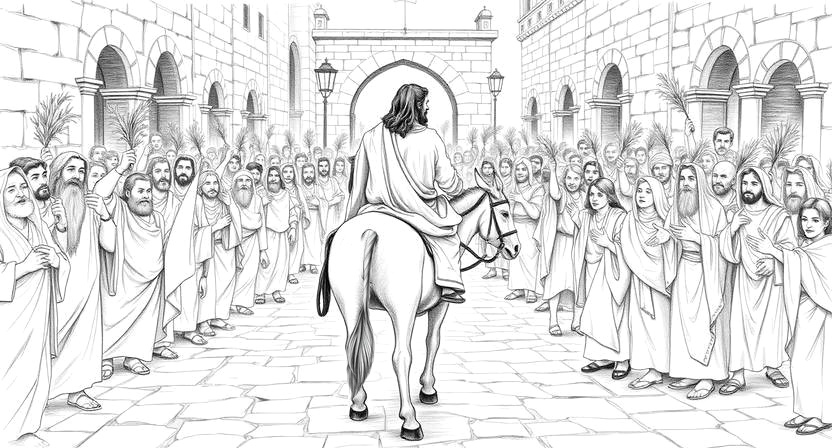
The Triumphal Entry
Gary Eugene Howell uses the Berean Standard Bible. The Holy Bible, Berean Standard Bible, BSB is produced in cooperation with Bible Hub, Discovery Bible, OpenBible.com, and the Berean Bible Translation Committee. The Text of the Berean Standard Bible was dedicated to the public domain as of April 30, 2023.
Verses 1-2
As they approached Jerusalem and came to Bethphage on the Mount of Olives, Jesus sent out two disciples, saying to them, “Go into the village ahead of you, and at once you will find a donkey tied there, with her colt beside her. Untie them and bring them to Me.”
Commentary
The triumphant entry of Jesus into Jerusalem is recorded in Zechariah 9:9–13, Matthew 21:1–11, Mark 11:1–11, Luke 19:28–44 and John 12:12–19.
Once again, Jesus demonstrates His omniscience. Clearly, He is not an ordinary man. He predicts future events with 100% accuracy.
Is this theft? Is Jesus telling the disciples to steal the donkey? No. He is borrowing it. Mark chapter 11 states that the animal’s owner was told his donkey would be returned to him shortly.
Verse 3
“If anyone questions you, tell him that the Lord needs them, and he will send them right away.”
Commentary
This can be viewed in a couple of different ways. The first is that Jesus is calling Himself Lord (i.e. Jesus is God). The second possible interpretation is that the Romans, as rulers over Israel, claimed the right to commandeer private property as needed for carrying out their duties. When the disciples said, “The Lord needs them,” the owner may have assumed the disciples had been sent by a Roman official. Whichever interpretation you lean toward, one thing is clear: Jesus knew ahead of time that the owner would agree to the borrowing of the animals.
Verses 4-5
This took place to fulfill what was spoken through the prophet:
“Say to the Daughter of Zion, ‘See, your King comes to you, gentle and riding on a donkey, on a colt, the foal of a donkey.’”
Commentary
Five hundred years earlier, God spoke through the prophet Zechariah, saying, “Your King comes to you, gentle and riding on a donkey …”
But did you know that this same prophecy given by Zechariah also includes references to Jesus’s second coming?
“Then He will proclaim peace to the nations. His dominion will extend from sea to sea, and from the Euphrates to the ends of the earth.” (Zechariah 9:10b)
This is speaking of Jesus’s millennial reign after the tribulation. This prediction is 100% accurate. It is going to happen. Faith is believing that what God has said is true.
Jesus’s first coming was marked by humility and servanthood. It’s why He was born in a manger and why He rode on a donkey. However, His second coming will be all about His authority as the King of kings, and He will be riding on a white horse.
Then I saw heaven standing open, and there before me was a white horse. And its rider is called Faithful and True. With righteousness He judges and wages war. He has eyes like blazing fire, and many royal crowns on His head. He has a name written on Him that only He Himself knows. He is dressed in a robe dipped in blood, and His name is The Word of God. (Revelation 19:11-13)
Today, in political and cultural discussions, Jesus is often presented as a figure who would align Himself with certain modern groups or causes assumed to represent compassion, justice, or love. The problem is that this version of Jesus is shaped entirely by His humble and lowly character as revealed in His first coming 2,000 years ago. At His second coming, however, Jesus will not be acting as a suffering servant but as a conquering King. Scripture teaches that He will judge and destroy all who oppose Him and will call the birds to come and eat their corpses, (See Revelation 19:17-18)
Verses 6-11
So the disciples went and did as Jesus had directed them. They brought the donkey and the colt and laid their cloaks on them, and Jesus sat on them. A massive crowd spread their cloaks on the road, while others cut branches from the trees and spread them on the road. The crowds that went ahead of Him and those that followed were shouting:
“Hosanna to the Son of David!”
“Blessed is He who comes in the name of the Lord!”
“Hosanna in the highest!”
When Jesus had entered Jerusalem, the whole city was stirred and asked, “Who is this?” The crowds replied, “This is Jesus, the prophet from Nazareth in Galilee.”
Commentary
The word Hosanna is a type of plea for salvation. When the people cried, “Hosanna in the highest,” they were essentially acknowledging Jesus as the Savior. Some may have realized that what they were witnessing fulfilled prophecy. Filled with excitement, they shouted Hosanna and praised Jesus.
Verses 12-13
Then Jesus entered the temple courts and drove out all who were buying and selling there. He overturned the tables of the money changers and the seats of those selling doves. And He declared to them, “It is written: ‘My house will be called a house of prayer.’ But you are making it ‘a den of robbers.’”
Commentary
When I read these two verses, the one thing that stands out to me the most is the phrase “den of robbers.” When the objective was to maximize profit rather than to perform a service for those coming to worship at the temple, the sellers and vendors made themselves robbers.
Gouging People for Profit & The Selling of Items at Church:
During World War II, German Luger pistols were highly sought after by U.S. soldiers. They were considered the pinnacle of war prizes. My father had two of them, and each was in near mint condition. He had gone to great effort over several decades to keep them in immaculate condition. After my father passed away, I inherited these two historical pieces. However, I did not have the same affinity for them that my father had, nor was it my intention to spend so much time caring for them, so I decided to sell them.
I took them to a public show where historical items are bought and sold. I visited one vendor who had many similar pieces on display. He examined the two pistols carefully and then offered me $250 for each. I had a strong feeling this man was trying to rob me. I declined his offer and walked away. A short while later, I found another vendor who had several historical German World War II relics similar to the ones I wanted to part with. I showed this second vendor what I had, and after examining them closely, he offered me $1,000 for each.
When people in Jesus’s time traveled to Jerusalem, they didn’t bring their temple sacrifice with them. They needed to purchase it upon arrival. The vendors who sold these sacrifices were gouging people, trying to make excessive profits rather than providing a service at a reasonable price to allow people to worship. These vendors were robbing people who simply wanted to worship God.
Today, if a church holds a Saturday morning flea market, there will often be someone who accuses them of wrongdoing, claiming that Jesus would flip over their tables. The issue in these verses, however, is not merely that money was being exchanged or that a service was being provided. It’s that the vendors were trying to rip people off. A church that holds a Saturday morning flea market may be attempting to raise money for a missionary, or perhaps they are raising funds to pay for a needed repair on the church building.
If, however, a church charged $10 for parking on Sunday mornings the same way a theme park or a professional sports stadium does, it would suggest that their desire for profit had begun overshadowing their invitation to worship.
Jesus was driving out of the temple those who were prioritizing profit at the expense of people being able to worship.
Verses 14-15
The blind and the lame came to Him at the temple, and He healed them. But the chief priests and scribes were indignant when they saw the wonders He performed and the children shouting in the temple courts, “Hosanna to the Son of David!”
Commentary
The priests and scribes in these verses hold the opinion that Jesus is not the Messiah. No matter what He does, they remain indignant toward Him. Even when He tells them plainly that He is the Messiah, they will declare it blasphemy (See Matthew 26:63–65).
This same pattern can be seen today. Some people begin with a fixed belief and then work backward into the Scriptures, twisting the Word of God to make it conform to their opinion. The proper approach, however, is the opposite. We must come to the Bible with humility, allowing it to shape and correct our beliefs rather than forcing it to support a pre-existing conclusion.
Verse 16
“Do You hear what these children are saying?” they asked. “Yes,” Jesus answered. “Have you never read: ‘From the mouths of children and infants You have ordained praise’?”
Commentary
It was only two chapters ago that Jesus said we all need to be like children (Matthew 19:13-15). Now, the children are praising Him and shouting, “Hosanna to the Son of David,” while the scribes and Pharisees are grumbling and complaining.
Furthermore, Jesus is quoting Psalm 8, which clearly speaks about God:
O LORD, our Lord, how majestic is Your name in all the earth! You have set Your glory above the heavens. From the mouths of children and infants You have ordained praise on account of Your adversaries, to silence the enemy and avenger. When I behold Your heavens, the work of Your fingers, the moon and the stars, which You have set in place—what is man that You are mindful of him, or the son of man that You care for him?
You made him a little lower than the angels; You crowned him with glory and honor. You made him ruler of the works of Your hands; You have placed everything under his feet: all sheep and oxen, and even the beasts of the field, the birds of the air and the fish of the sea, all that swim the paths of the seas. O LORD, our Lord, how majestic is Your name in all the earth! (Psalm 8:1-9)
By accepting the children’s praises and responding, “Have you never read: ‘From the mouths of children and infants You have ordained praise’?”, Jesus is identifying Himself as the subject of Psalm 8; the one crowned with glory and honor. In doing so, He is implicitly claiming to be God, the one worthy of praise from all creation.
Verse 17
Then He left them and went out of the city to Bethany, where He spent the night.
Commentary
This verse is largely self-explanatory, recording Jesus’s return to Bethany for the night after His actions in the temple. It marks the conclusion of His day teaching, healing, cleansing, and confrontation with the religious leaders.
Verses 18-19
In the morning, as Jesus was returning to the city, He was hungry. Seeing a fig tree by the road, He went up to it but found nothing on it except leaves. “May you never bear fruit again!” He said. And immediately the tree withered.
Commentary
This event is also recorded in Mark chapter 11, where it is described as occurring the following day, when the disciples see the fig tree withered. This, however, is not a contradiction, because a tree that withers completely overnight can still be described as having withered “immediately.” For example, when a pine tree is struck by lightning, it is typically killed instantly by electrocution, but it may take one to two weeks for its needles to dry and turn brown. Similarly, a tree that withers overnight can reasonably be described as having withered immediately.
But why did Jesus curse the tree?
Recall the parable of the sower, when Jesus describes the seed sown among thorns as unfruitful because “the worries of this life and the deceitfulness of wealth choke the word.” Then He explains that the seed sown on good soil represents those who hear the word and understand it. They bear fruit and produce a crop—a hundredfold, sixtyfold, or thirtyfold (Matthew 13:22–23).
Recall also when Jesus compared false teachers to bad trees bearing bad fruit (Matthew 7:15–20).
And when John the Baptist warned the Pharisees:
“You brood of vipers, who warned you to flee from the coming wrath? Produce fruit, then, in keeping with repentance. And do not presume to say to yourselves, ‘We have Abraham as our father.’ For I tell you that out of these stones God can raise up children for Abraham. The axe lies ready at the root of the trees, and every tree that does not produce good fruit will be cut down and thrown into the fire. (Matthew 3:7-10)
In Luke 13 we find the parable of the barren fig tree:
Then Jesus told this parable: “A man had a fig tree that was planted in his vineyard. He went to look for fruit on it but did not find any. So he said to the keeper of the vineyard, ‘Look, for the past three years I have come to search for fruit on this fig tree and haven’t found any. Therefore cut it down! Why should it use up the soil?’
‘Sir,’ the man replied, ‘leave it alone again this year, until I dig around it and fertilize it. If it bears fruit next year, fine. But if not, you can cut it down.’” (Luke 13:6-9)
Jesus is providing the disciples, and us, as Bible readers, a real-world example of what God’s judgment looks like. Those who bear no fruit (i.e. the fruit of faith) will be “withered”, cut down, and thrown into the fire.
Salvation is by faith. When we put our faith in Jesus Christ, we are filled with the Holy Spirit. This, in turn, begins to transform our lives so that slowly, over time, we become more like Christ. Our desires turn away from worldliness and toward God’s will for our present path and future. All of this can be compared to bearing fruit.

The person who “claims” the name of Christ yet has only green leaves and no fruit is someone who is merely playing Christianity but has not put their faith in Christ. There is no fooling God. As easily as you and I could walk up to a fig tree and see that it has no figs, God can just as easily look into our hearts and see whether or not we have faith.
These people honor Me with their lips, but their hearts are far from Me. (Matthew 15:8)
What Jesus is showing us in the example of the withered fig tree is that without the fruit of faith, you have no value to God. The fact that He planted you is evidence that He loves you, and the fact that you’re still alive is evidence that you remain under His grace and mercy. But if you don’t bear any fruit (i.e. if you have no faith), the love He has for you will not prevent Him from digging you up and throwing you away. He may love you, but do you love Him?
“Not everyone who says to Me, ‘Lord, Lord,’ will enter the kingdom of heaven, but only he who does the will of My Father in heaven. Many will say to Me on that day, ‘Lord, Lord, did we not prophesy in Your name, and in Your name drive out demons and perform many miracles?’ Then I will tell them plainly, ‘I never knew you; depart from Me, you workers of lawlessness!’” (Matthew 7:21-23)
What is the will of the Father in heaven? That we put our faith in Jesus Christ. Why does Jesus say He never knew them? Because they never put their faith in Him. The fact that they say, “Lord, Lord, did we not prophesy in Your name, and in Your name drive out demons and perform many miracles?” shows that they believed they could earn salvation through good works.
…without faith it is impossible to please God (Hebrews 11:6a)
Verses 20-22
When the disciples saw this, they marveled and asked, “How did the fig tree wither so quickly?”
“Truly I tell you,” Jesus replied, “if you have faith and do not doubt, not only will you do what was done to the fig tree, but even if you say to this mountain, ‘Be lifted up and thrown into the sea,’ it will happen. If you believe, you will receive whatever you ask for in prayer.”
Commentary
Does this mean we can all pray for a million dollars and expect to win the lottery next week? No. Absolutely not. Notice that Jesus said, “If you have faith.” Faith is believing that God exists, that Jesus Christ lived, died, and rose from the dead, and that what we read in the Word of God is true and trustworthy. Always remember: the Word was with God, and the Word was God (John 1:1).
If we have faith, we don’t pray to win the lottery because, by the Word of God, we understand that such a request would be contrary to God’s will. We don’t put our hope in money; we put our hope in Jesus.
To receive whatever you ask for in prayer, you must believe that the Word of God (the Bible) is true. Thus, the prayers you offer will begin to align with God’s will. We don’t ask for a million dollars, nor do we ask for the vain things of this world. Lust, fame, fortune, pride, and other worldly desires are all outside of God’s will. If we truly have faith, if we fully trust the Lord, we will not pray for such things.
Here’s an alternative: Pray for the salvation of every person you meet. Pray for every missionary you encounter, asking God to provide for them as they share the gospel around the world. Pray for the widows you meet, asking God to meet their needs, and that God might use you to provide those needs. Pray for Godly wisdom. Pray to be filled with the Holy Spirit. Pray for deeper understanding of God’s Word. Pray that you can raise your children to know and trust Jesus.
A Testimony of Doing What was Done to the Fig Tree
In Florida, there is an invasive species of tree called the Brazilian pepper. It’s native to Brazil. The rapid, widespread growth of its dense canopy threatens native Florida plant and animal species.
When my wife and I bought our first home, there was a Brazilian pepper tree in the backyard. We had only been in the house a couple of days when I stood at the back window, looking out at the tree. My wife commented that she disliked Brazilian pepper trees because of the way they make life more difficult for Florida’s endangered species.
Still looking out the window at the tree, I raised my hand, pointed at it, and said, “I curse that tree in the name of Jesus.” The comment was mean to get a laugh out of my wife. Afterward, I thought no more of it.
However, the next afternoon, when we returned home, I looked out the back window and, to my shock, the tree was gone. Someone had cut it down and completely removed it. Apparently, my neighbor had taken it upon himself to put a chainsaw to it and remove it. We had never spoken to our neighbor about the tree; he simply decided on his own to come over and cut it down.
I had spoken a curse on that tree in the name of Jesus, and the very next day, the tree was gone. It never ceases to amaze me how Jesus works and the ways He makes Himself known through the ordinary activities of our lives.
Does this mean I believe we can go around cursing every tree we don’t like? No. I don’t think what happened was about the tree; and it certainly wasn’t about me. I believe it was about Jesus making Himself known and receiving praise and glory.
Verse 23
When Jesus returned to the temple courts and began to teach, the chief priests and elders of the people came up to Him. “By what authority are You doing these things?” they asked. “And who gave You this authority?”
Commentary
“These things” likely refers to the previous day’s Triumphal Entry and the overturning of the tables, as well as His return to the temple that day to teach.
Let’s be honest, this is one occasion where we can sympathize with the chief priests and elders. Imagine you’re a pastor, and one Sunday morning a random person, who isn’t a member of your congregation, walks up to the pulpit, takes the microphone, and begins preaching to your congregation, and you don’t even know who the person is. You would likely be waving to the sound booth, signaling them to cut off his microphone. You would probably then call security to have the man escorted off the property.
But Jesus knows He has the authority to walk into the temple courts uninvited and begin teaching those who are there. What gives Him this authority?
So behold, I plan to build a house for the Name of the LORD my God, according to what the LORD said to my father David: ‘I will put your son on your throne in your place, and he will build the house for My Name.’ (1 Kings 5:5)
Solomon built the temple to be God’s dwelling place; Herod made it even grander. When Jesus enters the temple courts to teach, He is walking into the house that was built for Him. It is His house.
Furthermore, Jesus is the King of Kings. Does a King have authority? Absolutely.
Do you allow Jesus to have authority over your life? If not, why not?
Do you not know that your body is a temple of the Holy Spirit who is in you, whom you have received from God? You are not your own; you were bought at a price. Therefore glorify God with your body. (1 Corinthians 6:19-20)
Verses 24-27
“I will also ask you one question,” Jesus replied, “and if you answer Me, I will tell you by what authority I am doing these things. What was the source of John’s baptism? Was it from heaven or from men?”
They deliberated among themselves and said, “If we say, ‘From heaven,’ He will ask, ‘Why then did you not believe him?’ But if we say, ‘From men,’ we are afraid of the people, for they all regard John as a prophet.” So they answered, “We do not know.”
And Jesus replied, “Neither will I tell you by what authority I am doing these things.
Commentary
It’s interesting to note that Jesus gives an implicit answer. He doesn’t state it outright, but the answer to their question is fully contained in the question He asks.
As soon as Jesus was baptized, He went up out of the water. Suddenly the heavens were opened, and He saw the Spirit of God descending like a dove and resting on Him. And a voice from heaven said, “This is My beloved Son, in whom I am well pleased!” (Matthew 3:16-17)
Thus, by referring to John’s baptism, Jesus is telling the chief priests that His authority comes from God. However, Jesus knows that whatever answer He gives to their questions, they’re not going to accept it. So rather than answering them directly, He responds with a question of His own that exposes their hypocrisy and silences them.
Verses 28-32
But what do you think? There was a man who had two sons. He went to the first one and said, ‘Son, go and work today in the vineyard.’
‘I will not,’ he replied. But later he changed his mind and went. Then the man went to the second son and told him the same thing.
‘I will, sir,’ he said. But he did not go. Which of the two did the will of his father?”
“The first,” they answered.
Jesus said to them, “Truly I tell you, the tax collectors and prostitutes are entering the kingdom of God before you. For John came to you in the way of righteousness, and you did not believe him, but the tax collectors and prostitutes did. And even after you saw this, you did not repent and believe him.
Commentary
Jesus then tells a story with the intent of illustrating his point about the disbelief of the scribes and Pharisees.
The first son who refused to work in the vineyard but later changed his mind represents every sinner who, at first, lived in rebellion against God but later came to faith and repentance. Meanwhile the other son represents the pharisees and Sadducees and to a greater extent Israel as a whole. For they said after leaving Egypt that they would follow God, but then they didn’t.
Moses went back and summoned the elders of the people and set before them all these words that the LORD had commanded him. And all the people answered together, “We will do everything that the LORD has spoken.” (Exodus 19:7-8)
But they never did.
Verses 33-41
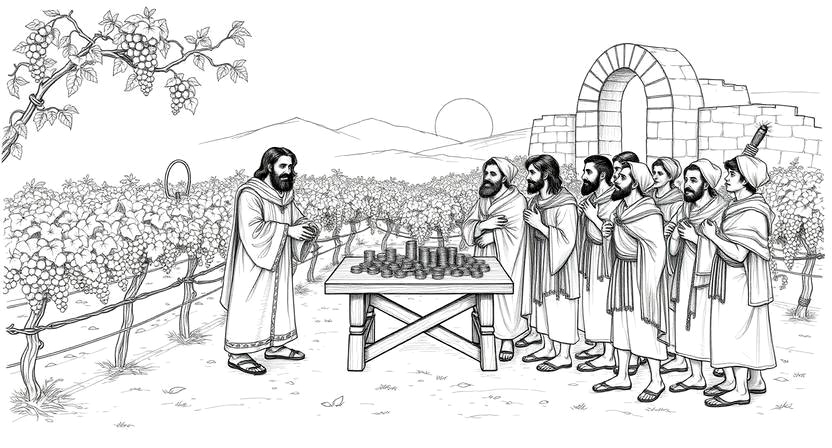
Listen to another parable: There was a landowner who planted a vineyard. He put a wall around it, dug a winepress in it, and built a tower. Then he rented it out to some tenants and went away on a journey.
When the harvest time drew near, he sent his servants to the tenants to collect his share of the fruit. But the tenants seized his servants. They beat one, killed another, and stoned a third.
Again, he sent other servants, more than the first group. But the tenants did the same to them.
Finally, he sent his son to them. ‘They will respect my son,’ he said. But when the tenants saw the son, they said to one another, ‘This is the heir. Come, let us kill him and take his inheritance.’ So they seized him and threw him out of the vineyard and killed him.
Therefore, when the owner of the vineyard returns, what will he do to those tenants?”
“He will bring those wretches to a wretched end,” they replied, “and will rent out the vineyard to other tenants who will give him his share of the fruit at harvest time.”
Commentary
In this parable, the landowner is God, the vineyard is the people of Israel (and, to a larger extent, the people of the world), the tenants are the Pharisees and Sadducees (or more broadly, the religious leaders of Israel), the servants are the Old Testament prophets, the son is Jesus Christ, and the other tenants are the Gentiles.
The landowner (God) has a vineyard (the people of Israel, and ultimately the people of the whole world). God desires that all people be saved.
This is good and pleasing in the sight of God our Savior, 4who wants everyone to be saved and to come to the knowledge of the truth. (1 Timothy 2:3)
So He set apart a particular group of people to represent Him and to present His will to the nations.
Now if you will indeed obey My voice and keep My covenant, you will be My treasured possession out of all the nations—for the whole earth is Mine. And unto Me you shall be a kingdom of priests and a holy nation.’ These are the words that you are to speak to the Israelites.” (Exodus 19:5-6)
God sent prophet after prophet, yet they were rejected and killed. Finally, God sent His Son, Jesus Christ; and as we are about to see in the final chapters of Matthew, they will kill Him as well.
This is reminiscent of the time when the prophet Nathan told King David a story about a rich man who took a poor man’s only lamb. Nathan described how the rich man, instead of taking from his own flock, took and slaughtered the beloved lamb of a poor man to feed a traveler. David became outraged at the injustice of the story, until Nathan revealed that the narrative was about David himself. “You are the man!” Nathan declared. (See 2 Samuel 12:1-7).
Jesus is telling this parable of the vineyard to the chief priests and elders of the people. They are the villains of the story. When asked what the owner of the vineyard should do, they declare that those wretches should be brought to a wretched end.
Verse 42
Jesus said to them, “Have you never read in the Scriptures: ‘The stone the builders rejected has become the cornerstone. This is from the Lord, and it is marvelous in our eyes’?
Commentary
Jesus is quoting Psalm 118:22–23. The stone is Jesus, and the builders are the chief priests. Jesus Christ has become the cornerstone of our salvation.
Jesus said, “Have you never read in the Scriptures?” Reading from your Bible on a daily basis should be the most important thing you do each day. Familiarity with the Word of God is the strategy by which you can avoid sin and its terrible consequences.
Imagine this scenario: you are drafted into a war. At some point, you must cross a minefield. You’re getting ready to take your first steps into the minefield when suddenly, someone discovers a map showing the exact location of every mine. They hand the map to you. What would you do? You would study that map very carefully.
This is precisely the situation you face with your Bible study. Satan is seeking to kill you, and the Bible tells you exactly how to avoid his schemes. If you are not reading it daily, that is a sign you have not yet grasped the seriousness of the situation.
Clarification: The Bible is not a self-help book for successful living, nor was it written primarily as a manual for how to avoid sin. Rather, it is a book about Jesus Christ, the author and perfecter of our faith. He is the one who makes right living possible. We don’t read the Bible daily to seek out health, wealth and success. We read it to know and have a relationship with the God we love.
For the word of God is living and active. Sharper than any double-edged sword, it pierces even to dividing soul and spirit, joints and marrow. It judges the thoughts and intentions of the heart. Nothing in all creation is hidden from God’s sight; everything is uncovered and exposed before the eyes of Him to whom we must give account. (Hebrews 4:12-13)
Verses 43-46
Therefore I tell you that the kingdom of God will be taken away from you and given to a people who will produce its fruit. He who falls on this stone will be broken to pieces, but he on whom it falls will be crushed.”
When the chief priests and Pharisees heard His parables, they knew that Jesus was speaking about them. Although they wanted to arrest Him, they were afraid of the crowds, because the people regarded Him as a prophet.
Commentary
Jesus is telling the chief priests and elders that the Kingdom of God will be taken from them and given to the Gentiles and they will produce its fruit.
“He who falls on this stone will be broken to pieces, but he on whom it falls will be crushed” means that those who reject and oppose Jesus bring destruction upon themselves. Without repentance, their fate is hell.