
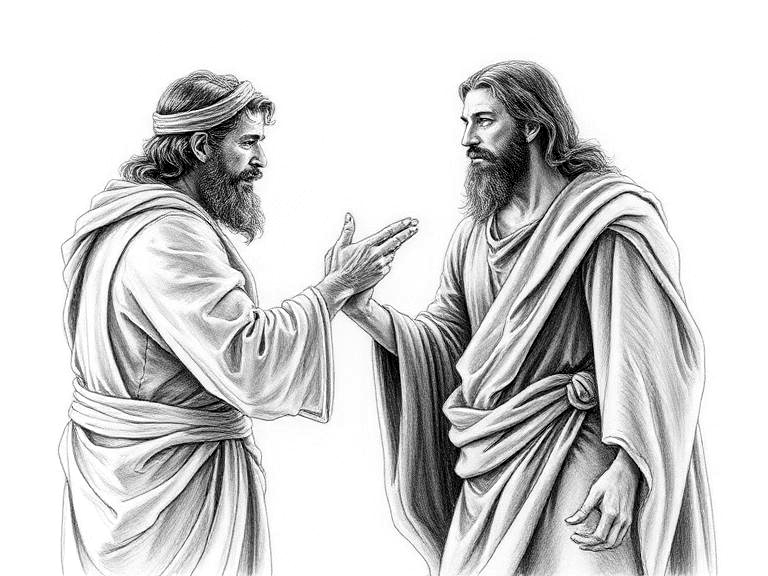
Peter attempts to rebuke Jesus (Matthew 16:22-23)
Gary Eugene Howell uses the Berean Standard Bible. The Holy Bible, Berean Standard Bible, BSB is produced in cooperation with Bible Hub, Discovery Bible, OpenBible.com, and the Berean Bible Translation Committee. The Text of the Berean Standard Bible was dedicated to the public domain as of April 30, 2023.
Verse 1
Then the Pharisees and Sadducees came and tested Jesus by asking Him to show them a sign from heaven.
Commentary
The Pharisees baffle me. Jesus had been performing miracle after miracle, and now they come to him asking for a sign from heaven. Of course, they didn’t actually want to see a sign; they were looking for a way to accuse him of wrongdoing. This is one of the reasons Jesus often warned people not to tell anyone after he healed them; he didn’t want the Pharisees to interfere with his earthly ministry too soon.
Verses 2-4
But He replied, “When evening comes, you say, ‘The weather will be fair, for the sky is red,’ and in the morning, ‘Today it will be stormy, for the sky is red and overcast.’ You know how to interpret the appearance of the sky, but not the signs of the times. A wicked and adulterous generation demands a sign, but none will be given it except the sign of Jonah.” Then He left them and went away.
Commentary
Jesus offers the Pharisees a simple analogy about weather. When we see the sky is dark and cloudy, we know it’s likely about to rain. Jesus then reprimands them, saying, “You know how to interpret the appearance of the sky, but not the signs of the times.” This is particularly striking because Jesus suggests the signs of the times should be obvious. He was, of course, referring to the signs that pointed to himself as the coming Messiah. This was a tremendous rebuke of the Pharisees because they were experts in the law. They were the ones who diligently studied the scriptures and were supposed to be able to identify the signs of the times as they pertained to the coming Messiah, but they refused to do so. Even after bearing witness to Jesus healing a man with a withered hand (Matthew 12), rather than accepting him as a miracle worker, they instead plotted how they might kill him.
Jesus continues, “A wicked and adulterous generation demands a sign, but none will be given it except the sign of Jonah.” This, of course, is referring to the fact that Jesus would go into the grave for three days and then come back to life. He is comparing himself to Jonah, who was in the belly of a fish for three days and then was vomited onto dry land.
I’ve heard scoffers accuse the Bible of being a fairy tale when they say, “How could a man survive for three days inside a fish’s stomach?” But therein lies the analogy. We don’t know for sure, but perhaps Jonah died in the fish, just as Jesus died, was buried in the tomb, and was resurrected three days later.
We do know, however, that Jonah prayed from inside the fish:
From inside the fish, Jonah prayed to the LORD his God, saying: “In my distress I called to the LORD, and He answered me. From the belly of Sheol I called for help, and You heard my voice. For You cast me into the deep, into the heart of the seas, and the current swirled about me; all Your breakers and waves swept over me. At this, I said, ‘I have been banished from Your sight; yet I will look once more toward Your holy temple.’ The waters engulfed me to take my life; the watery depths closed around me; the seaweed wrapped around my head. To the roots of the mountains, I descended; the earth beneath me barred me in forever! But You raised my life from the pit, O LORD my God! As my life was fading away, I remembered the LORD. My prayer went up to You, to Your holy temple. Those who cling to worthless idols forsake His loving devotion. But I, with the voice of thanksgiving, will sacrifice to You. I will fulfill what I have vowed. Salvation is from the LORD!” And the LORD commanded the fish, and it vomited Jonah onto dry land. (Jonah 2:1-10)
Notice that Jonah said, “As my life was fading away…” It’s entirely plausible that Jonah had only enough time to pray this prayer before he suffocated and died inside the fish, and was later resurrected back to life after the fish vomited him onto the land. The point of all this is that Jesus is telling the Pharisees that the only sign they will be given is that, like Jonah, he will be buried for three days and then resurrected back to life.
As we’re going to see, however, the Pharisees will attempt to cover up the resurrection miracle by paying soldiers to lie. No matter what, the Pharisees were never going to accept Jesus as their Messiah. Even today nothing has changed. When people scream, “Prove to me that there is a God!” those same people, if they saw Jesus Christ rise from the dead, would lie and try to cover it up because in their hearts they’ve already decided there is no God. Like the Pharisees, nothing is going to change their minds, (see Luke 16:31).
Verses 5-12
When they crossed to the other side, the disciples forgot to take bread. “Watch out!” Jesus told them. “Beware of the leaven of the Pharisees and Sadducees.” They discussed this among themselves and concluded, “It is because we did not bring any bread.”
Aware of their conversation, Jesus said, “You of little faith, why are you debating among yourselves about having no bread? Do you still not understand? Do you not remember the five loaves for the five thousand, and how many basketfuls you gathered? Or the seven loaves for the four thousand, and how many basketfuls you gathered? How do you not understand that I was not telling you about bread? But beware of the leaven of the Pharisees and Sadducees.”
Then they understood that He was not telling them to beware of the leaven used in bread, but of the teaching of the Pharisees and Sadducees.
Commentary
From our position of hindsight and having also the infilling of the Holy Spirit, we may tend to view the disciples as being somewhat dumb because they so often fail to grasp what Jesus is talking about. Remember, however, that at this point the Holy Spirit had not yet been poured out upon the disciples. It’s not their lack of intelligence; it’s that they were not thinking spiritually. Instead, they were thinking carnally.
Those without the Holy Spirit (I’m thinking particularly of atheists who often want to debate Christians) will get offended when told they cannot understand the Bible. Thinking carnally, they assume we are accusing them of not being intelligent enough to understand the message of the Bible. That’s not the case. To understand the Bible, its true meaning must be spiritually discerned. Thus, without the Holy Spirit, how can one understand something that requires spiritual discernment? Stated more succinctly; to understand the Bible, its meaning must be revealed to us by God. God will not reveal these meanings to someone who lacks the Holy Spirit.
The disciples, however, have Jesus Christ in their presence. Even though they don’t yet have the Holy Spirit, whatever they don’t yet understand spiritually, Jesus is there to explain to them.
He says to the disciples, “How do you not understand that I was not telling you about bread? But beware of the leaven of the Pharisees and Sadducees.”
How can we be aware of the leaven of false teachers? By knowing the Word of God well. Also, by looking at the fruit on their tree. All false teachers have, to some degree or another, a low opinion of Scripture and of the Bible as a whole.
Here are a few examples: a New Testament scholar argues that the Bible contains contradictions; a theologian questions the inerrancy of Scripture; a professor of biblical studies claims the Bible is merely of human authorship; a famous pastor argues that belief in Jesus should not be based exclusively on the Bible. All of these are the leaven of the Pharisees and are false teachers.
In every instance when Jesus was being tempted by Satan, Jesus used the Word of God to refute Satan. In order to defend yourself against demonic influence and to avoid being deceived by false teachers and false doctrine, you must be very familiar with the Word of God. Read it in conjunction with prayer for understanding.
Remember, false doctrine is often very subtle. No pastor ever goes to the pulpit and announces, “Now I’m going to teach you false doctrine.” Even after having read the Bible so many times, I still sometimes hear false doctrine and at first nod my head because it sounds so nice. Only after a few minutes of thinking about it do I suddenly say to myself, “Wait a minute, that’s not what the Bible says.”
But the Advocate, the Holy Spirit, whom the Father will send in My name, will teach you all things and will remind you of everything I have told you (John 14:26). How can the Holy Spirit remind you of something you’ve never read?
Salvation is by faith, but how can you be certain you are putting your faith into the right thing unless you read the instruction manual? How can you be certain that what you believe is correct unless you read the book that defines truth? Read the Bible, beginning with the New Testament. Not once, not twice, you should read from the Bible daily for the rest of your life. You should read the Bible so much that you eventually wear out the book and have to buy another.
[If you find something in my New Testament commentaries that you believe to be false doctrine, and you can convince me through Scripture of why I am wrong, I will gladly edit my commentary. However, what I’ve found in my experience is that in almost every case, when someone disagrees with an interpretation, that person often times has formed their argument based upon what someone else told them rather than upon their own diligent study of the Bible. The Bible has 1,500+ pages. Most people do not want to read a book that big. Many Christians try to take shortcuts. They try to take the easy route. Many Christians are not willing to inconvenience themselves for the sake of Jesus. Many Christians are not willing to pick up their cross and follow Jesus. They prefer the lazy route of not having to study the Bible and instead form their spiritual beliefs based on what they’ve heard other people say. I challenge you to be self-critiquing. How much have you personally studied the Bible? How often have you prayed for spiritual understanding? If your honest answer is “not very much,” begin today pursuing Jesus.]
Verses 13-19
When Jesus came to the region of Caesarea Philippi, He questioned His disciples: “Who do people say the Son of Man is?” They replied, “Some say John the Baptist; others say Elijah; and still others, Jeremiah or one of the prophets.”
“But what about you?” Jesus asked. “Who do you say I am?” Simon Peter answered, “You are the Christ, the Son of the living God.”
Jesus replied, “Blessed are you, Simon son of Jonah! For this was not revealed to you by flesh and blood, but by My Father in heaven. And I tell you that you are Peter, and on this rock I will build My church, and the gates of Hades will not prevail against it. I will give you the keys of the kingdom of heaven. Whatever you bind on earth will be bound in heaven, and whatever you loose on earth will be loosed in heaven.”
Commentary
When Jesus came to the region of Caesarea Philippi, which is in northern Israel, he questioned his disciples: “Who do people say the Son of Man is?” The phrase “Son of Man” is what Jesus frequently referred to himself as. It comes from the book of Daniel, in which Daniel was describing his vision.
In my vision in the night I continued to watch, and I saw One like the Son of Man coming with the clouds of heaven. He approached the Ancient of Days and was led into His presence. And He was given dominion, glory, and kingship, that the people of every nation and language should serve Him. His dominion is an everlasting dominion that will not pass away, and His kingdom is one that will never be destroyed. (Daniel 7:13-14)
By calling himself “Son of Man,” Jesus is identifying himself as the divine King of Daniel’s vision. Jesus asks his disciples, “Who do people say I am?” They replied, “Some say John the Baptist; others say Elijah; and still others, Jeremiah or one of the prophets.”
In other words, the crowds of people that follow Jesus do not know and/or don’t understand that he is the Messiah. Of course, there are a few exceptions, but many of those exceptions are non-Jewish people such as the Canaanite woman from the previous chapter.
Then Jesus asks, “But what about you? Who do you say I am?” Simon Peter answered, “You are the Christ, the Son of the living God.”
Everything that follows hinges on this declaration; that Jesus is the Christ (the Messiah) and the Son of the living God.
Jesus replied, “Blessed are you, Simon son of Jonah! For this was not revealed to you by flesh and blood, but by My Father in heaven. And I tell you that you are Peter, and on this rock I will build My church, and the gates of Hades will not prevail against it. I will give you the keys of the kingdom of heaven. Whatever you bind on earth will be bound in heaven, and whatever you loose on earth will be loosed in heaven.”
The Catholic Church teaches that Jesus built his church on Peter. I disagree with that interpretation. Instead, I hold to the idea that Jesus is building his church on Peter’s declaration that Jesus is the Christ (meaning the Messiah) and that he is the Son of the living God.
Within verses 13-19 there are three important points about the future church. The first is Peter’s confession: “You are the Christ, the Son of the living God.” The second is the moment when Jesus says, “And I tell you that you are Peter…,” which itself was stated moments after Jesus also said, “Blessed are you, Simon son of Jonah!” These two instances of Jesus calling Peter by name are a direct reference to and in deliberate contrast to his earlier warning about those he never knew.
Not everyone who says to Me, ‘Lord, Lord,’ will enter the kingdom of heaven, but only he who does the will of My Father in heaven. Many will say to Me on that day, ‘Lord, Lord, did we not prophesy in Your name, and in Your name drive out demons and perform many miracles?’ Then I will tell them plainly, ‘I never knew you; depart from Me, you workers of lawlessness!’ (Matthew 7:21-23)
When Jesus says, “Blessed are you, Simon son of Jonah!” and “I tell you that you are Peter,” he is saying that he knows Peter by name. They are on a first-name basis. They have a relationship. They are friends. Jesus is saying, “Peter, I know you.” The interpretation is that the church is built upon being in relationship with Jesus Christ.
The rock upon which Jesus builds his church consists of faith in the truth that Jesus is the Christ, the Son of the living God, and experiencing life in the Spirit; a genuine relationship with him. Jesus describes this as Spirit and truth.
“But a time is coming and has now come when the true worshipers will worship the Father in spirit and in truth, for the Father is seeking such as these to worship Him.” (John 4:23)
Jesus then speaks of “keys,” “binding,” and “loosing,” all within the same context of how his church will be built. Keys grant access. Jesus is giving the keys of the kingdom to Peter and the disciples so that they can open the door of salvation to the whole world through the sharing of the gospel to all nations (see Matthew 28:18-20).
This third point is that the church is going to grow by one person telling another, beginning with Peter, who will preach the first gospel sermon in Acts 2, where three thousand people will be saved.
Binding and loosing refer to the opening and closing of the kingdom through the gospel. Faith in Christ opens the door; rejection of Christ leaves it shut.
The rock, then, can be interpreted as an assurance that the method by which his church is built will never change. Faith in Christ, life in the Spirit, and the proclamation of the gospel from person to person will endure until the end.
Verse 20
Then He admonished the disciples not to tell anyone that He was the Christ.
Commentary
We know that after he has risen from the grave, he will tell his followers to “go and make disciples of all nations….” But for now, he is instructing his disciples to tell no one. In order to build his church, Jesus needs to keep his disciples alive. Jesus has already aggravated the Pharisees to the point they want to kill him. If the disciples were to now begin running throughout Jerusalem declaring Jesus to be the Messiah, they would likely all end up crucified right alongside Jesus, and that would be the end of the church.
Verse 21
From that time on Jesus began to show His disciples that He must go to Jerusalem and suffer many things at the hands of the elders, chief priests, and scribes, and that He must be killed and on the third day be raised to life.
Commentary
Speaking to his disciples, Jesus foretells everything that is going to happen to him. Jesus knows that the sheep are going to scatter, but by telling them exactly what is going to happen to him, and later their seeing it all come to pass exactly as he said it would, they will see firsthand that God is in control.
Verses 22-23
Peter took Him aside and began to rebuke Him. “Far be it from You, Lord!” he said. “This shall never happen to You!” But Jesus turned and said to Peter, “Get behind Me, Satan! You are a stumbling block to Me. For you do not have in mind the things of God, but the things of men.”
Commentary
Jesus is fully man and fully God. As fully God, Jesus knows what is about to take place, and he informs his disciples.
Peter attempts to rebuke Jesus, saying this will never happen. I empathize with Peter because if my best friend informed me that somebody was trying to kill him, I too would rally to his defense and would seek to protect him. Jesus, however, knows that what he’s about to do next will bring the offer of salvation to the entire human race for all of time. Peter, on the other hand, is thinking carnally.
Notice also that Peter talks like a tough guy when the threat is far off. But we’ll soon see that as soon as he comes face to face with persecution, Peter crumbles under the pressure.
Jesus turned and said to Peter, “Get behind me, Satan! You are a stumbling block to me. For you do not have in mind the things of God, but the things of men.”
Verse 24
Then Jesus told His disciples, “If anyone wants to come after Me, he must deny himself and take up his cross and follow Me.
Commentary
What does it mean to deny yourself? It means there may be some things you want to do but are not going to. Jesus said, “For out of the heart come evil thoughts, murder, adultery, sexual immorality, theft, false testimony, and slander” (Matthew 15:19). This means that bad decisions and human vices come from following one’s heart. If we want to follow Jesus, there may be times that you have to deny yourself the things you long for. Pursuing wealth, fame, popularity, style, easy money, materialism, alcohol, and other worldly pleasures are all examples of things you may need to deny yourself when choosing to follow Jesus.
Then Jesus says that if anyone wants to follow him, he must take up his cross. Jesus carried the cross he was going to be crucified on. For us, this represents carrying a great burden. I want to examine this in light of two types of people: the free and the oppressed.
There are currently 193 countries on earth; of them, 166 countries (86%) outlaw, persecute, harass, or are otherwise hostile toward Christians. As I am writing this, Christians are being murdered in Nigeria. If you live in a country where Christianity is persecuted, the cross you must take up to follow Jesus is that of being persecuted for righteousness’ sake (see Matthew 5:10-12). Great will be your rewards in heaven.

On the other hand, if you live in a free country such as the United States, where at the present time there is little to no religious persecution against the average Christian, the cross you must carry is that of putting upon yourself a high level of self-discipline in your pursuit of God.
Salvation is by faith, not by works. We cannot earn salvation. But Jesus is saying that after you put your faith in him, in order to follow him, you may have to pick up a burden when following him.
Many Americans have time for sports, entertainment, recreation, hobbies, exercise, fashion, friends, and the pursuit of wealth and business, yet have no time for Jesus, the author of their salvation.
An Iranian couple once immigrated to the United States in order to escape the persecution they faced for their Christian belief. In Iran, if someone converts to Christianity, they face the possibility of discrimination, prison, torture, and the confiscation of their property. This couple came to the US to escape such terrible persecution. But after they were in the United States for a couple of years, the wife begged her husband that they should go back to Iran, where she felt daily the tremendous need to rely upon Jesus for her and her husband’s very lives. In the United States, she witnessed firsthand how quickly the human heart can grow cold toward Christ. She sat around watching TV, drinking lattes, and filling her belly with good food, and her heart began to become complacent.
Be careful not to forget the LORD your God by failing to keep His commandments and ordinances and statutes, which I am giving you this day. Otherwise, when you eat and are satisfied, when you build fine houses in which to dwell, and when your herds and flocks grow large and your silver and gold increase and all that you have is multiplied, then your heart will become proud, and you will forget the LORD your God who brought you out of the land of Egypt, out of the house of slavery. (Deuteronomy 8:11-14)
In Iran, Christians are being put in prison, and in Nigeria, Christians are being shot, but in the United States, nearly every household has a Bible that’s collecting dust on a bookshelf. Again, I declare, salvation is by faith, but this author holds that if you have no interest in God’s Word, you have no interest in God. And that such fruit may be an indication that you’re not yet saved.
Has the freedom we enjoy in the US caused you to become complacent and forget about God? In the United States, the cross we often must bear is the self-discipline required to throw off our luxury, comfort, and culture of indulgent entertainment and instead go into your room, shut the door, open your Bible, and spend time with Jesus. Not twice a year on Christmas and Easter, not once in a while when you feel like it, but every single day.
Are you going to spend time at the feet of Jesus in prayer and in his Word, or are you going to fritter away your evenings streaming movies on your television or scrolling video shorts on your phone while simultaneously claiming you don’t have time to read the Bible?
Where there is no persecution, Christians get lazy. This means that if you want to follow Jesus, you have to pick up your cross and overcome your own laziness. Salvation is by faith, but can a person who ignores Jesus claim they are walking in faith? You need to be reading God’s Word daily, and not just superficially but through prayer. Study God’s Word in depth. Develop a dynamic and organized prayer list in which you are often praying for your needs and the needs of others. Get yourself plugged into a quality church and Bible study where you have the opportunity to associate regularly with people who are spiritually wiser than yourself. Get around them and listen. Allow them to influence your journey with God. Don’t be one of those people who sneaks into the back of the church five minutes after the service started and then dashes out the door the second the pastor says, “Go in peace.” Arrive early, stay late, meet people. Get to know other Christians and ask about the church’s Bible studies and small group programs. Pray for such opportunities. And also pray that God would give you the blessed Holy Spirit.
I challenge you to make those things a high priority. It’s very easy for us Americans to leave church on Sunday and never again think about God until the following Sunday. Be willing to inconvenience yourself for the sake of following Jesus. Remember, we don’t earn our salvation. Salvation is by faith. But does a person who perpetually ignores God have faith? Jesus is saying if you want to follow him, be prepared for something that’s not convenient!
Verse 25
For whoever wants to save his life will lose it, but whoever loses his life for My sake will find it.
Commentary
Going back to those who live in places where Christianity is persecuted, the person who tries to save his life by denying Jesus Christ will lose his life to hell, but the person who refuses to deny Jesus Christ, even when threatened with execution, will find his life in eternity with Jesus Christ in heaven.
Verse 26
What will it profit a man if he gains the whole world, yet forfeits his soul? Or what can a man give in exchange for his soul?
Commentary
The length of eternity is incomprehensible. I prefer, instead to put the topic into smaller units that can be more readily understood. Let’s agree that 8,500 years is a subset of the length of eternity. Now consider that the average lifespan today is around 85 years. Your whole entire life on this earth is only 1% the length of our comprehendible unit of eternity. So then, what does it profit you, to lose 8,500 years of your life for the sake of a mere 85 years of self-indulgence? When a child who is eight and a half years old dies, we consider that a tragedy; but it’s exactly the same thing if you die at 85 and don’t make it into heaven.
Verse 27
For the Son of Man will come in His Father’s glory with His angels, and then He will repay each one according to what he has done.
Commentary
Remember, God is an all-loving God. Therefore, to be all-loving, he must be a God of justice. In a court of law, if the judge let a murderer go free because the judge wanted to “show him love,” that judge would be unjust, having no concern for the victim and their family. Likewise, an all-loving God must be a God of justice. He will repay evil people for the evil they have done.
But regarding those who are saved, they will be repaid for the good they have done. Again, salvation is by faith and not by works, but we will be rewarded for whatever good we did. “Well done, good and faithful servant!” (Matthew 25:21a).
Verse 28
Truly I tell you, some who are standing here will not taste death before they see the Son of Man coming in His kingdom.”
Commentary
Does this mean that some standing there would live all the way into modern times (two thousand years) and not die until the second coming of Christ? That would be a fun sci-fi movie, but it’s not what this verse means.
This verse is about the transfiguration, which occurs on the very next page of the Bible, beginning with the first verse of Matthew 17.
After six days Jesus took with Him Peter, James, and John the brother of James, and led them up a high mountain by themselves. There He was transfigured before them. His face shone like the sun, and His clothes became as white as the light. (Matthew 17:1-2)