
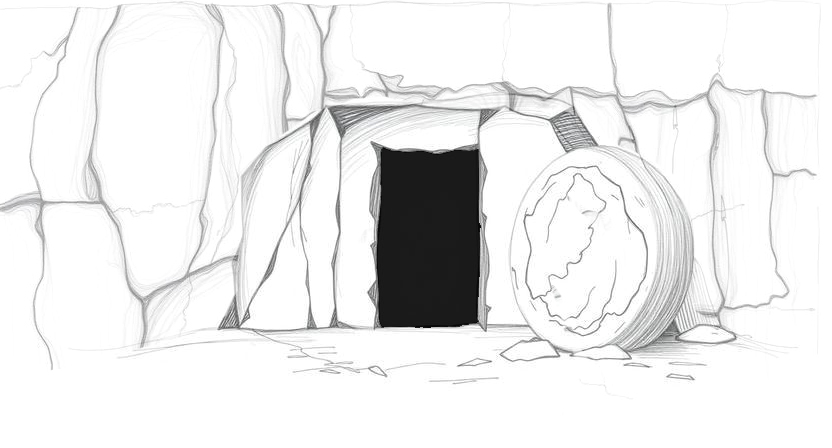
Stone Rolled Away
Gary Eugene Howell uses the Berean Standard Bible. The Holy Bible, Berean Standard Bible, BSB is produced in cooperation with Bible Hub, Discovery Bible, OpenBible.com, and the Berean Bible Translation Committee. The Text of the Berean Standard Bible was dedicated to the public domain as of April 30, 2023.
Verses 1-10
After the Sabbath, at dawn on the first day of the week, Mary Magdalene and the other Mary went to see the tomb. Suddenly there was a great earthquake, for an angel of the Lord descended from heaven, rolled away the stone, and sat on it. His appearance was like lightning, and his clothes were white as snow. The guards trembled in fear of him and became like dead men.
But the angel said to the women, “Do not be afraid, for I know that you are looking for Jesus, who was crucified. He is not here; He has risen, just as He said! Come, see the place where He lay. Then go quickly and tell His disciples, ‘He has risen from the dead and is going ahead of you into Galilee. There you will see Him.’ See, I have told you.”
So they hurried away from the tomb in fear and great joy, and ran to tell His disciples. Suddenly Jesus met them and said, “Greetings!” They came to Him, grasped His feet, and worshiped Him. “Do not be afraid,” said Jesus. “Go and tell My brothers to go to Galilee. There they will see Me.”
Commentary
Jesus is risen!! In the previous chapter, we talked about how Jesus took our sins upon Himself. The scarlet robe represented sin. The crown of thorns represented the curse given to Adam. Jesus’s death on the cross represented the death penalty He paid for our sins. In Christianese jargon, we call it “substitutionary atonement”.
But now, His rising from the dead represents Him having conquered death! This same resurrection from death is what He offers to us as well. We can escape death and instead live for eternity!
Of course, our physical, corrupted bodies will one day cease to function, but those who follow Christ by faith will be instantly transported to heaven and, at some point later, will be given a new physical body made of flesh and bone that is not subject to sin or decay. We will return to this earth with Christ and will be able, if we choose, to sit under the shade of a tree, drink an ice-cold lemonade, and watch the clouds roll by.
The point is that we will be alive!! Not in the form of an angel laying on a cloud and playing a harp for a thousand years. No! We will be alive! We will have avoided death! We will be right back here again on the earth enjoying for eternity everything that God created to be good!
[see 1 Corinthians 15:54-57, 2 Timothy 1:10, Hebrews 2:14–15, John 11:25–26, Philippians 3:20–21, Revelation 21:3, Isaiah 65:17–24, etc…]
The morning of the third day is a good place to discuss what appears to be contradictions in the Bible. Remember, anytime you see something that looks like a contradiction, the error is not in the Gospels but in your own understanding.
In Matthew 28:1–10, it says that Mary and Mary went to the tomb, and the angel was sitting on the stone that had been rolled away. Regarding the same event, the apostle Mark says that Mary and Mary, along with Salome, entered the tomb and encountered the angel seated inside the tomb (see Mark 16:1–8). Luke, meanwhile, states that the women arrived at the tomb, found it empty, were puzzled about what had happened, and suddenly two angels stood beside them (see Luke 24:1–7). Lastly, John states that Mary Magdalene alone found the tomb empty and immediately fled to inform the disciples.
Salvation is by faith, which means we believe that what God has said about Himself is true and trustworthy. Thus, if there were errors and contradictions in the Bible, we would not be able to believe and trust that God’s Word is true.
In these accounts of the empty tomb, let’s first examine how Matthew describes it. Matthew states, “After the Sabbath, at dawn on the first day of the week, Mary Magdalene and the other Mary went to see the tomb. Suddenly there was a great earthquake, for an angel of the Lord descended from heaven, rolled away the stone, and sat on it. His appearance was like lightning, and his clothes were white as snow. The guards trembled in fear of him and became like dead men.”
Meanwhile, Mark states, “When the Sabbath was over, Mary Magdalene, Mary the mother of James, and Salome bought spices so they could go and anoint the body of Jesus. Very early on the first day of the week, just after sunrise, they went to the tomb. They were asking one another, “Who will roll away the stone from the entrance of the tomb?” But when they looked up, they saw that the stone had been rolled away, even though it was extremely large.”
When reading these two accounts side by side, it becomes obvious that the women were not present when the stone was rolled away. The guards were the ones present. The angel sat on top of the stone after rolling it away, and the guards were so afraid they fainted.
The angel then moved from atop the stone and entered the tomb. When the women arrived, they found the stone already rolled away.
The lesson to be learned is that we often make assumptions about what we are reading. Matthew’s account states that the women went to the tomb, and this is immediately followed by the account of the angel descending from heaven and rolling away the stone. Our error is in assuming that the women had already arrived when the stone was being rolled away, but the Scripture doesn’t say that. By rightly dividing the Word of God, we see that in Mark’s account, they arrived to find the stone already rolled away, having not seen the angel descend or sit on the stone.
All that being said, the whole of the four accounts are not so readily harmonized. However, we can assume that none of the four writers intended to record the entire sequence of events. Each selected portions of what happened. Using this approach, the four accounts can be fitted together approximately like this:
• Several women go to the tomb early Sunday morning.
• Mary Magdalene was among them.
• They discovered the stone had been rolled away.
• Mary apparently ran back to tell Peter and John.
• The other women encountered the angels and received the resurrection announcement.
• Peter and John came to the tomb.
• Mary returned and encountered Jesus.
• The women subsequently reported what they had experienced.
Verses 11-15
While the women were on their way, some of the guards went into the city and reported to the chief priests all that had happened. And after the chief priests had met with the elders and formed a plan, they gave the soldiers a large sum of money and instructed them: “You are to say, ‘His disciples came by night and stole Him away while we were asleep.’ If this report reaches the governor, we will satisfy him and keep you out of trouble.” So the guards took the money and did as they were instructed. And this account has been circulated among the Jews to this very day.
Commentary
These verses are incredibly telling. No amount of evidence or proof was ever going to persuade the Pharisees.
Then Abraham said to him, ‘If they do not listen to Moses and the Prophets, they will not be persuaded even if someone rises from the dead.’ (Luke 16:31)
For the three years prior to the resurrection of Jesus Christ, these same Pharisees, elders, and chief priests saw Jesus miraculously heal people, cast out demons, and raise the dead to life, yet they continued insisting that Jesus give them a sign to prove He was who He said He was. Well, they finally got their sign, because today, every single one of them is in hell, able to look up and see the Son of Man sitting at the right hand of Power (see Matthew 26:64).
Understand that today, every time a person demands proof of God, proof that Jesus was raised from the dead, or proof that Jesus ever lived at all, they are often issuing that demand as a kind of “gotcha” statement because they assume we’ll be unable to provide such proof. But know this: even if you could pull from your pocket undeniable proof of both God and Jesus and place it directly into their hand, they would reject it! When a person demands proof, they are not asking you to convince them. They are informing you of the conclusion they’ve already arrived at.
Verses 16-20
Meanwhile, the eleven disciples went to Galilee, to the mountain Jesus had designated. When they saw Him, they worshiped Him, but some doubted.
Then Jesus came to them and said, “All authority in heaven and on earth has been given to Me. Therefore go and make disciples of all nations, baptizing them in the name of the Father and of the Son and of the Holy Spirit, and teaching them to obey all that I have commanded you. And surely I am with you always, even to the end of the age.”
Commentary
I want to focus on Jesus’s statement, “All authority in heaven and on earth has been given to Me.”
Nearly everything in life can be placed on a bell curve, with two opposite extremes and an average in the middle. In the case of church authority, the two opposite extremes are these: at one end of the bell curve are pastors and elders who seek to take Christ’s authority from Him and place it upon themselves as a kind of power trip. At the other extreme are church members who can’t be told what to do. You can’t even ask them to take the garbage from the church and put it into the dumpster. They think that’s someone else’s job.
Regarding pastors and elders on power trips who seek to control and manipulate the lives of their congregants, my advice is simply to find another church. Just put one foot in front of the other, walk out the door, and never return. In America, there’s a church on nearly every street corner.
When you first begin attending a new church, you should be ever watching and ever perceiving, looking to determine whether or not the fruit on their tree is good. This author’s position and attitude is that a church should be considered not good until proven otherwise, and this process can take three to six months of attendance.
But at the other end of our bell curve are congregants who, because of their pride, cannot receive instructions. Here’s a hypothetical example: After a fellowship dinner, the congregation is stacking and putting away chairs. Richard decides to lend a hand. He folds a couple of chairs and then leans them against the wall. The ministry leader, who’s in charge of organizing the fellowship dinners, says to Richard, “Don’t lean the chairs against the wall because they will leave marks on the wall.” Richard is offended at having been corrected.
All authority in heaven and on earth has been given to Jesus. Jesus is the head of the church; the pastor and elders are the heads of the congregation, and the ministry leaders are the heads of their respective ministries.
The ministry leader’s authority to tell Richard where to place the chairs comes from Jesus Christ. When he says, “Don’t lean the chairs against the wall,” it’s the same as if Jesus Himself had told Richard not to do it. But what tends to happen is that people, because of their pride, are easily offended when they’re told what to do. They may even be inclined to leave the church and claim they were hurt by the church. They then use this as an excuse to stop attending any church at all. The reality in our example, however, is that Richard was the problem because he was unwilling to submit to authority.
If you have faith in Christ, then you believe that everything Jesus said is true. You also believe that everything Paul, James, Peter, John, Jude, etc., wrote came from the Holy Spirit through the authority of Jesus Christ and is as valid as if Christ Himself had said it.
All Scripture is God-breathed and is useful for instruction, for conviction, for correction, and for training in righteousness, so that the man of God may be complete, fully equipped for every good work. (2 Timothy 3:16-17)
Therefore, if you volunteer at church and think something should be done a certain way, but the ministry leader tells you they don’t want to use your suggestion, are you going to accept the authority of Jesus Christ, or are you going to stomp your foot, cross your arms, and quit the church like a spoiled brat?
And when it comes to Bible interpretation, it’s reasonable to recognize that all of us today are trying to understand the meaning of what is written in Scripture. It’s perfectly reasonable to debate biblical interpretation. This is one reason why having so many different denominations can be a blessing: it gives you the freedom to fellowship with like-minded Christians.
However, there are many people today, both inside and outside the church, who want to argue and debate the rationale behind certain biblical instructions (not the interpretation, but the validity). The rationale for what God said doesn’t matter. Christ has all authority. If He said it, the underlying reason, logical basis, or explanation for it is irrelevant.
If you have faith in Christ, you will desire to do what He said, even when you don’t understand why you’re doing it. A big part of walking in faith is trusting God. For example, if Jesus Christ told you to go to the Euphrates River and bury a pair of your underwear in the mud (see Jeremiah chapter 13), would you do it because Christ told you to, or would you call a denominational convention to debate and vote on the merits of it?
Everyone who thinks they are wise is a fool. Those who seek a general assembly to vote on the merits of God’s Word are fools and are not operating their lives in faith. Salvation is by faith, yet many people don’t trust God’s Word. They feel the need to gather together men and women who are bound by sin in their flesh in order to vote on whether or not something God said is valid.
We need to look to God’s Word to see how our lives ought to be lived. The Bible has all the answers. All authority over life and death has been given to Jesus. Again, we can debate the interpretation of various passages, but not the authority of God’s Word.