
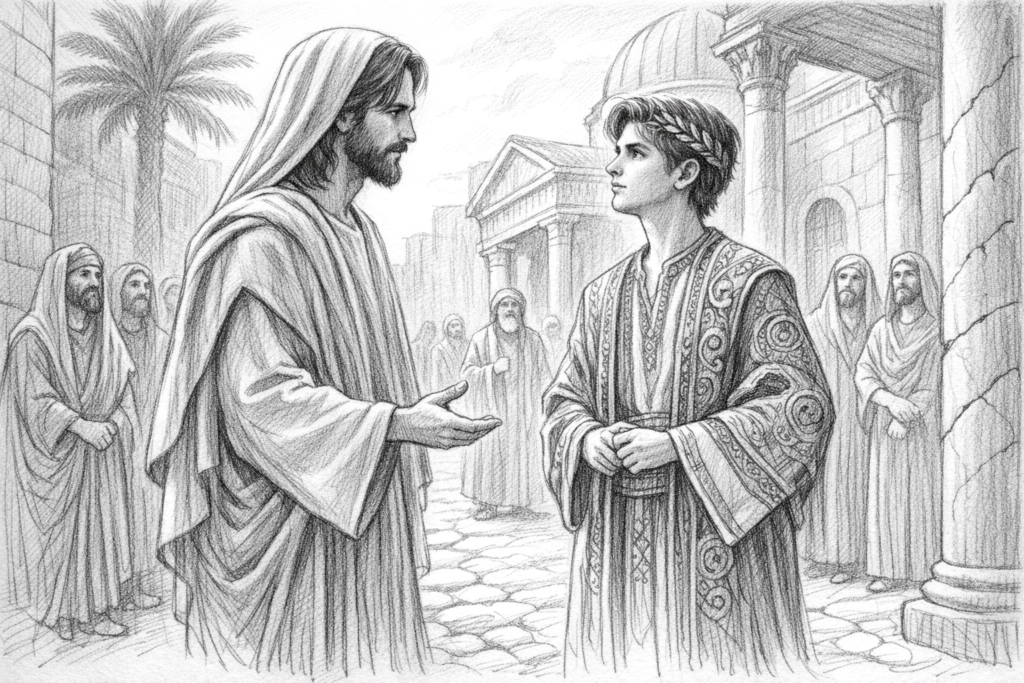
Jesus and The Rich Young Man
Matthew Chapter 19
Gary Eugene Howell uses the Berean Standard Bible. The Holy Bible, Berean Standard Bible, BSB is produced in cooperation with Bible Hub, Discovery Bible, OpenBible.com, and the Berean Bible Translation Committee. The Text of the Berean Standard Bible was dedicated to the public domain as of April 30, 2023.
Verses 1-2
When Jesus had finished saying these things, He left Galilee and went into the region of Judea beyond the Jordan. Large crowds followed Him, and He healed them there.
Commentary
“When Jesus had finished saying these things” refers to the end of the previous chapter. He then left Galilee and went to Judea; this is self-explanatory. However, it’s a long distance. Jesus’s only modes of travel were on foot, by boat, or on one occasion, by donkey. Walking from Galilee to Judea likely took from sunrise to sunset.
The verses state that crowds followed Him. We can assume Jesus probably healed people along the way, but if some individuals followed Him all the way from Galilee to Judea, it shows their desperation and determination to get close to Him. We can spiritualize this by asking ourselves: how determined are we to draw near to Jesus? These people walked from morning ’til evening, yet we may be hesitant to drive fifteen minutes to church on a rainy Sunday.
Verse 3
Then some Pharisees came and tested Him by asking, “Is it lawful for a man to divorce his wife for any reason?”
Commentary
The Pharisees continue to search for any opportunity to accuse Jesus. They search relentlessly, as if their greatest desire is to justify their rejection of the one person who is most clearly the Messiah.
Today is no different. There are individuals who search the Bible to find something (anything) with which they can accuse God, Jesus, or Christians of wrongdoing. When you approach the Bible, it should always be from a position of humility, prayer, and a desire to know God better. That is when God gives you understanding of the Scriptures. Otherwise, God can keep the Bible’s truths hidden from you, even if you read every word.
So the Pharisees ask, “Is it lawful for a man to divorce his wife for any reason?” Again, they are not asking because they want to know the answer; they are looking for a reason to accuse Jesus. This is why the verse says they came to test Him.
Verse 4
Jesus answered, “Have you not read that from the beginning the Creator ‘made them male and female,’
Commentary
Jesus answered, “Have you not read…?” Recall that when Jesus was tempted by Satan in the desert (Matthew 4), on every occasion He responded with the Word of God to rebuttal and rebuke Satan. He is doing the same here with the Pharisees. “Have you not read” is Jesus’s reprimand for their failure to know the Scriptures. The Pharisees are supposed to be experts in the Law, yet they come to Jesus asking questions they should already know the answers to.
We too should know the Word of God well enough to rebuttal and rebuke any false doctrine, deceit or demonic influence. Furthermore, knowing the Word of God well is invaluable, because it contains most of the answers people are searching for.
It is worth noting that when you ask God a question in prayer and hear only silence (that is, when you ask God something and He doesn’t answer), many times it may be because the answer is already in the Bible.
The verse continues, “from the beginning the Creator ‘made them male and female,’” Jesus’s point here is that human beings were designed from the beginning to be couples, however, there are some exceptions which Jesus will speak about in this chapter).
Verses 5-6
and said, ‘For this reason a man will leave his father and mother and be united to his wife, and the two will become one flesh’? So they are no longer two, but one flesh. Therefore what God has joined together, let man not separate.”
Commentary
“For this reason” refers back to them being male and female; having been made to be couples. A man will leave his father and mother, in other words, he’s going to start his own family in the same way that his parents started theirs. He’s going to be united to his wife. So far; very simple concepts.
The two will become one flesh. The question mark at the end of this verse is the conclusion of Jesus asking “Have you not read?”. But what does “the two become one flesh” mean? Some have interpreted this to mean that a married couple is united in purpose, goals and partnership. To this I totally disagree because anyone can be united in purpose and goals. For example, your business partner, your bowling league, your fishing buddy, all can be united in purpose, goals and partnership. Therefore, becoming one flesh must mean something far greater.
Eve was created from Adam’s rib, so she was literally made from Adams own body part.
And the man said: “This is now bone of my bones and flesh of my flesh; she shall be called ‘woman,’ for out of man she was taken.” For this reason a man will leave his father and mother and be united to his wife, and they will become one flesh. (Genesis 2:23-24)
Paul later writes;
The body is not intended for sexual immorality, but for the Lord, and the Lord for the body. By His power God raised the Lord from the dead, and He will raise us also. Do you not know that your bodies are members of Christ? Shall I then take the members of Christ and unite them with a prostitute? Never! Or don’t you know that he who unites himself with a prostitute is one with her in body? For it is said, “The two will become one flesh.” But he who unites himself with the Lord is one with Him in spirit. (1 Corinthians 6:13b-17)
Marriage between a man and a woman represents the marriage between Christ and the church. See the following verses: Ephesians 5:25–27; Revelation 19:7–9; Revelation 21:2; Revelation 21:9; 2 Corinthians 11:2; Matthew 9:15; Matthew 22:1–14; Matthew 25:1–13; Hosea 2:19–20; Isaiah 62:5.
Therefore, anyone who divorces their spouse represents the church divorcing Christ. Likewise, anyone who cheats on their spouse represents the church cheating on Jesus; and that’s not a good look, to say the least.
This comparison of being united in marriage as being like our union with Christ is continued by Paul in the book of Ephesians. Paul writes:
Pay careful attention, then, to how you walk, not as unwise but as wise, redeeming the time, because the days are evil. Therefore do not be foolish, but understand what the Lord’s will is. Do not get drunk on wine, which leads to reckless indiscretion. Instead, be filled with the Spirit.
Speak to one another with psalms, hymns, and spiritual songs. Sing and make music in your hearts to the Lord, always giving thanks to God the Father for everything in the name of our Lord Jesus Christ. Submit to one another out of reverence for Christ.
Wives, submit to your husbands as to the Lord. For the husband is the head of the wife as Christ is the head of the church, His body, of which He is the Savior. Now as the church submits to Christ, so also wives should submit to their husbands in everything.
Husbands, love your wives, just as Christ loved the church and gave Himself up for her to sanctify her, cleansing her by the washing with water through the word, and to present her to Himself as a glorious church, without stain or wrinkle or any such blemish, but holy and blameless.
In the same way, husbands ought to love their wives as their own bodies. He who loves his wife loves himself. Indeed, no one ever hated his own body, but he nourishes and cherishes it, just as Christ does the church. For we are members of His body.
“For this reason a man will leave his father and mother and be united to his wife, and the two will become one flesh.” This mystery is profound, but I am speaking about Christ and the church. Nevertheless, each one of you also must love his wife as he loves himself, and the wife must respect her husband. (Ephesians 5:15-33)
In these verses we see that the church submits to Jesus Christ and that Christ loves the church. He loved the church so much that He was willing to die in our place. By dying on the cross, Jesus sanctified the church so that we, the church, might be presented to Him without blemish.
All of this is represented in marriage. From the very first human beings, God intended marriage to represent what He would one day do for the church, for those who put their faith in Him. But verses 31 and 32 contain the essence of what we are looking for at this moment.
“For this reason a man will leave his father and mother and be united to his wife, and the two will become one flesh.” This mystery is profound, but I am speaking about Christ and the church.” (Ephesians 5:31-32)
When we put our faith in Jesus Christ, the Holy Spirit comes to abide within us. Thus, we, the church, are one with Christ, in that the Holy Spirit lives within us. Marriage represents this relationship between Christ and the church. In this way, the two becoming one flesh represents the marriage between Christ and the church: the two becoming one, Christ dying for us to make us pure, and we being filled with the Holy Spirit to become one with Him.
Therefore, any deviation from what God intended marriage to be, represents a departure from (a rejection of), what Christ has done for the church. Thus, sex before marriage, cohabitation without marriage, casual hookups, wedding ceremonies that exclude God, viewing marriage as merely a legal contract, prenuptial agreements, adultery, pornography, open marriages, gay marriage, gender fluidity and non-binary concepts of marriage, divorce, and no-fault divorce laws all represent departures from what God intended marriage to signify. As such, they reflect a rejection of what Christ did to redeem us.
This is why marriage should be taken very seriously, beginning with who you choose to marry. As Jesus stated, “What God has joined together, let man not separate.”
Verses 7-9
“Why then,” they asked, “did Moses order a man to give his wife a certificate of divorce and send her away?”
Jesus replied, “Moses permitted you to divorce your wives because of your hardness of heart. But it was not this way from the beginning. Now I tell you that whoever divorces his wife, except for sexual immorality, and marries another woman commits adultery.”
Commentary
Moses allowed divorce because of the Israelites’ hard hearts. Today, anyone who initiates a divorce, does so either because of their own hard heart or their spouse’s infidelity.
If your spouse cheats on you, you may divorce. Otherwise, it is better to work out your problems.
There are some people who incorrectly believe that if their spouse divorces them, they must spend the rest of their life alone and lonely. But let’s look at what it says in 1st Corinthians,
if the unbeliever leaves, let him go. The believing brother or sister is not bound in such cases. (1 Corinthians 7:15)
Verses 10-11
His disciples said to Him, “If this is the case between a man and his wife, it is better not to marry.” “Not everyone can accept this word,” He replied, “but only those to whom it has been given.
Commentary
Notice that Jesus is agreeing with them. Yes, it is better for a person not to marry; however, Jesus says that this applies only to those to whom it has been given not to marry. If you have any desire at all to be in a romantic relationship, to date, fall in love and someday marry, you are not among those to whom lifelong singleness has been given.
But why did Jesus say this? Why is it better not to marry?
The unmarried man is concerned about the work of the Lord, how he can please the Lord. But the married man is concerned about the affairs of this world, how he can please his wife, and his interests are divided. The unmarried woman or virgin is concerned about the work of the Lord, how she can be holy in both body and spirit. But the married woman is concerned about the affairs of this world, how she can please her husband. (1 Corinthians 7:32b-34)
Verse 12
For there are eunuchs who were born that way; others were made that way by men; and still others live like eunuchs for the sake of the kingdom of heaven. The one who can accept this should accept it.”
Commentary
Jesus is describing those to whom it has been given to remain single. The one who is able to accept singleness should accept it. But again, if you have any desire at all not to be single, you are not among those to whom singleness has been given.
Verses 13-15
Then little children were brought to Jesus for Him to place His hands on them and pray for them. And the disciples rebuked those who brought them. But Jesus said, “Let the little children come to Me, and do not hinder them! For the kingdom of heaven belongs to such as these.” And after He had placed His hands on them, He went on from there.
Commentary
The disciples viewed their activities with Jesus as “adult” matters and wanted to send the children away. This, despite Jesus having said to them earlier, “Whoever welcomes a little child like this in My name welcomes Me” (Matthew 18:5). Jesus then takes this opportunity to tell those around Him that “the kingdom of heaven belongs to such as these.”
Verses 16-22
Just then a man came up to Jesus and inquired, “Teacher, what good thing must I do to obtain eternal life?”
“Why do you ask Me about what is good?” Jesus replied. “There is only One who is good. If you want to enter life, keep the commandments.”
“Which ones?” the man asked.
Jesus answered, “‘Do not murder, do not commit adultery, do not steal, do not bear false witness, honor your father and mother, and love your neighbor as yourself.’”
“All these I have kept,” said the young man. “What do I still lack?”
Jesus told him, “If you want to be perfect, go, sell your possessions and give to the poor, and you will have treasure in heaven. Then come, follow Me.” When the young man heard this, he went away in sorrow, because he had great wealth.
Commentary
A man came up to Jesus and asked, “Teacher, what good thing must I do to obtain eternal life?” The question itself reveals a faulty assumption: that entrance into heaven can be earned through good deeds. This is an error.
Two thousand years later, not much has changed. Most people, when asked how a person gets into heaven, will respond, “By being a good person.”
Jesus is setting up this conversation to reveal the rich young man’s shortcoming and to give him the true answer regarding the path to eternal life.
“Why do you ask Me about what is good?” Jesus replied. “There is only One who is good…”
Jesus is giving a big hint. By saying, “There is only One who is good,” He’s revealing that this rich young man is not that one. Jesus is showing him that he doesn’t have within himself what it takes to obtain eternal life; because he’s not a good person. None of us are.
Jesus says, “If you want to enter life, keep the commandments.” Jesus knows this is an incomplete answer, but He’s steering the conversation.
“Which ones?” the man asked. He’s still thinking he can become righteous enough to walk himself into the kingdom of heaven.
Jesus proceeds to list a few of the Ten Commandments. “All these I have kept,” said the young man. “What do I still lack?”
(Set-up complete. Now for the slam dunk.)
Jesus then says to him, “If you want to be perfect, go, sell your possessions and give to the poor, and you will have treasure in heaven. Then come, follow Me.”
Now let’s examine carefully what Jesus just said. “If you want to be perfect”; in other words, Jesus is stating that to get into heaven one must be perfect. That’s a very high bar, which no one can reach on their own. What makes us perfect in God’s eyes? Jesus!
“Sell your possessions and give to the poor, and you will have treasure in heaven.” Remember the parable of the Sower in Matthew 13? This young man’s seed fell among the thorns, and the deceitfulness of wealth choked the word, making it unfruitful. Jesus wants this rich young man to shake off the thing that hinders him: his wealth. When we put our trust in money rather than Jesus, we have been deceived.
Notice that giving to the poor doesn’t earn this man his salvation; it only gives him treasures in heaven. (Again, treasures in heaven are the eternal friendships we will have with those we helped lead to Christ. A person can use their worldly wealth to acquire material possessions that are ultimately auctioned off to others when he dies, or he can use his wealth to fund and spread the gospel so that many people come to know Jesus as their Savior and are saved. Once in heaven, those same people will have eternal relationships (eternal friendships) with the one who helped lead them to Christ. Friendships are a valuable treasure.
Jesus then concludes his statement: “Then come, follow Me.” Following Jesus is the key to our entrance into heaven.
Jesus answered, “I am the way and the truth and the life. No one comes to the Father except through Me. (John 14:6)
Jesus recognizes that this rich young man places his trust in his money rather than in God. That’s why Jesus challenges him to sell everything and give it to the poor.
In the United States, most people rely on their money rather than on Jesus. Here’s an example: You have $1,000 in your checking account. You’re driving in your car and find yourself getting hungry. You know that at the next intersection is your favorite takeout restaurant. What do you do? Perhaps without giving it any thought, you pull into the restaurant, walk in, place an order for carry-out, receive your food, get back in the car and continue on your journey home; never once pausing to give thanks, or acknowledgement to how God provides for you. That is an example of relying on your money rather than on God. Simply paying for the things you need without giving it any thought demonstrates your reliance on your money instead of recognizing God’s provision.
Oh, and by the way, if you live and work in the United States, I can almost guarantee that you have more wealth than the rich young ruler had in these Bible verses we’re examining.
Is it necessary that each of us sell all our possessions? Again, salvation is not earned. We don’t get into heaven by having possessions, nor do we get into heaven by selling them. While I would encourage you to have a minimalist attitude toward material possessions, the point is not that you have no possessions. Rather, the point is your attitude toward your money and possessions. Do not be deceived by wealth. Do not put your trust and reliance in your bank accounts and investments. Get rid of the things in your life that prevent you from following Jesus. Get rid of the things in your life that distract you from Him.
I once met a rich man who said Christianity was a crutch. He believed that his wealth negated his need for Jesus. But that attitude will only get him about 80 years down the road, at which point he will discover that the bridge is out and his money cannot build it back.
When the young man heard Jesus’s instruction to sell his possessions and follow Him, he went away in sorrow, because he had great wealth.
Every sermon I’ve ever heard about this rich young man assumed that when he went away sorrowful, he was rejecting Jesus’s instruction. I completely disagree. Each time a pastor concludes that he chose his wealth over Jesus, I have to shake my head. Here’s why:
All throughout the Bible, there are individuals who received instructions from God that they didn’t like and didn’t want to do.
Moses didn’t want the job of freeing the Jewish people from slavery in Egypt and begged God to send someone else.
Jonah flat out refused God’s instruction to go to Nineveh.
Jeremiah didn’t want the calling God gave him.
Ananias didn’t want to go visit Paul as God had instructed.
Peter; when he said “Surely not, Lord! I have never eaten anything impure or unclean.” was objecting to God’s instructions.
And Jesus Himself, asked that the cup might pass from him.
Notice that the rich young ruler didn’t go away indignant. He didn’t go away in protest. He didn’t go away angry. He went away in sorrow. What made him sorrowful? He was picturing in his mind how uncomfortable and difficult it would be to sell all his possessions and give to the poor. He was fully aware that what he was being asked to do would require a very great sacrifice.
This is the case with us today as well. Not everything Jesus tells us to do will be convenient and comfortable. Not everything He asks of us will be received with joy. Sometimes we find ourselves saying, “Wait a minute Lord,… You want me to do what!?”
God’s will for our lives is not always going to be joyous and easy. Many times He will ask us to do things that require us to trust Him with our very lives. Sometimes the things Jesus asks us to do will make us feel apprehensive, discouraged, and at times, even afraid.
Then Jesus told His disciples, “If anyone wants to come after Me, he must deny himself and take up his cross and follow Me. For whoever wants to save his life will lose it, but whoever loses his life for My sake will find it. (Matthew 16:24-25)
There will be times in your Christian walk when following Jesus is uncomfortable, painful, and, in some cases, even dangerous. But even in our sadness, discouragement, or fear, we are called to walk in faith and obey regardless. This, I believe, is what the rich young ruler did. The fact that he was sorrowful about giving up his possessions shows that he understood the magnitude of the sacrifice required to follow Jesus. I believe he went away and did exactly what Jesus commanded.
Verses 23-24
Then Jesus said to His disciples, “Truly I tell you, it is hard for a rich man to enter the kingdom of heaven. Again I tell you, it is easier for a camel to pass through the eye of a needle than for a rich man to enter the kingdom of God.”
Commentary
At first glance, this appears to be a contradiction. Jesus says it’s hard for a rich man to enter heaven, then immediately says it’s impossible. “Hard” means difficult, whereas “impossible” means it can’t be done; a camel cannot pass through the eye of a needle.
[Side note: This author holds that there is no historical or archaeological evidence for a small gate in Jerusalem during the time of Jesus Christ called “the eye of the needle.”]
However, I don’t think Jesus is making a contradiction with these two statements. Rather, I think he’s escalating the emphasis. When he says “again I tell you,” he is repeating himself for emphasis. Jesus is saying that it’s easier for a camel to pass through a sewing needle than for a rich man to enter heaven; that it’s totally impossible for a rich man to enter heaven on his own.
But what does this impossibility mean? It’s not suggesting that your bank balance determines your eternal destiny, as though $1,000 will condemn you but $999 is acceptable. What Jesus is saying is that it is impossible for a rich person’s money to purchase entrance into heaven. There is no ticket to buy. As Curtis Mayfield sang in 1965, “You don’t need no ticket, you just thank the Lord.”
A person is only saved through faith in Jesus Christ. You cannot put your reliance, trust, or faith in your money; something wealthy people are prone to do.
And let me also say: if you make $38,000 a year or more, you are one of the richest people in the world. Most Americans define wealth as being in the millions or billions of dollars. But the type of “rich” that Jesus is talking about requires us Americans to compare ourselves to the other 8 billion people in the world. 50% of the human population earns less than $10,000 per year.
When you and I have plenty of money in our bank accounts, it’s very easy to spend less time thinking about God because we rely on our money rather than on Him. Make a habit of giving thanks for everything you purchase and/or sell.
In a previous commentary, I told the story of nearly running out of gas on a 14-mile stretch of highway. When I realized the gas gauge was below “E,” I prayed the whole way that God would prevent me from running out of gas. But on all other occasions when I’ve driven the same stretch of road with plenty of gas in the tank, I didn’t give a single thought to God’s provision. This is an example of relying upon money.
Make the habit of relying solely upon Jesus and not upon your money. When you have financial abundance and all your bills are paid, give thanks to God.
Verses 25-26
When the disciples heard this, they were greatly astonished and asked, “Who then can be saved?” Jesus looked at them and said, “With man this is impossible, but with God all things are possible.”
Commentary
This verse is pivotal to the entirety of Christianity. For man (i.e. for people), it is absolutely impossible for you to save yourself. There is no amount of good deeds that can bring about your salvation. I want to emphasize that again in all capital letters: IMPOSSIBLE. There is no way to enter the kingdom of heaven merely by being a good person. Salvation is not earned through good deeds or right living.
There are many Christians who think that attending church every Sunday or participating in a Bible study makes God like them more than those who don’t do these activities. Others assume that by volunteering, helping the needy, feeding the poor, or caring for the elderly, they are earning God’s favor. That is a false doctrine, because God’s favor cannot be earned. Jesus tells us plainly, it is impossible.
How, then, do you enter the kingdom of heaven? Only with God is it possible. God alone opens the pathway into heaven, and that pathway is His Son, Jesus Christ, who died on the cross for the remission of your sins. He is the One in whom you must place your faith.
Everything else we do as Christians flows out of our love for Jesus Christ and our desire for others to follow Him as well. Growing closer to God is not the same as earning more of God’s love. Rather, after putting our faith in Christ, we go to church, read the Bible, pray, attend Bible studies, and fellowship with other believers because we desire a deeper understanding of God’s will for our lives. From there, we love and serve our neighbors so that they, too, may come to know Christ.
Verses 27-29
“Look,” Peter replied, “we have left everything to follow You. What then will there be for us?”
Jesus said to them, “Truly I tell you, in the renewal of all things, when the Son of Man sits on His glorious throne, you who have followed Me will also sit on twelve thrones, judging the twelve tribes of Israel. And everyone who has left houses or brothers or sisters or father or mother or wife or children or fields for the sake of My name will receive a hundredfold and will inherit eternal life.
Commentary
This is an end-times prophecy. At that time, the disciples; Peter, Andrew, James, John, Philip, Bartholomew, Thomas, Matthew, James the son of Alphaeus, Thaddaeus, and Simon the Zealot; will sit as judges over the twelve tribes of Israel.
Everyone who has made sacrifices in order to follow Jesus will receive back a hundredfold what they gave up, as well as eternal life.
Verse 30
But many who are first will be last, and the last will be first.
Commentary
Matthew 19:30, Matthew 20:16, Mark 10:31 and Luke 13:30 all mention the last being first and the first being last.
The sentence here in verse 30 is only 14 words. It’s something that is easy to breeze by with hardly a notice, yet it’s one of the most troubling verses in the entire Bible.
You and I have only our physical senses by which we draw conclusions about the people around us. We can hear what they say and see what they do, but that is more or less the extent of our ability to discern a person’s sincerity. God, on the other hand, can see into the human heart. When Jesus says, “many who are first will be last,” He is referring to the reversal of expectations we will experience.
When our lives have ended and we stand before God, we are going to be shocked to see who is being turned away from entering heaven. There will be many pastors, elders, deacons, Sunday school teachers, Bible study leaders, mentors, missionaries, disciplers, counselors, worship leaders, church planters, church administrators, and those who faithfully tithed who are turned away from heaven and sent to hell. In this world, they appeared as though they would be the first to enter heaven, but Jesus is saying they’re the last. On the outside, they appeared to be “super-duper” Christians, but they never actually put their faith in Jesus Christ.
That is by no means a condemnation of all church leaders everywhere. Jesus specifically used the word “many,” not the word “all.”
Jesus then says, “and the last will be first.” At the same time that we are seeing those we expected to be first being turned away from heaven, we will also see people who were repeat DUI offenders, people who were strung out on fentanyl or meth, prostitutes, men who were hooked on pornography, people who were deep in gambling debt, fraudsters who ran phone and internet scams, identity thieves, shoplifters, cartel members, people with violent records, domestic abusers, deadbeat dads, those who had rage issues, internet trolls, corrupt politicians, and those who scammed the elderly out of their retirement money strolling into heaven and into the presence of Jesus Christ to receive eternal life.
“What??? Why??? That doesn’t make any sense!!!”
The Bible says:
Do you not know that the wicked will not inherit the kingdom of God? Do not be deceived: Neither the sexually immoral, nor idolaters, nor adulterers, nor men who submit to or perform homosexual acts, nor thieves, nor the greedy, nor drunkards, nor verbal abusers, nor swindlers, will inherit the kingdom of God. (1 Corinthians 6:9-10)
But that same verse continues: And that is what some of you were. But you were washed, you were sanctified, you were justified, in the name of the Lord Jesus Christ and by the Spirit of our God. (1 Corinthians 6:11)
The point Jesus is making here in Matthew 19:30 is that salvation is not by works. Good works don’t get us into heaven, and bad works don’t keep us out of heaven. It is by faith through grace that we can enter into eternal life.
But let me clarify to the reader that one cannot claim to have faith while living a life of violent crime, drug use, and gambling. One cannot claim to be a follower of Christ while walking in sin (those are the first who will be last). Rather, it is to say that the drug cartel member who is shot in Juárez, Mexico, while trying to steal drug money from a rival cartel, lying in the street and dying, looks up to the sky and, with a sincere heart, says, “Jesus, save me.” That person will be ushered into the kingdom of heaven.
Meanwhile, there is a grandma who bakes apple pies for her grandchildren. She takes them to church every Sunday, and she herself hasn’t missed a Sunday service in over twenty years. When she passes away at age 90, she arrives at the gates of heaven and is told to stand aside while the drug cartel gang member is ushered into eternal life. She, on the other hand, is told, “I never knew you; depart from me,” and is sent into hell.
All this happens because one had sincere faith (even if it wasn’t until he lay dying from a gunshot wound). The other, though she appeared righteous on the outside, always considered herself a good person and thought that her own good deeds and good living would be enough to earn her place in heaven. She was wrong. She never put her faith in Jesus. Instead, she put her faith in herself.
Many who are first will be last, and the last will be first.