
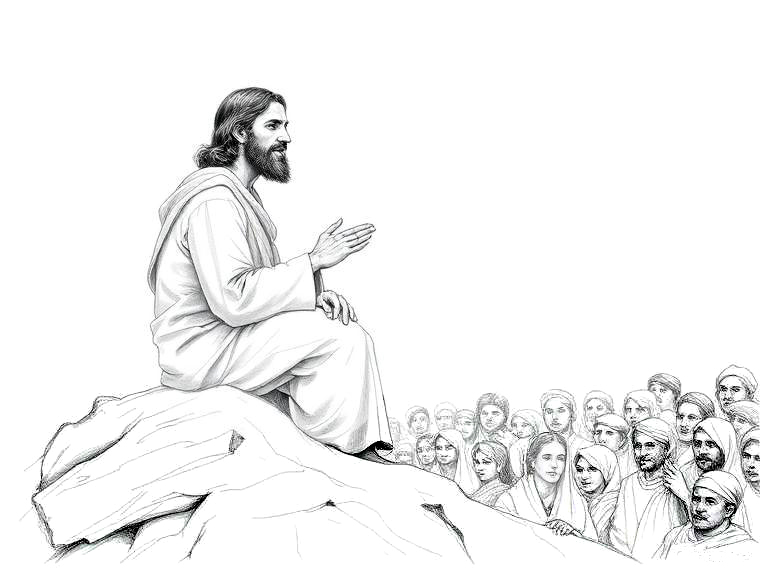
Sermon on the Mount
Gary Eugene Howell uses the Berean Standard Bible. The Holy Bible, Berean Standard Bible, BSB is produced in cooperation with Bible Hub, Discovery Bible, OpenBible.com, and the Berean Bible Translation Committee. The Text of the Berean Standard Bible was dedicated to the public domain as of April 30, 2023.
Verses 1-2
When Jesus saw the crowds, He went up on the mountain and sat down. His disciples came to Him, and He began to teach them, saying:
Commentary:
Verse one states that when Jesus saw the crowds…. Well, where did all these people come from? And why are they there? Remember, When Jesus started healing people, word about him spread fast. People were coming from all over Israel, hoping that Jesus might heal them or one of their family members. They all wanted Jesus to do something for them.
I can not speak to the status of medical practices during the time of Jesus, but I’m willing to assume that even the simplest of medical issues, probably went untreated 2,000 years ago. When word began to spread that a man could heal individuals of their ailments, that news brought out thousands of people.
Jesus begins to teach them saying:
Verse 3
Blessed are the poor in Spirit, for theirs is the kingdom of heaven.
Commentary:
This is referring to those who are humble. It’s not referring to people who are financially disadvantaged. Matthew chapter 23 states that:
Whoever exalts himself will be humbled, and whoever humbles himself will be exalted. (Matthew 23:12)
Faith begins with humility. Salvation is a gift to those who have faith. Thus, what Jesus means by saying those “poor in spirit” is, blessed are the humble for theirs is the kingdom of heaven.
Verse 4
Blessed are those who mourn, for they will be comforted.
Commentary:
This is speaking of repentance. Those who mourn over their sins and sinful behavior will be forgiven and in being forgiven will thus be comforted.
Verse 5
Blessed are the meek, for they will inherit the earth.
Commentary:
I believe this to be an end times prophecy. Meekness is like that of humbleness. God exalts those who are humble and meek, yet humbles the proud and those who exalt themselves.
So, when Jesus says the Meek will inherit the earth. He’s talking about those who will enter into the Millennial reign of Christ. They will inherit the earth because they’ll be the only ones remaining on earth after Christ returns and his wrath kills everyone else. (see Revelation 19) The meek will then have the whole earth to themselves.
Verse 6
Blessed are those who hunger and thirst for righteousness, for they will be filled.
Commentary:
Today, via the internet, we can watch many videos in which people such as Frank Turek, Jeff Durbin, or Cliffe Knechtle (pronounced “Connect Lee”) go out on the streets or to college campuses and debate people about Christianity. On some occasions, by the nature of the questions people ask, it is apparent that they are not searching. It seems that some people don’t actually want to know about God and His character. Instead, they simply want to be antagonistic. They ask questions because they want to argue or try to shut down their opponent.
But the person who is seeking God, the person who hungers and thirsts for righteousness, asks questions because they genuinely want to know the answer. They are seeking to understand God.
The end of verse six says, “for they will be filled.” Filled with what? The Holy Spirit.
Jesus Christ and the infilling of the Holy Spirit is what makes a person righteous in God’s sight. We, in and of our own selves can not achieve righteousness. We don’t get extra credit points for helping a turtle cross the road or performing other good deeds. Our righteousness is bestowed upon us because of Jesus’s righteousness. When we put our faith in Christ, and in so doing, receive the Holy Spirit, we put on the righteousness of Christ.
Verse 7
Blessed are the merciful, for they will be shown mercy.
Commentary:
This is very much a lesson in sowing and reaping. By giving mercy, we will be given mercy.
Verse 8
Blessed are the pure in heart, for they will see God.
Commentary:
The implication herein is that if one’s heart is not pure; they will not see God. In Matthew chapter fifteen Jesus states,
“For out of the heart come evil thoughts, murder, adultery, sexual immorality, theft, false testimony, and slander. These are what defile a man…” (Matthew 15:19-20a)
When we have a relationship with Jesus Christ, our desire for sin fades and what comes out of our hearts is less evil than it previously was. Instead, our desires begin to align with God’s will for our lives.
Verse 9
Blessed are the peacemakers, for they will be called sons of God.
Commentary:
When we talk about peacemakers, English language speakers might immediately think of someone who prevents war. “Peace in our time” was a declaration by British Prime Minister Neville Chamberlain when he foolishly believed that he himself had prevented World War II, after his meeting with Adolf Hitler.
But I strongly doubt that the absence of war is the proper interpretation here because of what Jesus said in Matthew chapter ten.
Do not assume that I have come to bring peace to the earth; I have not come to bring peace, but a sword. (Matthew 10:34)
However, when a person is filled with the Holy Spirit, they experience internal peace, even in the midst of war. So then who are the peacemakers? They would be those who bring the good news of the gospel.
How beautiful on the mountains are the feet of those who bring good news, who proclaim peace, who bring good tidings, who proclaim salvation, who say to Zion, “Your God reigns!”
Listen! Your watchmen lift up their voices, together they shout for joy. For every eye will see when the LORD returns to Zion. (Isaiah 52:7-8)
Verses 10-12
Blessed are those who are persecuted because of righteousness, for theirs is the kingdom of heaven. Blessed are you when people insult you, persecute you, and falsely say all kinds of evil against you because of Me. Rejoice and be glad, because great is your reward in heaven; for in the same way they persecuted the prophets before you.
Commentary:
Here in the United States, for the most part, we have freedom of religion, but don’t assume that by being a Christian, everything in life will go your way. As a Christian believer who tells other people about the good news of Jesus Christ, you will have people who insult you or falsely say evil things about you.
But we can’t be shy about the gospel or the name of the one who has given us eternal life. Paul writes in Romans chapter one,
“I am not ashamed of the gospel, because it is the power of God for salvation to everyone who believes, first to the Jew, then to the Greek.” (Romans 1:16)
There are, however, cultural norms in America, that if you violate those norms, it doesn’t matter whether you’re talking about Jesus or the weather outside, you’ll always get a negative response from people.
In America, we were raised not to talk to strangers. So you can’t just march up to a total stranger and scream “Hey!! You!! I want to tell you about Jesus!” They’re probably going to call the police.
However, if two strangers share a common circumstance, such as both of you are standing in the same line at the grocery store, or both of you are walking your dogs on the same street, then it is within cultural norms to say hello and start a conversation regarding the circumstance you both have in common, and then it’s possible to steer that conversation into the topic of faith.
Blessed is the person who is not ashamed of Jesus Christ.
Verses 13-16
You are the salt of the earth. But if the salt loses its savor, how can it be made salty again? It is no longer good for anything, except to be thrown out and trampled by men.
You are the light of the world. A city on a hill cannot be hidden. Neither do people light a lamp and put it under a basket. Instead, they set it on a stand, and it gives light to everyone in the house. In the same way, let your light shine before men, that they may see your good deeds and glorify your Father in heaven.
Commentary:
These are interesting verses because they speak of someone losing their saltiness (the NIV & ESV use the word saltiness). When reading verse thirteen, some people have attempted to assign application to the modern Christian. But they struggle because they know the Holy Spirit can not be lost, so they hem and haw about what this verse could mean but end up explaining something that’s convoluted and makes little sense.
Remember the context of what’s happening. The first word in verse thirteen is “You”. Who is Jesus speaking to? A big crowd of people during his sermon on the mount. These are Jewish, Israelites. They are God’s chosen people who were supposed to present the true and living God to the whole world. But they lost their saltiness because of unbelief. Paul writes in Romans chapter eleven,
“…because of their trespass, salvation has come to the Gentiles to make Israel jealous.” (Romans 11:11b)
Now if some branches have been broken off, and you, a wild olive shoot, have been grafted in among the others to share in the nourishment of the olive root, do not boast over those branches. If you do, remember this: You do not support the root, but the root supports you.
You will say then, “Branches were broken off so that I could be grafted in.” That is correct: They were broken off because of unbelief, but you stand by faith. Do not be arrogant, but be afraid. For if God did not spare the natural branches, He will certainly not spare you either.
Take notice, therefore, of the kindness and severity of God: severity to those who fell, but kindness to you, if you continue in His kindness. Otherwise you also will be cut off. And if they do not persist in unbelief, they will be grafted in, for God is able to graft them in again. For if you were cut from a wild olive tree, and contrary to nature were grafted into one that is cultivated, how much more readily will these, the natural branches, be grafted into their own olive tree! (Romans 11:17-24)
Because of unbelief, the Jewish people lost their saltiness. Losing one’s saltiness is in no way applicable to today’s spirit filled Christ follower who walks in faith. One can not lose the Holy Spirit. The verse is specifically talking about those Jewish people. From the day they walked out of Egypt, they operated their lives in unbelief and thus lost the saltiness they were supposed to have.
Salvation then, has been given to the gentiles who put their faith in Jesus Christ. They now are the salt of the earth and the light of the world, but Christians today can not lose their saltiness as the Israelites did because the Holy Spirit has now been poured out and one can not lose the Holy Spirit once acquired.
(I know that some people reading this are screaming Hebrews 6:4-6. Bear with me, we will get to the book of Hebrews).
While losing one’s saltiness is not applicable to us today, what is applicable is that salvation has come to the gentiles, making us now the salt of the earth and the light of the world.
There is a football stadium just three and a half miles from my home. When they hold a football game there, the stadium lights are so bright at night that they light up the clouds which pass over the stadium. Those illuminated clouds in turn, light up the whole town. If I’m outdoors on a game night walking my dog, I find myself checking my watch and wondering why it’s so bright out at this time of night. That’s when I look up and see the glow of the stadium and the clouds reflecting the stadium’s lights.
This is how Jesus wants us to be. We live in a world filled with darkness where people stumble and fall in the dark. Jesus wants you to be a light that illuminates your whole town and points people to Jesus.
Verses 17-20
Do not think that I have come to abolish the Law or the Prophets. I have not come to abolish them, but to fulfill them. For I tell you truly, until heaven and earth pass away, not a single jot, not a stroke of a pen, will disappear from the Law until everything is accomplished.
So then, whoever breaks one of the least of these commandments and teaches others to do likewise will be called least in the kingdom of heaven; but whoever practices and teaches them will be called great in the kingdom of heaven. For I tell you that unless your righteousness exceeds that of the scribes and Pharisees, you will never enter the kingdom of heaven.
Commentary:
There is a phrase I often use called “Rightly dividing the word of Truth”. It comes from the King James Version and is found in 2 Timothy 2:15. The reason I like this specific rendering of that verse is due to its imagery. The use of the word dividing, brings to my mind the image of a bible with many slips of paper sticking out of its pages marking where its owner has identified verses which he can now easily flip back and forth to.
He uses the Bible to interpret the Bible. This is an important concept that some people miss; and in missing it, they err in their understanding of certain Bible passages.
Verses seventeen and eighteen of Matthew chapter five are verses where this error of not using the Bible to interpret the Bible, (not rightly dividing the word of truth), often occurs.
If one reads verses seventeen and eighteen as a standalone statement, one may inevitably conclude that we are still under the law and that the law will be in effect as long as the earth exists. I have met many Christians who cling to that interpretation (and yet they do not follow the law). But when we read the entirety of the New Testament, it is without question that the resurrection of Jesus Christ and the outpouring of the Holy Spirit brought about a New Covenant.
Here are just three examples,
By speaking of a new covenant, He has made the first one obsolete; and what is obsolete and aging will soon disappear. (Hebrews 8:13)
And He has qualified us as ministers of a new covenant, not of the letter but of the Spirit; for the letter kills, but the Spirit gives life. (2 Corinthians 3:6)
Brothers, let me put this in human terms. Even a human covenant, once it is ratified, cannot be canceled or amended. The promises were spoken to Abraham and to his seed. The Scripture does not say, “and to seeds,” meaning many, but “and to your seed,” meaning One, who is Christ.
What I mean is this: The law that came 430 years later does not revoke the covenant previously established by God, so as to nullify the promise. For if the inheritance depends on the law, then it no longer depends on a promise; but God freely granted it to Abraham through a promise.
Why then was the law given? It was added because of transgressions, until the arrival of the seed to whom the promise referred. It was administered through angels by a mediator. A mediator is unnecessary, however, for only one party; but God is one.
Is the law, then, opposed to the promises of God? Certainly not! For if a law had been given that could impart life, then righteousness would certainly have come from the law. But the Scripture pronounces all things confined by sin, so that by faith in Jesus Christ the promise might be given to those who believe.
Before this faith came, we were held in custody under the law, locked up until faith should be revealed. So the law became our guardian to lead us to Christ, that we might be justified by faith. Now that faith has come, we are no longer under a guardian. (Galatians 3:15-25)
All of that was to say, without a doubt, that we are no longer under the law. Okay then, so what does Jesus mean when he says “Do not think that I have come to abolish the Law or the Prophets?
First of all, the phrase “the law and the prophets” refers to the sum total of the Old Testament, not merely the law of Moses. Recall from the book of Luke when Jesus, after his resurrection, was walking on a road with two disciples.
“And beginning with Moses and all the Prophets, He explained to them what was written in all the Scriptures about Himself.” (Luke 24:27)
The Mosaic law consists of ceremonial and ritual practices of sacrifices, dietary laws, clean and unclean regulations, festivals, and priestly rules. Under the New Covenant in Christ, these ceremonial laws are fulfilled in Him.
Everything that Jesus is saying here in Matthew 5, is a rebuke of the Pharisees and a rebuttal to their accusation that he is a law breaker. The Pharisees repeatedly accused Jesus of violating the law. Jesus says that he has come to fulfill the law, which is exactly what he is going to do on the cross. Jesus goes on to rebuttal the Pharisees by leveling at them an accusation of his own. He says, “whoever breaks one of the least of these commandments and teaches others to do likewise will be called least in the kingdom of heaven.”
This is exactly what the Pharisees have been doing. In Matthew chapter fifteen, when speaking to the Pharisees Jesus replied,
“And why do you break the command of God for the sake of your tradition? For God said, ‘Honor your father and mother’ and ‘Anyone who curses his father or mother must be put to death.’ But you say that if anyone says to his father or mother, ‘Whatever you would have received from me is a gift devoted to God,’ he need not honor his father or mother with it. Thus you nullify the word of God for the sake of your tradition. You hypocrites! Isaiah prophesied correctly about you: ‘These people honor Me with their lips, but their hearts are far from Me. They worship Me in vain; they teach as doctrine the precepts of men.” (Matthew 15:3-9)
So when looking at these verses in chapter five, understand that they are not a prescription for Christian life today. Instead, it is a rebuke of the Pharisees back then. And this point is succinctly made by Jesus in verse twenty when he proclaims, “unless your righteousness exceeds that of the scribes and Pharisees, you will never enter the kingdom of heaven.”
Jesus is saying that although the scribes and Pharisees believe themselves to be so righteous, they are not and they will not enter into the kingdom of heaven.
Verses 21-22
You have heard that it was said to the ancients, ‘Do not murder’ and ‘Anyone who murders will be subject to judgment.’ But I tell you that anyone who is angry with his brother will be subject to judgment. Again, anyone who says to his brother, ‘Raca,’ will be subject to the Sanhedrin. But anyone who says, ‘You fool!’ will be subject to the fire of hell.
Commentary:
God’s standards are much stricter than mans’. The reason of course is that God is able to judge the heart. We can only judge by what actually takes place. If someone murders someone, there is a dead body, or at least a missing person. We can investigate and solve a crime, and in a courtroom, we can declare that suspect guilty or not guilty.
God, however, doesn’t need evidence or forensics. He doesn’t need to investigate or to interview witnesses. Even if that person did not carry out the murder, God knows they had wanted to and thus, they are guilty.
Verses 23-26
So if you are offering your gift at the altar and there remember that your brother has something against you, leave your gift there before the altar. First go and be reconciled to your brother; then come and offer your gift.
Reconcile quickly with your adversary, while you are still on the way to court. Otherwise, he may hand you over to the judge, and the judge may hand you over to the officer, and you may be thrown into prison. Truly I tell you, you will not get out until you have paid the last penny.
Commentary:
Jesus is saying that there are priorities in worship. Bringing a gift to the alter while simultaneously having wronged a fellow believer is getting your priorities mixed up. First go to your fellow believer and reconcile your differences. That’s the higher priority.
Then Jesus suddenly changes the tone of the discussion. He previously said be reconciled to your brother, but now he talks about an adversary. That is substantially different. To me, a brother is a fellow believer. Perhaps someone in my congregation. But an adversary is someone I’m not friends with. They are someone I would likely prefer not to associate with. Jesus is saying that we need to reconcile with our adversary. This is very reminiscent of “Love your enemies”. Jesus is saying that it may not go well for you in this life if you don’t reconcile with your adversaries.
Verses 27-30
You have heard that it was said, ‘Do not commit adultery.’ But I tell you that anyone who looks at a woman to lust after her has already committed adultery with her in his heart. If your right eye causes you to sin, gouge it out and throw it away. It is better for you to lose one part of your body than for your whole body to be thrown into hell. And if your right hand causes you to sin, cut it off and throw it away. It is better for you to lose one part of your body than for your whole body to depart into hell.
Commentary:
As mentioned, a moment ago, God judges the heart. A person who commits adultery is guilty, but a person who desires adultery, even though they don’t actually do so, is also guilty in God’s eyes. He knows the intent of our hearts.
Jesus then proceeds to make some seemingly strange comments. If your eye causes you to sin, gouge it out, or if your hand causes you to sin, cut it off. Is this a literal instruction? No. Jesus is using hyperbole. If it were literal, the whole world would have neither eyes nor hands, nor any other parts of their body. Furthermore, we already know that sin comes from the heart, not the eyes or the hands.
So then what is Jesus telling us? We should be willing to take drastic measures to get sin out of our lives. However, here’s the irony of it, we can not overcome sin through our own strength. If we could, anyone could become sinless and could teach others to do the same. But sin is bound in our flesh! It’s like an ugly tattoo. You can’t get rid of it. So what then should we do?
We must draw near to Jesus Christ and allow the Holy Spirit to work in our lives, helping us turn away from sin. As we remain close to Him, the Spirit continues to transform us, teaching us to walk in greater obedience; not making us sinless, but helping us to sin less as we grow in faith.
Remember that salvation is by faith, but we’re not talking about salvation at this moment. We’re talking about gouging out your eye and cutting off your hand. We’re talking about repentance through the power of the Holy Spirit.
It is the Holy Spirit that helps us turn away from sin. The problem, however, is that people are inherently lazy and we are always prone to drifting away from God and back into sin. Thus, the work required in Christianity is not for salvation, it is for remaining near to God.
It is the hard work and self-discipline of remaining near to God that allows us to be continually reminded of our need to rely upon the Holy Spirit.
It takes hard work and self-discipline to read from the word of God every day even when you don’t feel like it. It takes self-discipline to spend quality time in prayer every single day even when you have a long list of other things you need to do and a schedule that requires you to be certain places at certain times. It requires a well-disciplined time-blocked schedule in order to attend both church each week and a monthly group Bible study. It takes pain, discomfort and self-discipline as well as hard work to consistently fast and put the flesh under subjection. It takes self-discipline to go to bed early and get out of bed early every day so that you have the time to spend sitting at the feet of Jesus Christ before going to work. It takes sacrifice and self-discipline to prioritize God over sports, hobbies, recreational activities and all the other distractions that use up the 168 hours you’re given each week.
When it comes to getting a particular sin out of your life, let me give you this tip. Use sin as a tool to draw closer to God. That sounds weird! I know, but bear with me.
At the time my daughter was born, I was working at a company that employed thousands of people. One of my responsibilities was to keep track of an assortment of approximately 200 various tools.
Like library books, employees would come to me and check-out certain tools. If those tools were not returned within a given period of time, I knew who checked them out and where to find them.
One of the tools I was responsible for keeping track of was a Geiger Counter. Its purpose was to measure radioactivity. It made a clicking sound when in the presence of a radioactive material. The closer the Geiger counter got to something radioactive, the faster the Geiger counter would click. And the more dangerous the radioactive material, the faster the Geiger counter would click, warning the user that they needed to back away.
Now let’s imagine that our propensity toward sin can serve as a measuring tool in some ways similar to a Geiger counter.
When a person is in close relationship with Jesus Christ, their sin nature lessens and begins to fade. Their habitual sins might vanish all together. But when that same person begins to drift away from God, sin re-emerges.
We must pay closer attention, therefore, to what we have heard, so that we do not drift away. (Hebrews 2:1)
We do not have the ability to overcome our own sin. If we did, there would be plenty of perfect people in the world. However, there is someone who can overcome our sins, and that person is Jesus Christ. Therefore, since it is impossible for us to overcome our own sins, but Jesus Christ can, it stands to reason that the only thing we can do to lessen and, in some cases, even get rid of certain sins all together is to run to Jesus. To draw near to Him. To hide behind Jesus. To let him be our shield against Satan and against our own ingrained tendencies and habits.
Like the Geiger counter alerting its user to something dangerous, a person can use their own return to habitual sin as a tool to alert them to something dangerous, namely that their distance from God has increased.
The Geiger counter is measuring something nearby (radioactivity). Your backsliding into old habitual sins is measuring something that is getting further away (your distance from God).
Anytime, that old habitual sin, you thought you overcame a long time ago, suddenly springs back to life, the first thing you should think is “ah ha, this sin is an indication to me that I’m beginning to drift away from God.” That then is an opportunity to first pray to the Lord for forgiveness (which he already gave you at the cross), and to ask for wisdom to understand where you are drifting. Perhaps you haven’t been in God’s word lately or have been reading it superficially for the sake of a check mark on your daily to-do list. Perhaps you’ve recently been neglecting prayer or neglecting to fellowship with Christians who are spiritually wiser than yourself.
It is an opportunity to look at yourself introspectively, and ask the Holy Spirit for help. Then you get back up, brush yourself off and draw nearer to God.
Draw near to God, and He will draw near to you. (James 4:8a)
For the past five years, I’ve worked from a home office. My window faces the street. All summer long I will see people from the neighborhood out walking, jogging, and bicycling up and down the street. The joggers often have on their jogging outfits giving me the impression that their effort to exercise is very intentional. However, come winter when it’s only 20 degrees outside, I will see zero people outside my window. Staying warm is of greater importance to them than exercising. (Okay, maybe they have a treadmill at home), but the point that I’m making here is that to draw near to Jesus Christ, and to remain close to him, we must desire Jesus more than we desire comfort and convenience. Again, salvation is not earned. But how many people backslide into sin merely because spending time at the feet of Jesus is not always convenient?
And without faith it is impossible to please God, because anyone who approaches Him must believe that He exists and that He rewards those who earnestly seek Him. (Hebrews 11:6)
Again, it is Christ who overcame our sins. So when Jesus says pluck out your eye or cut off your hand to get rid of sin, what he means by that is that you should go to any length to draw near to God and then remain near to God, because it is He, through the power of the Holy Spirit, that causes those habitual sins within you to fade. Even if drawing near to God is uncomfortable and inconvenient, you should desire Him more than your comfort and convenience. Jesus Christ has overcome your sins. If you draw near to Him he will draw near to you. Again, salvation is by faith not by works, but He rewards those who earnestly seek Him. What is that reward? A life that is led by the Holy Spirit.
Verses 31-32
It has also been said, ‘Whoever divorces his wife must give her a certificate of divorce.’ But I tell you that anyone who divorces his wife, except for sexual immorality, brings adultery upon her. And he who marries a divorced woman commits adultery.
Commentary:
God is against divorce. Why? Because marriage between a man and a woman represents the marriage between Jesus and the Church. Treating marriage flippantly is a sin.
The overall divorce rate in America is around 50%. Even among US Christians, the divorce rate is still 25%, meaning one out of every 4 Christian couples will get divorced. So if you’re a single young Christian who hopes one day to get married, what should you do?
There is a phrase in computer programing that says “Garbage in, garbage out”. What it means is that the quality of the output is largely determined by the quality of the input. So how does one avoid divorce? One way is to choose with great discernment the quality of the person they will marry.
The only person you should marry is someone who is filled with the Holy Spirit. And guess what? The only person they should marry is someone filled with the Holy Spirit. So if between the two of you, you are the one who is not yet filled with the Holy Spirit, you are the one who is not yet marriage material!
We can not see the Holy Spirit, so how do we know if someone is filled with the Holy Spirit? It’s my personal opinion that if you spend enough time with a person, listening to the things they talk about, you will discover what their priorities are. This is why it’s so important to refrain from intimacy before marriage because once you’ve crossed that line, it’s 100 times more difficult to have spiritual discernment about someone you’ve already made a physical commitment to.
I would say, if you are looking for a spouse, seek the Lord. If you want to get married, don’t search for a husband, search for Jesus. Jesus Christ knows the identity of every person on the planet and he has the ability to make your paths cross. Even if the person he has for you, lives a thousand miles away, he can cause your paths to cross.
My practical advice for those who want to get married is this:
If you attend a church whose congregation is all married couples and retirees. You should pray about switching churches. Go to a church where the truth of God’s word is being taught, but look for a place where there are a lot of people your age, in their 20’s and 30’s.
However, my advice to young Christian women is to not be deceived. I have seen young men enter into a church congregation because they assumed Christian girls are naïve and are easy prey. Such men can be readily spotted because they have a tendency to boast and brag about their own holiness, assuming that Christian girls will be impressed.
Again, if you avoid intimacy and instead spend a long time getting to know someone, their mouth will eventually reveal everything you need to know about that person.
Oh, yeah, and by the way ladies….We don’t live in the 1900’s anymore. If you sit around waiting for a man to pursue you, before you know it, you’re going to be 40 years old and still single. Walk up to him and say hello. I’m not telling you to pursue him. I am advising you to let him know you are approachable.
If you’re married and having marriage problems, present your cares and concerns to the Lord and then seek wise counsel.
Verses 33-37
Again, you have heard that it was said to the ancients, ‘Do not break your oath, but fulfill your vows to the Lord.’ But I tell you not to swear at all: either by heaven, for it is God’s throne; or by the earth, for it is His footstool; or by Jerusalem, for it is the city of the great King. Nor should you swear by your head, for you cannot make a single hair white or black. Simply let your ‘Yes’ be ‘Yes,’ and your ‘No,’ ‘No.’ Anything more comes from the evil one.
Commentary:
In my youth, I had understood this to mean that we should not make vows to one another, however, that’s not correct because we obviously make wedding vows. Today when I read this, what stands out to me is that the verse is specifically about not making vows to God.
Don’t promise something to God, that turns out later you can’t fulfill.
Verses 38-47
You have heard that it was said, ‘Eye for eye and tooth for tooth.’ But I tell you not to resist an evil person. If someone slaps you on your right cheek, turn to him the other also; if someone wants to sue you and take your tunic, let him have your cloak as well; and if someone forces you to go one mile, go with him two miles. Give to the one who asks you, and do not turn away from the one who wants to borrow from you.
You have heard that it was said, ‘Love your neighbor’ and ‘Hate your enemy.’ But I tell you, love your enemies and pray for those who persecute you, that you may be sons of your Father in heaven. He causes His sun to rise on the evil and the good, and sends rain on the righteous and the unrighteous. If you love those who love you, what reward will you get? Do not even tax collectors do the same? And if you greet only your brothers, what are you doing more than others? Do not even Gentiles do the same?
Commentary:
Jesus consistently preaches messages of love, forgiveness, patience, mercy, grace, etc. By loving our enemies, we avoid escalation into greater and greater sin.
In the United States, during the late 1800’s there were two families, the Hatfield’s and the McCoy’s. One day they argued over who owned a pig. Floyd Hatfield owned the animal but Randolph McCoy claimed it was his. That argument was all it took to make enemies of the two families. After which one side would do something mean to the other and the wronged side would feel the need for revenge. This escalated and escalated until the two families had a literal battle not unlike two militaries engaged in war. During this event many people from both families were killed.
Imagine what might have been if Floyd Hatfield had followed Jesus’s advice and simply let Randolph McCoy have the pig.
Verse 48
Be perfect, therefore, as your heavenly Father is perfect.
Commentary:
Be perfect? What is that about? First of all, let’s consider the context. All of Matthew chapter five has been Jesus addressing a crowd during his sermon on the mount. He’s been instructing the people on how to behave according to God’s will. He talked about being salt and light, about anger issues and reconciliation. He talked about not committing adultery, not getting divorced, and not swearing an oath to God. And he talked about loving your enemies.
Now he’s saying that the standard by which we should compare ourselves is God. This is very important, because many people think they’re going to get into heaven because they’re a good person. However, those who think they are a good person, draw that conclusion by comparing themselves to people more terrible than themselves. Murderers, rapists, gang members, drug dealers, etc…But Jesus is telling us here, that our righteousness is not ranked by comparing ourselves to the dregs of society. Instead, we need to compare ourselves against God’s perfection.
And bear in mind also, that when it comes to judgement, God examines the entirety of our lives. In your waning years you might be a wonderful grandpa who also volunteers at your church. But when you were 20 years old, you were a thief! How are the sins of your youth going to be covered when you stand before God to give an account?
It’s only through faith in Jesus Christ that we are made perfect. By putting our faith in Jesus Christ, our sins are nailed to the cross. When we stand before God, we are as white as snow. Our sins are cast as far as the east is from the west. Our perfection comes only from Jesus Christ.
Watch the video version for this Matthew chapter 5 commentary
Listen to the audio podcast episode for this Matthew chapter 5 commentary
Access the group bible study recourse for Matthew 5.