
Commentary Matthew 1
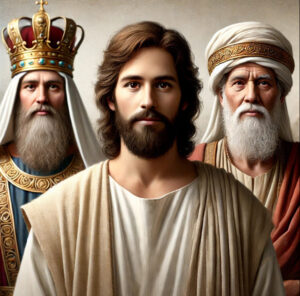
Abraham, King David and Jesus
Gary Eugene Howell uses the Berean Standard Bible. The Holy Bible, Berean Standard Bible, BSB is produced in cooperation with Bible Hub, Discovery Bible, OpenBible.com, and the Berean Bible Translation Committee. The Text of the Berean Standard Bible was dedicated to the public domain as of April 30, 2023.
View Matthew 1 bible study resource
Verse 1
This is the record of the genealogy of Jesus Christ, the son of David, the son of Abraham:
Commentary
Jesus Christ is a direct descendant of King David and of Abraham. This, of course, fulfilled the prophecies that the Messiah would come from Abraham as well as from the line of David.
And through your offspring all nations of the earth will be blessed, because you have obeyed My voice.” (Genesis 22:18)
You said, “I have made a covenant with My chosen one, I have sworn to David My servant: ‘I will establish your offspring forever and build up your throne for all generations.’” (Psalm 89:3-4)
Key Takeaway:
Jesus is the only person in human history who could have possibly been the Messiah.
Many of the Jewish people today are still waiting for a coming messiah. However, because the Jewish people were scattered across the globe for more than a thousand years up until the 20th century and in the Holocaust, nearly 40% of the world’s Jewish population perished, the Jewish people today have lost the ability to trace their ancestry back to the original 12 tribes of Israel.
This means that no person claiming to be a messiah today could fulfil the prophecy of being from the line of David because no Jewish person today knows their ancestry that far back. Again, Jesus Christ is the only person who fulfills all the prophecies about a coming Messiah.
Verses 2-16
Abraham was the father of Isaac,
Isaac the father of Jacob,
and Jacob the father of Judah and his brothers.
Judah was the father of Perez and Zerah by Tamar,
Perez the father of Hezron,
and Hezron the father of Ram.
Ram was the father of Amminadab,
Amminadab the father of Nahshon,
and Nahshon the father of Salmon.
Salmon was the father of Boaz by Rahab,
Boaz the father of Obed by Ruth,
Obed the father of Jesse,
and Jesse the father of David the king.
Next:
David was the father of Solomon by Uriah’s wife,
Solomon the father of Rehoboam,
Rehoboam the father of Abijah,
and Abijah the father of Asa.
Asa was the father of Jehoshaphat,
Jehoshaphat the father of Joram,
and Joram the father of Uzziah.
Uzziah was the father of Jotham,
Jotham the father of Ahaz,
and Ahaz the father of Hezekiah.
Hezekiah was the father of Manasseh,
Manasseh the father of Amon,
Amon the father of Josiah,
and Josiah the father of Jeconiah and his brothers
at the time of the exile to Babylon.
After the exile to Babylon:
Jeconiah was the father of Shealtiel,
Shealtiel the father of Zerubbabel,
Zerubbabel the father of Abiud,
Abiud the father of Eliakim,
and Eliakim the father of Azor.
Azor was the father of Zadok,
Zadok the father of Achim,
and Achim the father of Eliud.
Eliud was the father of Eleazar,
Eleazar the father of Matthan,
Matthan the father of Jacob,
and Jacob the father of Joseph, the husband of Mary,
of whom was born Jesus, who is called Christ.
Commentary:
Verses two through sixteen identify the names of each person in Jesus’s genealogy from Abraham all the way to Joseph and Mary, a span of approximately 2,000 years.
Key Takeaway:
When you study the Old Testament accounts connected to this genealogy, you’ll see that many of those in Jesus’s lineage were troubled, sinful, and broken people. Some were liars, idolaters, adulterers, and even murderers. Jesus did not come from a line of perfect or noble people. He came through a long list of ordinary men and women, some of whom had burdened pasts; perhaps in some ways similar to the background you may have come from. Yet this genealogy shows God’s grace and the way He can work through imperfect people.
It’s a common misbelief that a person has to clean up their life before coming to God. That is an error. You cannot make yourself right with God on your own. It is God who restores you. It is through faith in Jesus Christ that you are made right before God.
Verse 17
In all, then, there were fourteen generations from Abraham to David, fourteen from David to the exile to Babylon, and fourteen from the exile to the Christ.
Commentary:
Matthew’s purpose is to demonstrate that Jesus is the rightful heir to David’s throne. The number 14 was likely intended as a memory aid for the Jewish readers of Matthew’s time.
Seeming Contradiction:
The genealogy of Jesus appears in both the books of Matthew and Luke. But the names differ in each account. One might be inclined to conclude there is some sort of error, however, we must recall what is written in 2 Timothy chapter 3 in which it states,
All Scripture is God-breathed and is useful for instruction, for conviction, for correction, and for training in righteousness, so that the man of God may be complete, fully equipped for every good work. (2 Timothy 3:16-17)
If we are to live by faith, we cannot approach the Word of God with a critical attitude, searching for faults or claiming it contains errors. The moment you conclude that something in the Bible is an error, you open the door to dismissing anything in scripture you don’t like.
Some people have referred to the differences in these two accounts of Jesus’s genealogy as a contradiction. However, whenever we encounter something in Scripture that appears to be a contradiction, we should first assume that the error lies in our own understanding, not in God’s Word. We can also be confident that, over the centuries, careful and capable scholars have already examined these concerns. In most cases, a brief online search will reveal thoughtful explanations that address every issue. But even if we don’t immediately find a satisfying answer, we can continue in faith, trusting that the error must be our own, rather than God’s. In time, further study may bring clarity. Not having an immediate answer should never weaken one’s faith.
The answer, however, is simply that Matthew wanted to highlight Jesus’s ancestry by tracing it through Joseph, connecting him to both Abraham and King David to show his fulfillment of prophecy regarding his identity as the Messiah. Luke, on the other hand, traces Jesus’s lineage through Mary, going all the way back to Adam.
Verses 18-25
This is how the birth of Jesus Christ came about: His mother Mary was pledged in marriage to Joseph, but before they came together, she was found to be with child through the Holy Spirit. Because Joseph her husband was a righteous man and was unwilling to disgrace her publicly, he resolved to divorce her quietly.
But after he had pondered these things, an angel of the Lord appeared to him in a dream and said, “Joseph, son of David, do not be afraid to embrace Mary as your wife, for the One conceived in her is from the Holy Spirit. She will give birth to a Son, and you are to give Him the name Jesus, because He will save His people from their sins.”
All this took place to fulfill what the Lord had said through the prophet:
“Behold, the virgin will be with child and will give birth to a son, and they will call Him Immanuel” (which means, “God with us”).
When Joseph woke up, he did as the angel of the Lord had commanded him and embraced Mary as his wife. But he had no union with her until she gave birth to a Son. And he gave Him the name Jesus.
Commentary:
When Joseph first learned of Mary’s pregnancy, he assumed she had been unfaithful. Yet after receiving God’s message, he accepted her. Notice that Joseph didn’t question, argue, or ask for further confirmation. He simply obeyed in faith.
The angel instructed Joseph, “you are to give Him the name Jesus, because He will save His people from their sins.” The purpose of Jesus’s coming is salvation. This is significant because sin is the true problem separating humanity from God. While many in Israel were longing for deliverance from Roman oppression and the restoration of their nation, these verses show that the deeper need was for the forgiveness of sin.
The Gospel points to the condition of the human heart. Throughout the Gospel, Jesus calls people to repentance and He ultimately gives His life as a sacrifice for sin. The message of the Gospel is that reconciliation with God is found through Jesus Christ, for sin is what separates us from Him, and it is through Christ alone that we are restored.
Practical Truth:
Matthew also emphasizes that these events fulfilled what the Lord had spoken through the prophet Isaiah. God keeps His word. What He promised, even generations earlier, He brings to pass.
You will find throughout your life that God’s timeline is never like your own. God may tell you something today about your future, and you may assume it will happen next week, next month, or even next year, but often it may not come to pass for ten, twenty, or even thirty plus years.